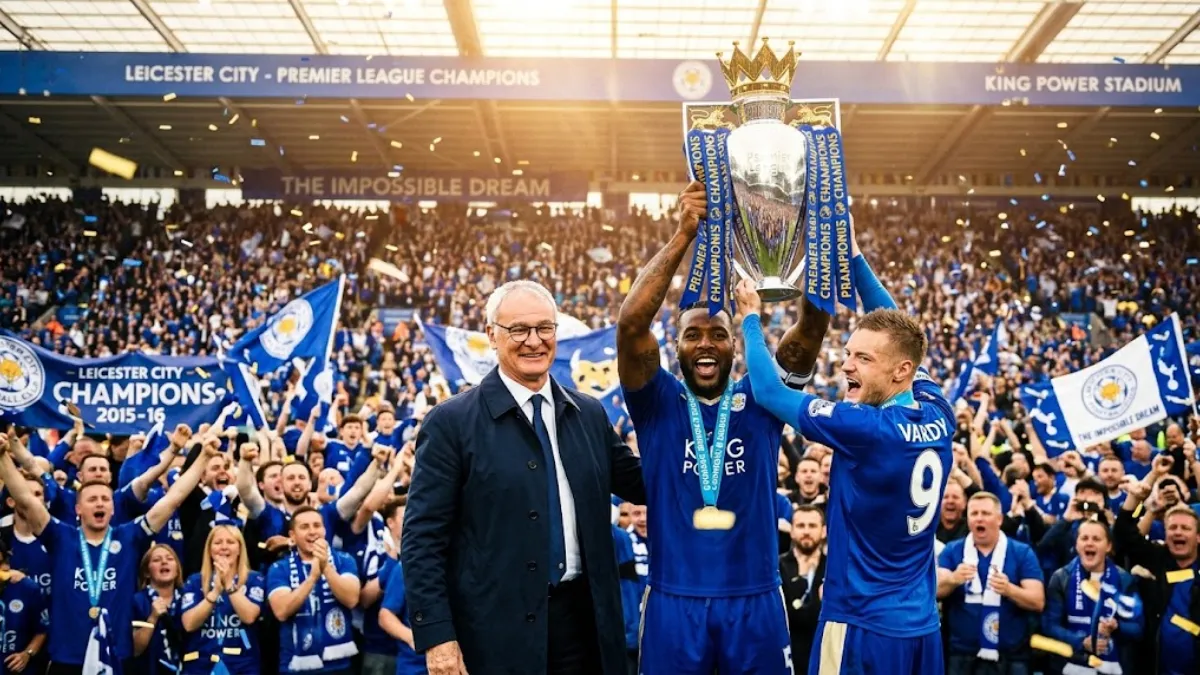
In the commercial theatre of the Premier League, where astronomical TV contracts skew football gravity and the status quo has perpetuated itself ruthlessly for decades, the 2015/16 season was expected to follow a familiar script. The wealthiest corporations were supposed to battle for the gold medals, the prosperous mid-table teams would distribute European spots, while the rest would nervously glance over their shoulders at the relegation zone.
Instead, English football bore witness to a seismic shift in basic logic. Leicester City, who had miraculously avoided relegation to the Championship just twelve months prior, became champions of England. Not due to blind luck or a fluky spring burst, but through a resolute 38-game campaign that saw them finish ten points clear of their nearest rivals. This wasn’t just incredible; it was a full-blown structural rebellion. In the realm of elite sport today, such an outcome bordered on mathematical impossibility.
The economics of undervalued talent
To grasp the true scale of the upheaval, one must examine the financial balance sheet. In an era where assembling squads at the giants resembled arms races, Leicester’s championship squad was priced at an indecently modest sum. The entire starting eleven cost about as much as any top club would fork out for a single marquee signing.
N'Golo Kante arrived from humble French side Caen for what seemed a speculative purchase rather than a strategic investment. Riyad Mahrez moved from Le Havre for pennies, being a promising but relatively unknown winger from League Two. Jamie Vardy was playing non-league football just a few seasons before his triumph, juggling his football career alongside factory shifts. Wes Morgan was viewed as a decent, if lumbering, Championship defender. Kasper Schmeichel had spent years trying to reinvent his career outside the shadows of his famous father, while Robert Huth’s arrival bore no trace of glamour.
The low price didn’t denote a lack of quality. Instead, it indicated that this quality was woefully underestimated by the elite. Leicester’s scouting department and analysts weren’t inventing talent out of thin air; they identified players that the affluent clubs dismissed with a sense of superiority. Kante’s ability to dominate space, intercept passes, and win duels was evident during his time in France, yet he didn’t ignite a bidding war among the superclubs. Mahrez's technical finesse and unpredictability were apparent even in the lower leagues. Vardy’s blistering pace and irrepressible spirit were unmistakable. During the 2015/16 season, the environment changed; all these disparate elements were expertly optimised within a singular mechanism.
The club’s hierarchy, led by Thai owner Vichai Srivaddhanaprabha, provided a rare stability in the industry: the club developed its training facilities and expanded scouting networks without eccentric interference in sporting matters. Leicester wasn’t about high-profile signings; they were obsessively searching for the perfect footballing profiles.
The understated genius of Claudio Ranieri
At the heart of this optimisation was Claudio Ranieri. When he was appointed in the summer of 2015, the news was met with open scepticism. The Italian had just endured a disastrous stint with the Greek national team, and English football’s memory was firmly tied to his chaotic tenure at Chelsea, where he earned the label of the eternally second-best 'Nice Guy Claudio'. It seemed the club, fresh from survival in the top flight, had made a disastrous sentimental choice.
However, the appointment turned out to be an astute call at a historic moment. Ranieri’s outward geniality masked an unwavering pragmatism. He inherited the foundation laid by Nigel Pearson, whose victorious spring charge was built on vertical counter-attacking energy and a strict defensive setup. Key to Ranieri’s success was a sense of proportion: he didn’t tear apart a working structure for the sake of his own ego. He instilled psychological resilience, structural organisation, and rid the team of any hint of panic.
Tactically, Leicester didn’t reinvent the wheel, operating in a classic 4-4-2 shape that some football theorists had already deemed museum material amid the trend for hybrid positional structures. But beneath this simplicity lay a lethal precision:
- Defensive core: Wes Morgan and Robert Huth formed an impregnable fortress. They defended deep and compactly, avoiding pointless pressing, winning aerial duels, and shutting down central corridors, forcing opponents into wide crosses.
- Midfield duo: Kante’s incredible coverage freed Danny Drinkwater’s hands, enabling him to launch quick diagonal balls into space.
- Wingers: Marc Albrighton and Riyad Mahrez provided essential width, diligently tracking back during defensive phases.
- Striker: Jamie Vardy relentlessly tore apart opposition defences with his ceaseless runs behind the lines.
Leicester played straight-forward, vertical football without unnecessary sentiment. The club consciously ceded possession to the opponent, conceding just 36 goals throughout the season (the second-best defensive record in the league).
Concurrent crises of giants and a record-breaking run
This tactical clarity from Leicester coincided with an unprecedented paralysis among traditional heavyweights:
- The reigning champions Chelsea descended into internal strife, leading to a swift plunge, costing Jose Mourinho his job;
- Manchester United remained in a stylistic daze under Louis van Gaal;
- Manchester City was rocked by the public announcement of Pep Guardiola’s impending arrival;
- Arsenal alternated between bright spells and inexplicable collapses;
- Younger Tottenham remained Leicester’s closest pursuers but crumbled under the weight of the final stretch.
The hierarchical grip loosened, and Leicester struck mercilessly. Victories that seemed charming anomalies in August turned into a fascinating narrative by October, culminating in Jamie Vardy’s record-breaking run. The striker scored in eleven consecutive Premier League matches, surpassing what seemed a timeless achievement held by Ruud van Nistelrooy. What looked like a spontaneous flash morphed into a manifestation of systemic quality.
Mahrez made a comparable leap: his elegant incursions from the right flank for left-footed strikes bewildered elite defenders. If Vardy was pure dynamism, then the Algerian epitomised football artistry. And behind them reigned Kante, whose inexhaustible energy spawned the famous adage: 'Earth is covered 70% by water, and the other 30% by N'Golo Kante.'
Ten years later: a lonely peak in a sea of capital
By spring, the question of 'Can they?' unalterably shifted to 'Could they actually do it?'. Away victories over Manchester City and Tottenham became manifestos for their championship ambitions. Ranieri persistently publicised his aim of merely reaching the '40-point safety threshold', alleviating the burden of expectation, while introducing humorous rewards like pizza outings for games kept 'clean'.
When Andrea Bocelli’s voice resonated in the packed King Power Stadium before the match against Everton, and the stadium was awash in blue and white colours, the city celebrated not just a sporting victory but a historic liberation from the monetary dictatorship.
Today, ten years on, the distance of time puts everything into perspective. A decade is ample time for the myth to firm up, revealing the league’s fundamental laws. With the benefit of hindsight, Leicester's triumph appears even more monumental precisely because it remains a unique phenomenon.
Over the past ten seasons, the gravity of wealth has reasserted its dominion with overwhelming force. The title once again devolved into a closed monopoly for clubs with bottomless budgets. The financial stratification of the league has only deepened: broadcast rights have skyrocketed, contracts have globalised, and the transfer values of squads have soared into the stratosphere. The top of the table has become an impregnable fortress.
No other club has come close to replicating Leicester's phenomenon. The nature of modern football's structure dictates that the giants have learned lessons and no longer allow simultaneous collective downturns. The elite have fortified their positions with ultra-modern analytics, deep benches, and flawless planning.
Leicester itself has strikingly illustrated the difficulty in maintaining such a fragile balance. Following their fairytale championship, they reached the Champions League quarter-finals, but market laws swiftly came into play. Retaining their blossoming stars proved impossible: Kante departed, Mahrez followed suit, and Ranieri was dismissed barely a year after their triumph. Since then, the club has experienced both the bitterness of relegation battles and the pains of rebuilding.
The 2015/16 season didn’t rewrite the economics of world football, nor did it herald an era of universal equality. It was a statistical anomaly of the highest order—an ideal convergence of inner cohesion, managerial wisdom, tactical discipline, and the decline of established frontrunners. Yet this is precisely what makes that championship eternal. It stands as a solitary mountain peak, towering over the football landscape. A reminder to every supporter on the planet that even in a world dominated by trillions, the game leaves a crack for genuine miracles.
