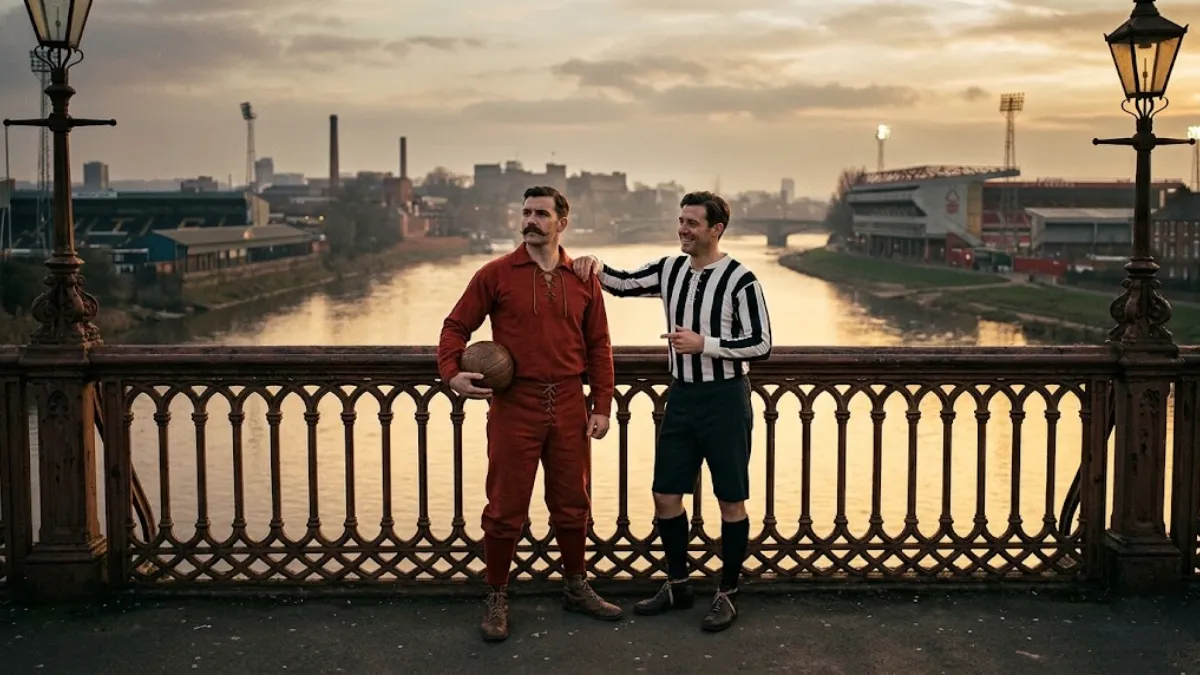
The River Trent, the third longest in England, lazily flows north, dividing Nottingham not just geographically but in footballing terms as well. Cross the majestic Trent Bridge, built in 1871, and you enter the heart of a unique rivalry. Look to the northeast: on the right bank stands the City Ground, home of Nottingham Forest, while on the left is Meadow Lane, the fortress of Notts County.
Both clubs aren’t merely sports teams; they are a living history and cultural code of the city, established long before the bridge itself. Notts County proudly wears the title of the "oldest professional football club in the world," founded in either 1862 or 1864, depending on your sources. Their rivals, Nottingham Forest, came into being a bit later, in 1865, within the confines of a local pub. Legend has it that Forest initially positioned itself as a working-class club, a clear contrast to the more respectable, bourgeois Notts County.
Born in a time of change: stadiums in the forest and on the pasture
The emergence of two such old clubs in one city is a testament to Nottingham’s profound footballing traditions. For comparison, Birmingham's Aston Villa and Birmingham City only sprang up in the mid-1870s, while Manchester’s giants were formed even later.
The 1860s were a tumultuous time for England. Nottingham was described as a dangerous, rapidly expanding city filled with slums and cholera outbreaks. Yet, it was also a period when the foundations for modern urban governance and public health were laid. Laws enabling the enclosure of common land allowed local authorities to create green spaces for the city's industrial workers to unwind.
In Nottingham, the enclosure coincided with part of Sherwood Forest being cut down, leading to the creation of the Forest Recreation Ground. It was here that the early athletes of Nottingham Forest trained and played, likely giving the club its name. Notts County also benefited from the emergence of public spaces, hosting their early matches on the now-closed Meadows cricket ground by the Trent.
Moreover, electoral reforms in 1832 and 1867 began to shift the balance of power, granting working men more rights and, importantly, free time. Shortened working hours and the introduction of Employment Law meant Saturdays became days off. This newfound leisure time saw workers pour into football, both as players and spectators, which acted as a catalyst for the rapid growth of both Nottingham clubs.
The lace influence: Nottingham enters the global market
The beginnings of both clubs are rooted in quintessentially English traditions. A stroll around Meadow Lane and the City Ground lets you feel the spirit of provincial England. These aren't modern super stadiums, but institutions embedded in the cityscape, cherished and valued by the local communities. The stands and statues bear the names of classic English heroes—Jimmy Sirrel and Brian Clough—with victories in the FA Cup (County in 1894, Forest four years later) etched in gold on the Honours Board.
Yet behind this English facade lies a remarkable international aspect. An unseen but robust Anglo-Italian thread links both clubs and the city as a whole. A driving force behind Nottingham's global influence was its flourishing lace industry. By the 1840s, the Lace Market area had transformed into a bustling industrial hub of global significance, bestowing wealth and status upon the city.
Global trade inevitably led to exchanges not merely of skills but of people. Nottingham lace houses established ties with international fashion houses, such as Christian Dior. This exchange gifted the football world with a remarkable story.
Herbert Kilpin: from Nottingham shop to founding AC Milan
Herbert Kilpin was born in 1870 in Nottingham to a butcher's family. After finishing school, he found work in the lace industry but was, at heart, a passionate amateur footballer. When the chance arose to move to Italy for work with the textile company of Edoardo Bosi, he jumped at the opportunity.
In 1891, Bosi founded a club in Turin, which might well have been the first proper Italian football team—Internazionale Torino. Kilpin played for this club. By the end of the century, he had moved to Milan, where he became one of the founding fathers of the Milan Football and Cricket Club, now known as AC Milan. In 1901, just its second year, the Rossoneri won the Italian Championship. Under Kilpin’s guidance as playing manager, they repeated this success in 1906 and 1907. In tribute to him, Nottingham’s civic society established a memorial plaque at Kilpin's birthplace, adorned with the emblem of AC Milan.
Giuseppe Garibaldi and the red colours of Forest
The influence of Italian culture is also evident in the Nottingham Forest's formation. In 1865, when choosing their club colours, the founders were inspired by the figure of Italian revolutionary and patriot Giuseppe Garibaldi and his volunteer brigades, the "redshirts."
Garibaldi was extremely popular in Britain as a romantic and bold hero. He visited England in 1864, but due to Queen Victoria's concerns over his radical views, he didn't leave London. Nevertheless, groups of Nottingham workers wrote to him, praising him as the liberator of oppressed people and a fighter for freedom.
Riding the wave of this passionate popularity, the red of Garibaldi was adopted by Forest, and this legacy lives on today. The Forza Garibaldi fan group directly claims to support the club in the spirit of its historical legacy.
Black and white brotherhood: Notts County and Juventus
On the other side of the Trent, Notts County also has deep ties to Italy, but not politically—these are purely footballing. In its early years, the club experimented with various colours and nicknames, but by 1890, it settled on black and white.
While the black and white stripes are synonymous with Notts County, on a global scale, this colour has become more closely associated with the Turin giants, Juventus. However, it wasn’t always this way. Initially, the Old Lady played in pink and grey. A pivotal change came thanks to an Englishman with Nottingham roots.
Tom Gordon Savage, a friend of Herbert Kilpin, was a technical advisor to Juventus in its early days. He made several significant changes, the most notable being the club colours. Savage leveraged his Nottingham connections to revamp the Turin club’s image, adopting what he deemed the bold and powerful colours of Notts County. This ideal persists in Juventus to this day.
The historical bond was officially recognised in September 2011 when Juventus invited Notts County to play in the opening match of their new stadium. The friendly ended in a 1-1 draw, cementing the black-and-white brotherhood between the Zebras and the Magpies.
As American author David McCullough reminds us: "History is who we are and why we are the way we are." The Anglo-Italian stories of Kilpin, Garibaldi, and Juventus present a wonderful opportunity to connect with a rich footballing past.
Nottingham is a remarkable football city, brimming with unique heritage.
