Graham Souness is widely known today as a no-nonsense television pundit with a tough reputation. However, long before the social media era, the Scottish football warrior left a lasting mark that divided Turkish football forever. To the European side of Istanbul, he became a god, while to the Asian side he was Public Enemy Number One, evoking visible rage even today.
In 1994, Souness left Liverpool amid a scandal. His pride was shattered; just a single FA Cup to show for his time, fraught relationships all around, and a toxic interview left his future with the club in tatters. A year later, he found himself jobless after failing to secure a position at Middlesbrough, and his managerial career appeared to be fading fast.
It was during this critical juncture that Galatasaray extended a lifeline. After a disastrous season, club president Alp Yalman relieved German manager Reinhard Saftig of his duties. Yalman wasn’t known for his patience; in just three years, he had seen three men sit in the manager's seat. The invitation to Souness came at a hefty price for a mid-'90s outfit, costing the club £500,000 and sparking a wave of scepticism.
Souness brought along a British contingent, notably signing 31-year-old injury-prone striker Dean Saunders for a staggering £2 million, familiar to Souness from his Merseyside days. He was soon joined by midfielder Mike Marsh, Barry Venison, and American goalkeeper Brad Friedel from Brondby.
Failure in Europe and the Brit's partying antics
The start in Turkey was anything but smooth. In a country where even friendlies were treated with ferocious seriousness, uninspiring matches against Nantes and Borussia Dortmund had the fans turning against their manager. Souness’s confident claims about inevitable triumph in the league and UEFA Cup only added fuel to the fire. The reckoning came swiftly, as in late August, Czech side Sparta Prague eliminated Galatasaray in the preliminary round of the European tournament.
Domestically, things picked up, with a goal from future Blackburn star Tugay securing a 1-0 win over Vanspor, and then Saunders scoring a brace in front of 20,000 fans in a 3-1 victory against Kayserispor. However, off the pitch, the British recruits quickly found distractions, with Marsh and Venison caught on camera inebriated after a match, resulting in a public dressing down by the Turkish press.
Despite the backlash, Souness stubbornly continued to field his fellow countrymen, leading to scathing criticism from local media. Marsh lasted a mere two and a half months before fleeing to modest Southend, and Venison soon followed suit back to England with Southampton. The only one to meet expectations turned out to be Saunders.
Derby humiliation and cup resurgence
The intercontinental derby between Galatasaray (European side of the Bosphorus) and Fenerbahce (Asian side) ranks among the fiercest rivalries on the planet, where the intensity of hatred sometimes leads to tragedy.
Souness’s first derby on October 22, 1995, ended in catastrophe. Fenerbahce's striker Dalian Atkinson netted a hat-trick within just 32 minutes. A 3-1 defeat turned Souness into a target for irate fans. Winning the league might earn accolades, but a loss to their fiercest rivals leaves a deep, everlasting scar. Souness’s seat began to wobble, yet Yalman displayed an unexpected patience and gave him a chance to redeem himself.
In the league, results were mixed; the Lions dispatched mid-table teams but faltered against direct rivals. A decisive 3-1 loss to Besiktas effectively extinguished championship ambitions. The season could be salvaged only through the Turkish Cup.
Galatasaray thrashed Denizlispor 4-0, driven by efforts from Safet Sancakli, Hakan Unsal, and Hakan Sukur. In the quarter-finals, Souness's side exacted revenge on Besiktas, with a goalless draw at home followed by a gutsy 2-1 away win bolstered by a brace from Arif Erdem. Saunders' stunning solo performance against Samsunspor in the semi-finals resulted in a 3-1 aggregate victory, securing a place in the final.
Saunders' final flourish on enemy territory
The opponent in the two-legged final was none other than Fenerbahce. Tension filled the air. On April 11, 1996, at Ali Sami Yen Stadium, a solitary incident decided the match: Fenerbahce's goalkeeper brought down Kubilay Turkyilmaz in the box, with Saunders coolly converting the penalty into the bottom corner—1-0.
The return leg at Sukru Saracoglu Stadium descended into chaos. Fenerbahce laid siege to Galatasaray’s goal, rattling the woodwork before Aykut Kocaman nodded in a cross from the far post, equalising on aggregate. Galatasaray was up against the ropes but survived under immense pressure from the vibrant home crowd.
The climax arrived in extra time. With legs weary, Dean Saunders latched onto a rebound and thumped the ball under the crossbar, burying Fenerbahce's hopes. The Welshman collapsed to the pitch beneath a pile of jubilant teammates. The Turkish Cup was Souness’s.
Three strikes into the heart of the stadium
What happened just minutes after the final whistle has entered football folklore. In Turkish culture, a legend exists about the fall of Constantinople in 1453: when the Ottoman siege felt hopeless, a flag raised above the fortress wall turned the tide of battle.
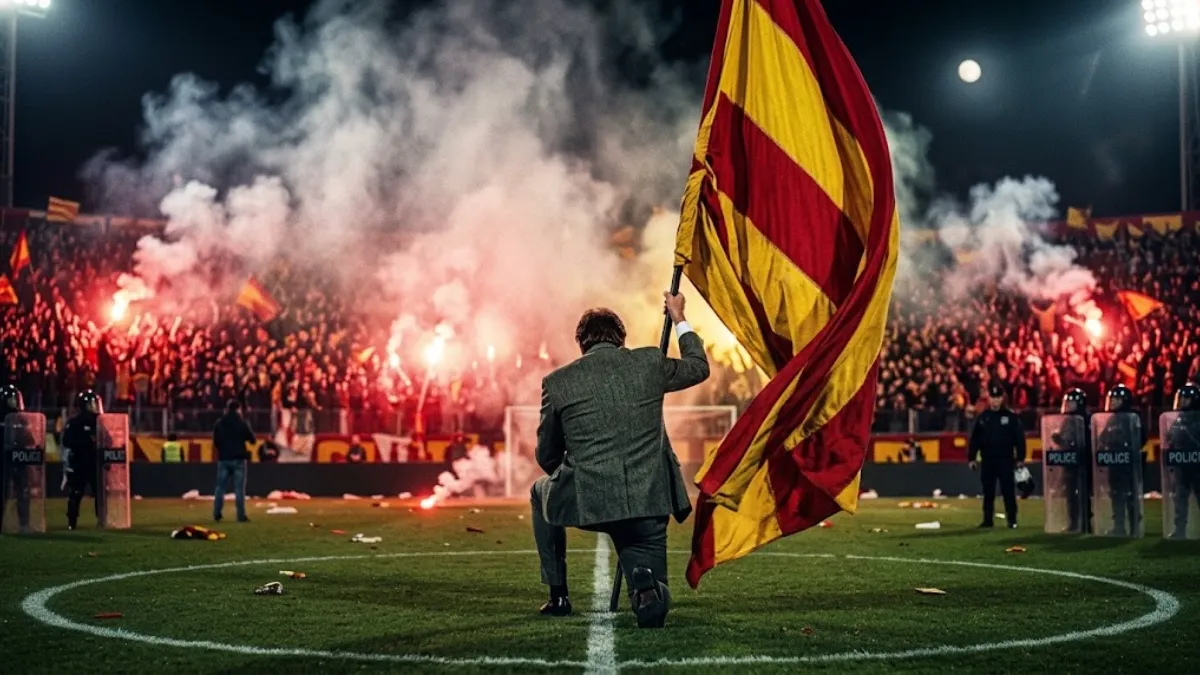
In a moment resembling an ancient conqueror's instinct, Souness somehow seized a massive red and yellow Galatasaray flag and charged across the pitch to the centre circle of the rival stadium.
To the furious roars of a hostile crowd, the Scottish manager violently plunged the flagpole into the turf of the enemy arena—once, twice, three times.
Realising the impending backlash, Souness sprinted towards the tunnel with surprising speed. The trophy presentation turned into a siege: Galatasaray players lifted the trophy under the protection of riot shields, dodging hailstorms of stones, bottles, and seats raining down from the stands. Souness, advised by security, locked himself in the dressing room, listening to the furious crowd’s roar shake the concrete walls around him.
Instead of the expected backlash for his reckless act, the dressing room was stormed by tearful club officials elated by the victory. As the Scotsman later recounted:
I have never been hugged and kissed by so many men in such a short time in my life.
Souness's immortal legacy
That two-minute outburst turned Souness into a folk hero. Galatasaray fans nicknamed him Ulu Batli Souness, after the legendary warrior Ulu Batli Hasan, who raised the Ottoman flag at the walls of the defeated city. For Fenerbahce supporters, the act became an indelible insult; threats of physical retribution against the manager continued for decades.
This madness sparked a wave of absurd imitations. Years later, a Fenerbahce fan nicknamed Rambo managed to sneak into Galatasaray's stadium, hiding inside an advertising board for hours before leaping onto the centre circle with a pocket knife and attempting to plunge his club's flag into the pitch.
As emotions settled in the summer of 1996, Galatasaray's hierarchy opted to part ways with Souness, choosing not to extend his contract. Yet, his brief Istanbul chapter remains etched in the annals of football insanity. Souness reflects fondly on that wild night:
I am incredibly proud that people still remember me for that act.
