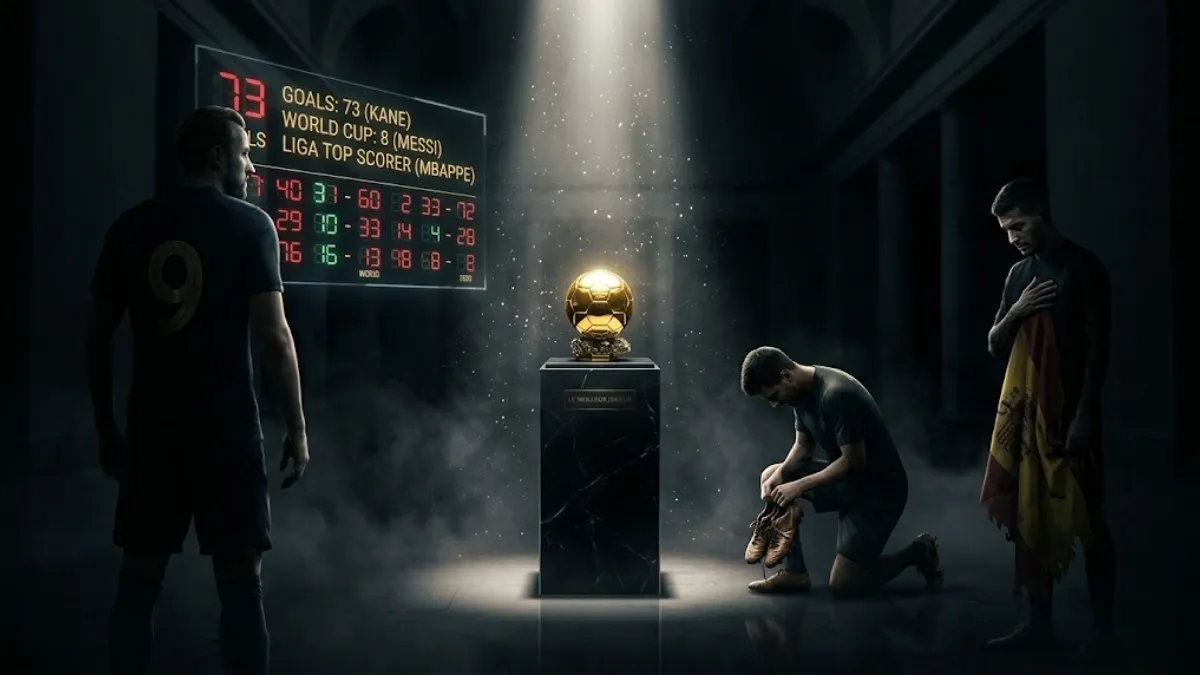
The prestigious individual accolade in world football aims to crown the best player on the planet, yet it repeatedly encounters an intractable philosophical dilemma: how do we measure greatness in footballing terms? Once, the formula seemed straightforward — score the most goals, lift illustrious trophies, create masterpieces in crucial matches, and etch your name into the memories of millions. However, today's game is far too intricate and nuanced to be reduced to a mere collection of statistical figures.
The list of contenders for the 2026 award vividly exposes this crisis. Harry Kane netted an astonishing 73 goals for Bayern Munich in the 2025/26 campaign — a career record and a staggering 19 goals ahead of any player in the top five European leagues. Kylian Mbappe scored 42 goals for Real Madrid, becoming the top scorer in both La Liga and the Champions League, adding another 10 at the World Cup. Lamine Yamal registered 24 goals and 17 assists for Barcelona, creating the most scoring opportunities in La Liga and finishing the season triumphant with the Spanish national team. Jude Bellingham bagged seven goals for England in the World Cup, despite his club failing to claim any trophies. Meanwhile, Ousmane Dembele seeks to maintain his title after helping Paris Saint-Germain lift the Champions League for a second consecutive year.
These seasons are monumental in their own right, yet utterly incomparable to one another. And therein lies the systemic paradox of the voting process.
The mechanics of selection and the subjective impasse
According to the rules set out by France Football, the trophy is awarded to the absolute best player in the world based on three criteria in order of importance: individual performance, team achievement with titles won, and the principles of fair play and sportsmanship. Since 2022, the organisers have strictly assessed players based on the results of the club and international season, with the 2026 period covering from 3 August 2025 to 19 July 2026.
The fate of the trophy is decided by precisely 100 football journalists — one from each of the top one hundred countries in the FIFA men's national team rankings. Each voter compiles a personal top ten, awarding points ranging from 15 down to 1.
However, no set of rules can clarify for an expert what number of goals outweighs a missed final, how much a World Cup gold medal weighs against a Champions League trophy, or how many sublime passes by a playmaker equate to the 40 goals of a centre-forward.
A glaring blind spot in the regulations is the factor of context, which the rules entirely omit. Take Lionel Messi, for instance, during the 2025/26 campaign: his statistics appear unreal on paper. The Argentine scored 29 goals and provided 19 assists in just 28 MLS matches, winning the Golden Boot, and notched six more goals and nine assists in the playoffs, leading Inter Miami to their historic first championship and securing the MVP title in the final. He then added 8 goals and 4 assists in eight World Cup matches, guiding Argentina to the final. Yet, no voter will view those astonishing MLS numbers with the same weight as performances in the Premier League or the Champions League.
In contrast, Khvicha Kvaratskhelia stands out: with 57 matches this season, he totaled 24 goals and 10 assists, bolstered by an impressive Champions League run — 10 goals and six assists in 16 matches, earning him the title of best player in Europe’s premier club tournament and gold medals with PSG.
This brings up a fundamental question: is the Ballon d'Or awarded to the best footballer, or to the player who constructed the most compelling narrative around their achievements?
The trap of individual mastery
The first criterion of individual performances initially sounds strict and academic until the debate arises: what constitutes dominance? There's no mathematical formula in play — just the subjective judgment of 100 specific reporters.
A notable example is Rodri's victory in 2024. The Manchester City midfielder claimed the trophy not for sheer numbers of goals but for his significant impact on the game’s structure: clinching a fourth consecutive Premier League title and leading Spain to victory in the European Championship, being named Player of the Tournament. During Euro 2024, Rodri completed 411 out of 439 passes (92.84% accuracy), scoring once and starting six out of seven matches. The sheer volume of his work cannot be encapsulated in standard highlights.
The 2024 voting was fiercely competitive: Rodri edged out Vinicius Junior by a mere 41 points, with seven other players receiving at least one first-place vote from journalists. There was a split in the panel: one half viewed Vinicius as the most dangerous forward in the world, deciding the fate of crucial moments in the Champions League for Real Madrid, while the other recognised Rodri’s orchestrating influence in midfield as paramount.
This conflict of tastes reignites for 2026. If we focus purely on raw numbers, Harry Kane's case is unassailable. Kylian Mbappe offers a formidable challenge alongside him, while Lamine Yamal brings a fresh perspective, generating 41 goal contributions (19 more than any other teenager in top European leagues), becoming Spain’s leading playmaker and creator. Which of these metrics carries more weight? The rules provide no answer.
The magic of titles and the narrative dictatorship
Team trophies further complicate the picture. The Champions League and World Cup sit atop the hierarchy, but what is the true value of a domestic league title or a domestic cup? Lacking an exact formula, journalists assess the significance of achievements based on narrative impact.
Ousmane Dembele's triumph in 2025 represented a moment of total consensus. The Frenchman achieved 37 goals and 15 assists for PSG, was named MVP of the Champions League, and delivered the club’s long-awaited first victory in the tournament. All 100 jury members included him in their top ten, with 73 placing him unequivocally first. Lamine Yamal, who finished second, was on every ballot but only 11 voters gave him top honours (six first-place votes went to Vitinha, four to Mohamed Salah). Dembele's story was seamlessly coherent, leaving little room for alternative interpretations.
In 2026, this balance is disrupted due to the World Cup. Voters face a cognitive dissonance: how can one equate nine months of steady club performance with a fleeting burst during seven matches in the planet's premier tournament?
The coverage factor plays a role as well: a player’s massive statistics outside the elite club spotlight inevitably pale beside the dazzling performances under the Champions League lights. For over a decade, Lionel Messi and Cristiano Ronaldo have set astronomical benchmarks for expectations. After them, Karim Benzema (2022), Messi (2023), Rodri (2024), and Dembele (2025) have claimed the award, yet the historical conflict between attacking stars and players in other positions endures.
The curse of position: why defenders and goalkeepers need a monumental feat
History illustrates how players in defensive roles find it incredibly hard to break through the cult of goals. Franz Beckenbauer won twice (in 1972 and 1976) by literally reinventing the libero position. Lothar Matthaus claimed the prize in 1990 as captain of the championship-winning West Germany, Matthias Sammer won in 1996 after a triumphant Euro, and Fabio Cannavaro in 2006 became the first pure centre-back since Sammer, delivering an exemplary World Cup. Luka Modric's 2018 victory came from a combination of Champions League success and the heroic performance of the Croatian national team reaching the World Cup final.
Lev Yashin remains the only goalkeeper in history to lift the Ballon d'Or. In modern football, goalkeepers are often sidelined: the establishment of the Yashin Trophy has effectively legitimised their omission from the main nomination. The year 2026 saw an unprecedented situation: for the first time since the practice of publishing extended shortlists began in 1995, no goalkeeper made it to the list of thirty nominees.
To overcome the natural human inclination toward goals and flashy dribbles, a non-attacking player requires a grand historical feat. In other cases, voters nearly always lean toward those whose achievements can be easily quantified.
So what is truly evaluated?
When voting for the award winner, experts assess not just the season of an individual player but their own worldview. For those who see football primarily as a numbers game, there’s no doubt they'll choose Kane's 73 goals. A romantic who values major tournament triumphs will vote for the World Cup victor. A tactical connoisseur will favour the genius orchestrating the tempo in midfield. None of them break the rules — they simply interpret them differently.
The Ballon d'Or has long ceased to be an accolade for the highest number of goals or even the most titles lifted above one’s head. Today, it's an award for the most convincing, beautiful, and indisputable narrative of footballing greatness woven over the past twelve months. As long as this appraisal is made by living humans, the debates surrounding the coveted golden trophy will never cease.
