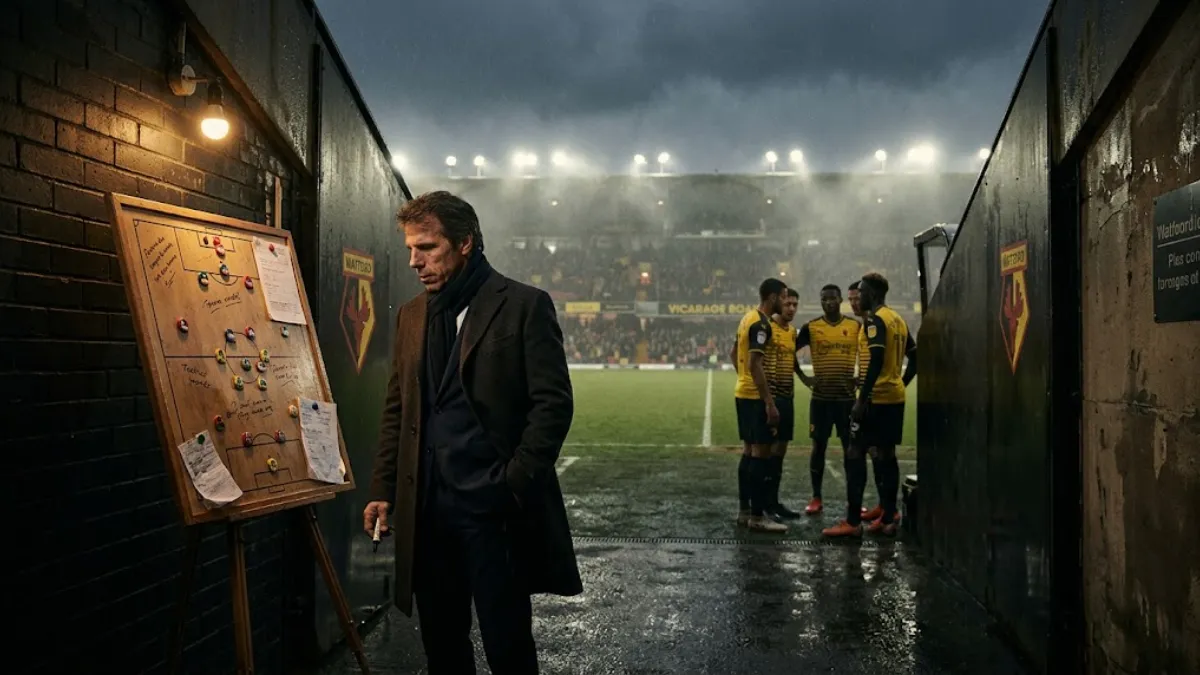
Watford's acquisition in June 2012 resembled a covert operation executed under time pressure. The previous owner, Laurence Bassini, was mired in debt and found guilty of financial misconduct. When Giampaolo Pozzo and his son Gino sealed the deal, mere weeks remained before the transfer window slammed shut, leaving no room for meticulous planning.
The new Italian owners wasted no time, sacking Sean Dyche and handing the reins to Gianfranco Zola—an iconic former forward for Chelsea and Napoli, who had no managerial experience in England. With limited options and an urgent need to reinforce the squad, the Pozzo family made the only move they could: they picked up the phone and contacted their other clubs.
A family empire and a loophole in the law
The Pozzo family weren’t your typical football investors. Alongside Watford, they also owned Udinese in Serie A and Granada in La Liga. This multi-club system benefitted from a robust scouting network with 25 to 30 experts, who had spent decades combing South America, Africa, and Eastern Europe for talent. Udinese had built a reputation as a flawless 'talent factory' in Italy.
Zola later admitted that the rapidity of the club's acquisition precluded any lengthy transfer negotiations. Their sole escape route was to execute loan deals on a grand scale using their foreign assets.
It was here that a brilliant legal loophole emerged. The English Football League's regulations strictly prohibited clubs from loaning more than two players from the same English or Welsh team. However, international loans were classified, at the point of registration, as full permanent transfers rather than internal loans. This meant the limits simply didn’t apply. Watford found themselves able to sign as many as an entire squad from Udinese, provided every transfer was executed via the international transfer system.
That summer, the Hornets managed to bring in a staggering 14 players on loan. The vast majority—between ten and twelve by various accounts—came from Udinese, with the remaining additions hailing from Granada. Pre-season preparations resembled pure improvisation: during their openings against semi-professional sides Boreham Wood and Wealdstone, Zola fielded entirely different line-ups in each half, trying to get a grip on the new signings. Both matches ended 1-1.
Destined wonders and deadweight
The influx of talent was remarkably eclectic, but the standout acquisitions proved to be spot on. Twenty-year-old Czech forward Matej Vydra, who had barely featured for Udinese, scored in his debut against Crystal Palace and went on to have a fantastic season: netting 22 goals in 44 appearances and winning the Championship Player of the Season award ahead of Glenn Murray and Tom Ince.
Swiss playmaker Almen Abdi, who had initially joined as a trialist, became the brains of the midfield; Zola fashioned the team’s playing model around him, and the club’s dip in form in November coincided with a significant shoulder injury to the Swiss star. Fernando Forestieri, also signed on loan and later purchased mid-season, became a key figure in attack.
Of course, not every gamble paid off. Cameroonian striker Steve Leo Beleck vanished into the lower leagues without making an impact, and Diego Fabbrini found himself farmed out to another club mid-season for game time. Nevertheless, the results were stunning: the hastily assembled squad of largely unfamiliar faces propelled themselves to third place in the Championship, trailing the automatic promotion spots by only five points.
Almunia's save, Deeney's goal, and the drama at Wembley
The playoff semi-final against Leicester City at Vicarage Road became etched in the annals of English football. With the score at 2-2 in the seventh minute of injury time, Spanish goalkeeper Manuel Almunia pulled off a miraculous double save, repelling Anthony Knockaert's penalty and subsequent follow-up. In an instant, the Hornets were off on the counter-attack: Forestieri delivered the ball into the box, and Troy Deeney fired home, sending the team to Wembley with a 3-2 aggregate win.
However, the fairy tale ended there. In the final showdown for a coveted spot in the Premier League, Watford fell to Crystal Palace 1-0 after extra time. Ironically, the decisive penalty was scored by 39-year-old Kevin Phillips, who himself had been on loan at Palace from Blackpool. The penalty was earned by the unstoppable Wilfried Zaha, named Man of the Match, who would soon after make a move to Manchester United. In the dying moments, Forestieri had a chance to send the match to penalties, but Palace defender Joe Ward cleared the ball off the line. The ticket to the Premier League, worth over £120 million, slipped through Watford's fingers, while the Italian international was confined to the second tier for another two years.
A loophole closed with unanimous approval
The reaction from rival clubs to the Pozzo family's ruse was one of outrage. Championship managers openly voiced their displeasure at how owners with foreign affiliates could effectively field a second elite team, unattainable for other competing clubs.
The Football League's hierarchy responded promptly. Within a year, the regulations underwent radical revision: international loans were now subject to the same stringent limits as domestic transfers. The unbounded influx of players from a single feeder club was permanently blocked.
The vote to amend the regulations was unanimous: all 72 professional clubs in the league voted 'in favour', including Watford itself. By that point, the club had already secured key players like Forestieri and Vydra on permanent deals, and by 2015, they were back in the top flight through conventional transfer methods. Yet the 2012/13 season remains a unique moment in history when a profound understanding of regulation, family connections, and the goals of a Czech forward nearly turned the hierarchy of English football upside down.
