With six European Cups, three UEFA Cups, and the legendary nights at Anfield, it seems that Liverpool have always ruled European football. The Merseysiders boast the famous Istanbul miracle of 2005, the deafening roar against Saint-Etienne, and the heartbreak of Hillsborough.
However, every great empire starts with a timid first step. For the Reds, this daunting journey began in the summer of 1964. Britain was swept by Beatlemania: cinemas were buzzing with the premiere of A Hard Day's Night, and the return of the ‘Liverpool Four’ saw a crowd of 150,000 in their hometown, leading to hundreds of fans getting injured in a crush. Liverpool was transformed into a cultural epicentre, overshadowing London.
This musical boom coincided with a football revolution. Bill Shankly lifted the club from the depths of the Second Division in 1962, and just two seasons later, he guided the Merseysiders to their first league title since 1947. The main attacking force behind that campaign was the trio of Roger Hunt, Ian St. John, and Alf Arrowsmith, who netted an astonishing 92 goals between them. Their reward was a debut appearance in the elite European Cup — a competition exclusively for national champions played in a knockout format, without seeding or group stages.
While Manchester United, Wolverhampton, Hibernian, and Dundee were discovering Barcelona, Madrid, and Milan, Liverpool spent years toiling in the lower leagues at places like Scunthorpe, Plymouth, and Rotherham. Now the once provincial club was primed to share the stage with giants like Real Madrid, Benfica, and the reigning holders, Inter Milan.
The tour of camps and 'eskimos' in Reykjavik
Fortune in the draw spared the debutants from facing giants right away, sending them instead to exotic Iceland to face KR Reykjavik. This was the Icelanders’ first foray into European competition, and for Liverpool, the logistics proved to be a harsh test. There were no direct flights: the team travelled from Liverpool to Manchester, then flew to London, next to Prestwick in Scotland, before finally reaching Reykjavik.
Some dedicated Merseyside fans made this journey at their own expense; for most, it was their first-ever trip outside England. The fans later chuckled at their naïve expectations: many had genuinely believed they would see eskimos in igloos but instead met local lads who were remarkably similar in spirit to Scousers.
The Scottish leg of the journey passed through Ayrshire, the birthplace of Bill Shankly. The manager couldn’t resist the temptation to show off his hometown, hiring a bus to take the entire squad on a tour... to the Butlin's holiday camp. When Shankly proudly announced that he was in the presence of the English champions, Liverpool, the bewildered camp director politely replied, 'I think you’ve taken the wrong turn, sir.'
On August 17, 1964, in front of 10,000 spectators, Liverpool stepped onto the European stage for the first time. Initial nerves were evident as they led only 1-0 at half-time. However, in the second half, class and physicality prevailed, with Gordon Wallace netting a brace and Hunt adding another, resulting in a 5-0 rout. A month later, the Icelanders faced a nightmarish return at Anfield, losing 6-1, with St. John bagging another brace.
The birth of the red cult and Shankly's tricks
In the quarter-finals, Liverpool encountered a significant test — the formidable Anderlecht. The Belgian champions of that era were a world-class machine, boasting legendary marksman Paul Van Himst, who scored 233 goals over 16 years at the club. The strength of the Brussels side was so substantial that during a 1964 match between Belgium and the Netherlands, ten starters represented Anderlecht, with only one foreign player being the Standard goalkeeper, Guy Delhays.
Shankly recognised the colossal threat and undertook a historic rebranding. Traditionally, Liverpool played in red shirts and white shorts. The manager decided that a completely red kit would make his players appear larger, instilling primal fear in their opponents. Thus, the iconic all-red kit was born, which would become synonymous with the club for decades. To neutralise Van Himst, Shankly deployed the tenacious young defender Tommy Smith.
Before stepping out onto the packed Anfield on November 25, Shankly employed a subtle psychological trick, encouraging his players:
Right, lads. There’s no one to beat here; they're just a bunch of rubbish.
The Merseysiders swept the Belgians aside with a crushing 3-0 victory, thanks to goals from St. John, Hunt, and Ron Yeats. Barely had the door to the changing room closed after the final whistle, when Shankly, with a calm demeanour, issued a completely different speech:
Congratulations, boys. You’ve just trampled one of the strongest teams in Europe.
A 1-0 victory in Brussels propelled the English side into the semi-finals with a perfect record of four wins out of four.
Drama in Rotterdam: the coin stuck in the mud
In the semi-finals, the Reds faced Köln, who were the winners of the inaugural Bundesliga season in 1963. The clash turned into a tactical stalemate, with 0-0 results in both Germany and Merseyside. 180 minutes of goalless football necessitated a replay at a neutral venue in Rotterdam’s De Kuip stadium.
On March 25, 1965, the teams produced a thriller. St. John and Hunt had given the English side a comfortable 2-0 lead by the 37th minute, only for goals from Karl-Heinz Thielen and Hannes Löhr to level the scores at 2-2. Extra time saw no winner, and at that time, shootouts didn’t exist.
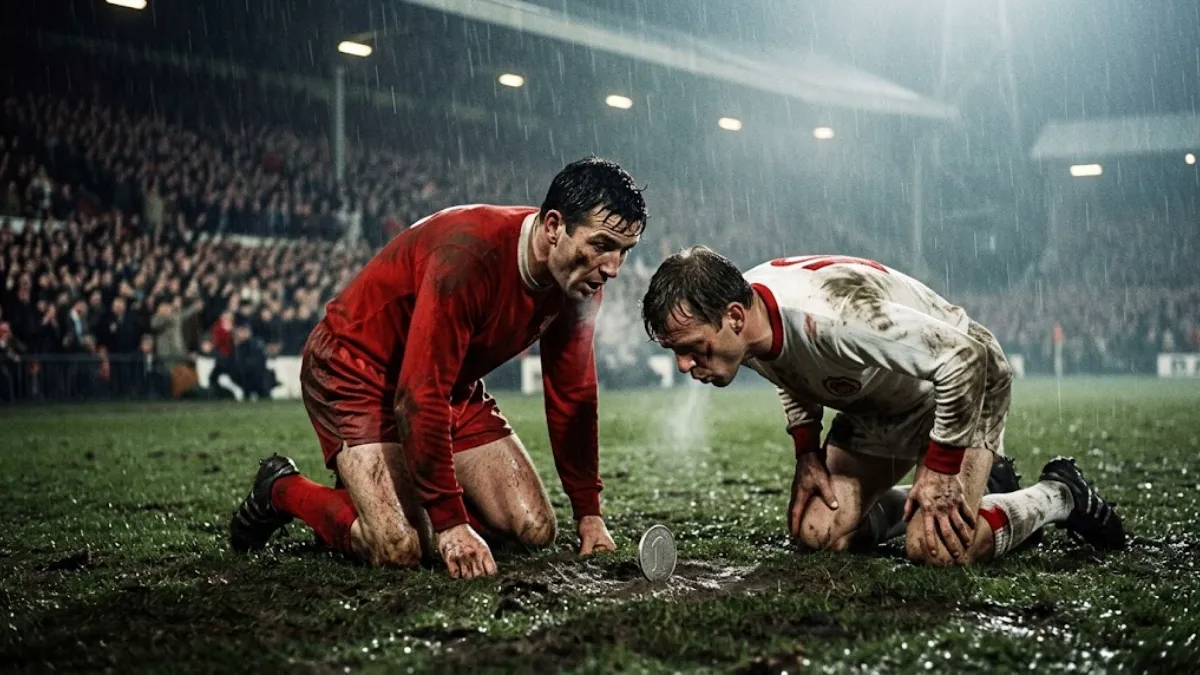
The semi-final of the continent's premier tournament was decided by coin toss — right in the middle of the pitch, live in front of 48,000 spectators.
Captain Ron Yeats approached the referee and instantly shouted: 'Tails!' The referee confirmed: 'Liverpool – tails, Köln – heads.' The referee tossed the coin, and the stadium held its breath. The coin landed on the soggy pitch, not settled on either side, as it stuck vertically in a patch of churned-up turf!
Both captains dropped to their knees and blew on it: the German leader Hans Sturm attempted to blow it onto heads, while the giant Yeats tried for tails. The German proved more persistent, and the coin slowly began to tip towards heads. Yeats instantly reacted: 'Referee, that toss doesn’t count; we need to re-throw!' The referee agreed. The coin soared into the air once again — and this time, a clean tails sent Liverpool into the semi-finals. Shankly approached the German bench with words of sympathy, acknowledging that deciding the outcome of such a monumental duel in this manner was pure madness.
The 'Night of Nights' and Milan's vendetta
In the semi-finals, the Merseysiders faced the reigning champions, Inter Milan, managed by Helenio Herrera. The Italians had just crushed Milan 5-2, raising the cattenaccio, with the libero position, to the rank of tactical artistry, while their squad was brimming with stars including Giacinto Facchetti, Armando Picchi, Luis Suarez, and Sandro Mazzola.
Three days before the home clash, Liverpool had battled through a grueling FA Cup final, clinching a 2-1 victory over Leeds after extra time, marking their first-ever trophy win. Following tumultuous celebrations amid a quarter of a million fans, the fatigued side took to the pitch against the fresher Italians.
Shankly employed psychological pressure once again; just moments before kick-off, he ordered the recently won trophy to be carried around the pitch. Anfield erupted, the stands shaking with noise. Ian St. John later labelled that match 'the night of nights.'
By the third minute, Hunt found the net following a low cross from Callaghan. Mazzola quickly levelled the score, but from then on, it was all Liverpool. A superb free-kick routine allowed Callaghan to restore the lead to 2-1, and in the second half, St. John sealed the deal with a 3-1 finish. The kings of cattenaccio now had to overturn a two-goal deficit in the return leg at the San Siro.
A dark evening at the San Siro: the fury of Yeats
Prior to the return leg, the Italian press openly threatened the English side with headlines like, 'You'll never be allowed to win'. The psychological assault began at their base on Lake Como, with the ringing of church bells and choral singing from the locals robbing the guests of their sleep.
On May 12, at the 76,000-capacity San Siro, a referee farce unfolded under the stewardship of Spanish official Jose Maria Ortiz de Mendibil. Within eight minutes, the referee awarded a dangerous free-kick against the visitors, dramatically gesturing for the set-piece. As he measured out ten yards for Liverpool’s wall, the Spaniard took comically large steps, pushing the British players almost twenty yards back. Mario Corso struck directly into the net — and without hesitation, the referee pointed to the centre circle.
Moments later came a second scandal. Liverpool goalkeeper Tommy Lawrence had gathered the ball and lightly tapped it against the ground prior to a clearance. At that moment, home forward Joaquin Peiro dashed in from behind, booting the rebound from the goalkeeper's gloves into the empty net. The goal, which clearly violated basic rules about obstructing the keeper and offside, was coolly awarded. The English side’s lead evaporated within ten minutes.
After the break, Facchetti added a third, and a clear goal from St. John was disallowed without explanation, resulting in a 0-3 outcome. In the final act of this drama, furious captain Ron Yeats chased the referee down the tunnel, shouting abuse and aiming kicks at his ankles.
The shadow of that semi-final haunted European football for years. Inter’s secretary, Italo Allodi, later featured in match-fixing investigations, while his trusted aide Deje Scholtzi was openly accused by referees in 1966 of attempts at bribery (sums equivalent to five Mercedes cars were suggested). Subsequently, UEFA officially deemed Scholtzi guilty in a series of referee briberies in the mid-1960s.
The 1964/65 campaign ended on the edge of tragedy and deceit, but it laid the foundation for Liverpool’s indomitable European character. The team would continue to play in Europe for the next twenty seasons, learning harsh behind-the-scenes lessons of continental football and ultimately returning to the summit under Bob Paisley and Joe Fagan.
