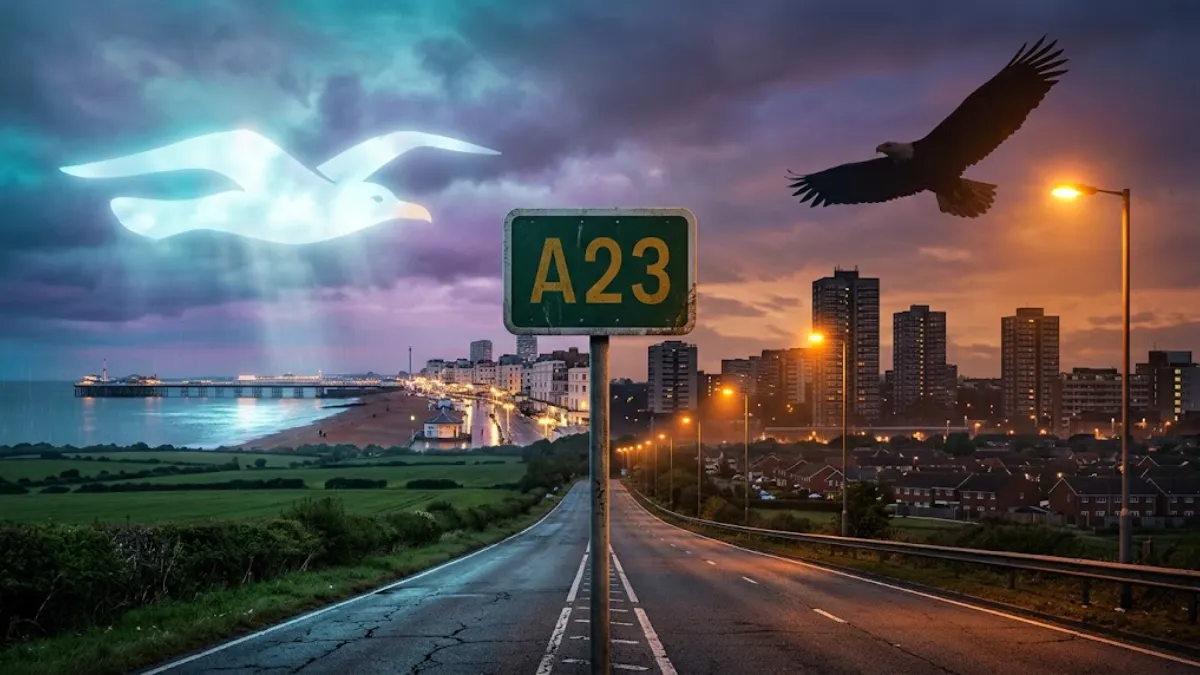
Many British rock legends have composed nostalgic ballads about their hometowns. The Beatles sang about Penny Lane, The Kinks marvelled at the sunset over Waterloo, and Gerry Rafferty played a soulful sax solo in honour of Baker Street. But if you were to ask David Bowie about his roots in Croydon, he probably wouldn't have a kind word to say:
It represents everything I never wanted to see in my life and everything I wanted to escape from. The most derogatory insult I can think of is, 'God, this is such f***ing Croydon.'
In the 1970s and 1980s, Croydon earned a reputation as a grey concrete labyrinth. Following a ban on skyscrapers in central London, developers rushed to pour concrete into the suburbs, creating lifeless towers, flyovers, and grim shopping centres. Yet for locals, there was a magical road to freedom: a family trip down the A23 in a Ford Cortina, cutting through the picturesque Sussex hills until the land stretched out towards the English Channel.
At the end of that journey lay Brighton—a coastal gem of Victorian architecture, piers filled with amusements, and a plethora of candy and ice cream. It stood in stark contrast to Croydon.
The two towns are separated by a mere 39 miles (about 63 kilometres). A train ride from East Croydon to the coast takes nearly an hour—a significant distance in British terms for a football rivalry. Crystal Palace had its fair share of local London derbies with neighbours like Wimbledon, Charlton, and Millwall, while Brighton faced Portsmouth, 42 miles down the coastline.
Fans of both clubs readily admit: geographically, it's not a derby in the traditional sense like those seen in Liverpool or Manchester. Yet, the animosity is authentic, fierce, and deeply rooted.
Toxic friendship: seeds of discord at White Hart Lane
To understand the origins of this rivalry, we must return to the locker room of Tottenham in the 1960s. In 1967, Spurs lifted the FA Cup by defeating Chelsea 2-1. In that midfield, Alan Mullery and Terry Venables played side by side.
On the pitch, they complemented one another, but off it, tension sparked. Venables, a natural leader and tactician, had to settle for the role of vice-captain beside the blunt and tough Mullery. Their friendship was non-existent. Once they hung up their boots and turned to management, a collision became inevitable.
By the mid-1970s, Crystal Palace and Brighton had long been apart in different leagues. All that changed in the 1974/75 season when the two sides found themselves in the Third Division. Brighton had just emerged from a brief spell under Brian Clough, whose departure for Leeds saw his assistant, Peter Taylor, take charge. Meanwhile, the flamboyant Malcolm Allison led Palace—far from a man of modesty or restraint.
Their clash at Goldstone Ground packed the stands and saw the first mass brawls among drunken fans. The following season saw tensions run high: the match at Selhurst Park attracted a record crowd in two years, ending in a 1-0 victory for the hosts, after which Allison publicly accused the opponents of excessive violence on the pitch.
The birth of the Eagles and Seagulls
It was Malcolm Allison who helped shape the modern identities of both clubs. Before 1973, Crystal Palace was modestly nicknamed the Glaziers—a direct reference to the historical glass palace. Allison deemed it bland and looked to continental Europe for inspiration, drawing from Benfica and renaming his side the Eagles.
Brighton fans, meanwhile, voted to adopt the nickname Dolphins in honour of their local aquarium established in 1969. But chanting ‘Go on, Dolphins!’ sounded downright ridiculous. In a 1976 showdown, London fans mocked, singing: ‘Eagles! Eagles!’ to which the home crowd spontaneously replied with ‘Seagulls! Seagulls!’. That rhyming moniker quickly took hold, with the club officially adopting the seabird as their emblem while Dolphin merchandise was discounted.
This avian exchange soon spiralled into open violence. In that same match, away fans threw smoke bombs onto the field, nearly halting the game. The Rubicon had been crossed.
Boiling coffee for 30 pence: the legend of ‘Challis from Palace’
In the summer of 1976, both clubs underwent managerial changes. Venables replaced the departed Allison at Palace, while Mullery took charge of Brighton for the first time, setting the stage for the fiery feud between the former Spurs teammates.
The draw for the first round of the FA Cup saw the teams go head to head. Their first match finished in a draw, with Mullery furiously criticising Palace’s defensive tactics. A replay again yielded no winner, leading to a second replay that was twice postponed due to poor weather before they finally met on neutral ground at Stamford Bridge.
The Eagles took a swift lead. But soon after, the referee disallowed a perfectly good goal from Brighton’s Peter Ward for a supposed handball. After the final whistle, Palace defender Jim Cannon cynically confessed that he had pushed Ward onto the ball.
The climax came in the 78th minute when referee Ron Challis awarded a penalty against Palace. Brian Horton coolly converted, but Challis shockingly ordered a retake, claiming an attacker had entered the box prematurely (though it was clear that a defender had shoved him in). The retaken penalty was saved by the goalkeeper, and Brighton were eliminated, with fans forever branding the referee’s bias as the ‘Challis from Palace’ meme.
Final whistle turned the pitch into hell. Irate Mullery was escorted by police to the changing rooms through a furious London crowd:
Some bloke on the upper tier threw a scalding hot cup of coffee right on my head. I pulled out some change from my pocket—there was only about 30 pence—and threw it onto the stand, shouting at the crowd: ‘Here’s your bloody price!’
Mullery lost his cool and flashed a double-finger gesture to the crowd, accompanied by a barrage of expletives. This gesture became iconic for a generation of Brighton fans, costing the manager a £100 fine from the Football Association.
The teams marched on together: both achieved promotion to the Second Division, and in the 1978/79 season, they climbed to the top tier of English football, with Palace snatching the title from Brighton on the final day.
Madness with five penalties and ‘Poo-gate’
The insanity continued to escalate. In 1982, Palace shocked fans by appointing Mullery as manager (akin to watching Rafael Benitez take over at Everton). He lost twice to his former club before being swiftly dismissed. In 1985, a reckless challenge by a Palace defender ended the career of Brighton’s veteran Gerry Ryan, breaking his leg in three places.
But the apex of football absurdity occurred in 1989 at Selhurst Park, where referee Kelvin Morton astonishingly awarded five penalties in a single match!
- Firstly, young Ian Wright blasted a breathtaking goal from a tight angle, catching visiting keeper John Keeley off guard, and Brighton’s Mike Trussler was sent off for a foul.
- On the 20-minute mark, a foul in the area led to the first penalty, converted by Mark Bright.
- Only two minutes later, Eddie McGoldrick was tripped for the second penalty. Bright took it again, but Keeley made the save.
- After a corner kick, Morton awarded a third penalty in three minutes! The ground called for Wright to take it, but he hit the post.
- At the start of the second half, a dubious penalty was awarded against Palace when Alan Curbishley reduced the deficit.
- Another eleven minutes passed before the fifth penalty was awarded when a ball struck a Brighton defender’s hand—sent to take it was John Pemberton, a defender who was never meant to step up to the spot. He launched the ball into the sky. Out of five penalties, only two were scored, yet Palace held on to win 2-1.
After a two-decade lull caused by Brighton's drop to lower leagues and financial woes, the rivalry reignited in the play-off semi-finals of the 2012/13 season.
The return clash along the coast became infamous as ‘Poo-gate’. Upon entering the visitors' changing rooms, Palace players were met with an unbearable stench: the floor had been deliberately smeared with human faeces. Enraged, the Londoners hit the pitch seeking revenge and knocked Brighton out of the promotion race thanks to Wilfried Zaha’s brace.
Brighton manager Gus Poyet laid into the stadium staff in an internal memo demanding explanations for the disgraceful sabotage, but he himself was suspended by the club. Former Palace players later confessed there were no nefarious goings-on; their own bus driver simply experienced stomach issues and hadn’t made it in time.
Christmas truce
The animosity has flared up repeatedly, from Glenn Murray's switch between clubs to Shane Duffy's headbutt incident in 2018 and countless dramatic last-gasp goals from Alexis Mac Allister, Christian Benteke, and Neal Maupay.
Yet, within this hatred lies a noble side. In September 2001, following the 9/11 attacks, Brighton fan Robert Eaton tragically lost his life. Supporters from both bitter clubs united to organise an annual charity match in his memory, where veterans from both sides share the pitch with fans, raising tens of thousands of pounds for children's sports centres.
The supporters themselves call this match the 'Christmas Truce in the trenches'. They might despise each other for 90 minutes along the A23, but deep down, they recognise: every superhero needs a nemesis to keep football the greatest drama of life alive.
