In the National Football Museum in Manchester lies a relic with an incredible story - the trophy from the 1966 World Cup. The home tournament became the pinnacle of glory for the birthplace of football, heralding an era in which England would not win a major international tournament again. The ‘Golden Goddess’ - the Jules Rimet Trophy (originally named ‘Victory’) - was destined to be embroiled in a series of thefts, illicit copies, and conspiratorial mysteries.
FIFA's ban, a daring copy, and the canine national hero
Even before the tournament kicked off, the Football Association approached FIFA for a precise replica of the trophy for display purposes. International football officials categorically declined, but the English turned a blind eye and covertly commissioned jeweller George Bird in London to work on a perfect duplicate, indistinguishable to the naked eye.
As fortune would have it, this British precaution proved prophetic. Just four months prior to the World Cup, the original trophy was showcased at the Gibbons Stamp exhibition, sitting among rare postage stamps worth ten times more than the sporting relic. Security was laughably inadequate; a single elderly guard kept watch over the priceless item. Unsurprisingly, thieves managed to snatch the trophy right under the nose of security.
Petty thief Edward Bletchley was sentenced to two years for the crime, but he insisted until the end that he was merely a middleman for a mysterious criminal mastermind known as ‘The Pole’. The trophy itself vanished without a trace on the streets of London.
The saviour of English honour turned out to be a mutt named Pickles. During a routine walk in a London suburb, the dog sniffed out a suspicious bundle of old newspapers hidden under a hedge — and there lay the stolen masterpiece. Pickles instantly became a global superstar, starring in the film 'A Dog's Life' alongside Eric Sykes and June Whitfield, receiving a silver medal from the National Canine Defence League, and an entire year's supply of dog food from Spillers.
His owner, Mr. David Corbett, was rewarded £3,000 by the government, which he used to buy a new family home in Surrey. Tragically, Pickles met an untimely end; while chasing a neighbour’s cat, the dog became entangled in his collar on a tree branch and suffocated. The remains of the legendary dog are buried in Mr. Corbett’s garden, marked by a commemorative plaque that has cemented his place in British football folklore.
A covert operation in the Wembley dressing room
A true detective story unfolded around the duplicate made by George Bird. Historians still debate whether the copy was completed before the March theft or hurriedly made right after. The English association was terrified of another mishap and refused to let the original leave its secure vaults.
On July 30, 1966, England saw off West Germany at Wembley with a score of 4-2. Queen Elizabeth II presented the original Jules Rimet Trophy to captain Bobby Moore. However, as the weary victors exited the pitch and retreated to the dressing room, the original disappeared from the public eye.
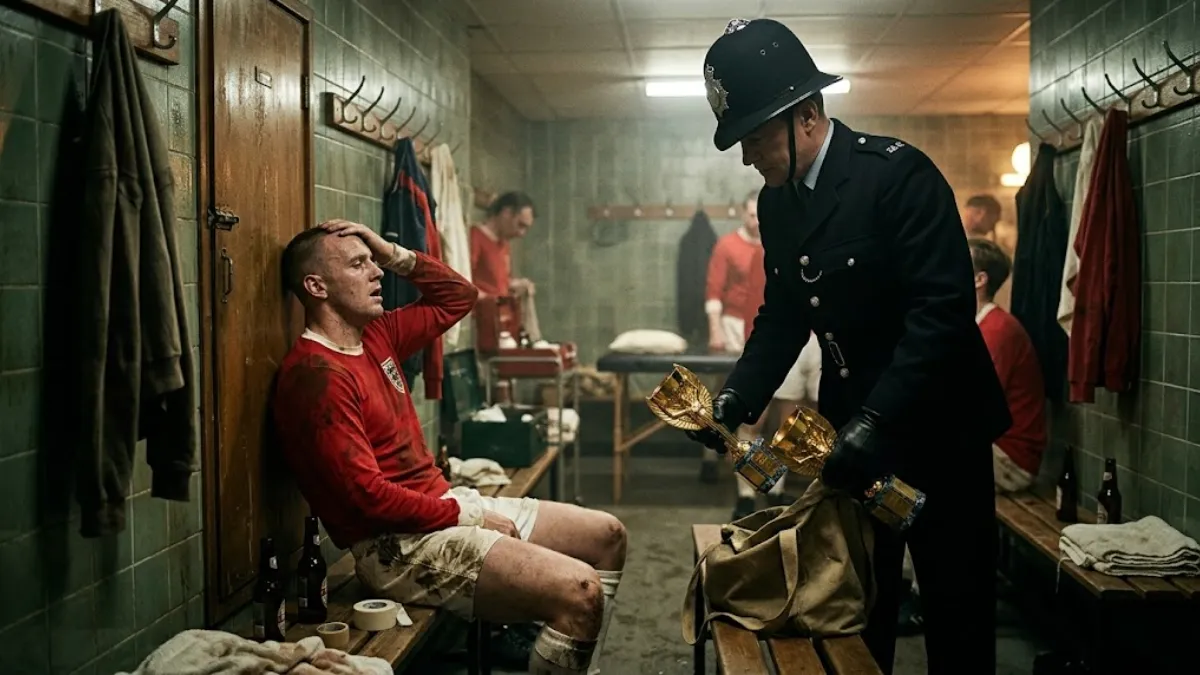
In the dressing room, a metropolitan police officer entered holding the replica made by Bird. Approaching midfielder Nobby Stiles, who was exhausted and slumped on the bench holding the trophy, the officer carefully took the original from him and replaced it with the fake.
None of the England players had a clue about the switch. The entire nation rejoiced, and the players celebrated their success, posing for photographs with the replica. The real ‘Golden Goddess’ was quickly hidden away in a secure safe. From that moment on, only the copy appeared at official banquets, parades, and historical photographs. Only a handful of high-ranking officials were aware of this mystification and swore to secrecy.
A hidden treasure beneath the bed and FIFA's auction hunt
The original trophy was returned to FIFA just before the next World Cup in Mexico. In 1970, Brazil won the tournament for the third time and, according to regulations, received the Jules Rimet Trophy for permanent possession. However, in 1983, it was stolen again from the Brazilian Football Confederation’s headquarters in Rio de Janeiro. It is believed that the thieves melted it down for bullion, although they were likely to be disappointed, as the trophy was made of silver gilt, not pure gold.
Meanwhile, the trail of that English 1966 copy was discovered unexpectedly in the bedroom of jeweller George Bird. For all those years, the duplicate lay in a simple box under his bed, wrapped in old rags, miraculously surviving two burglaries. In 1995, Bird passed away, and as relatives sorted through his belongings, they were astonished when a dazzling, golden-winged figure fell out from the tattered cloth.
The family put the relic up for prestigious auction at Sotheby’s, hoping to fetch a modest £10,000. However, a fierce bidding war erupted, and the hammer came down at a staggering £254,500!
The mysterious anonymous buyer turned out to be FIFA itself. The federation's general secretary, Sepp Blatter, ordered the purchase of the statuette at any price, fearing that the original, lost in Rio, could resurface disguised as a replica. An examination confirmed that Bird's cup was expertly cast in bronze and coated with gold. The international federation ultimately donated the historical artifact to the collection at the National Football Museum in Manchester.
Rumours persist among researchers that as many as five different replicas of the Jules Rimet Trophy exist in the world; experts had noted visual differences as far back as the 1954 World Cup compared to the 1950 model. While the full chronicle of the trophy may never be revealed, the feat of the faithful dog Pickles will forever remain a golden chapter in football history.
