People often ask why I play worse for the national team than for Burnley. It’s simple — Danny keeps me up all night talking,
Blanchflower was as adept with words as he was with his feet. His unique verbal prowess, genuine passion, and unyielding conviction in his beliefs radiated from every statement. From his profound insights, one could fill an entire book, and television producers realised quickly that for a deep, astute interview after a game, Danny was the name to call.
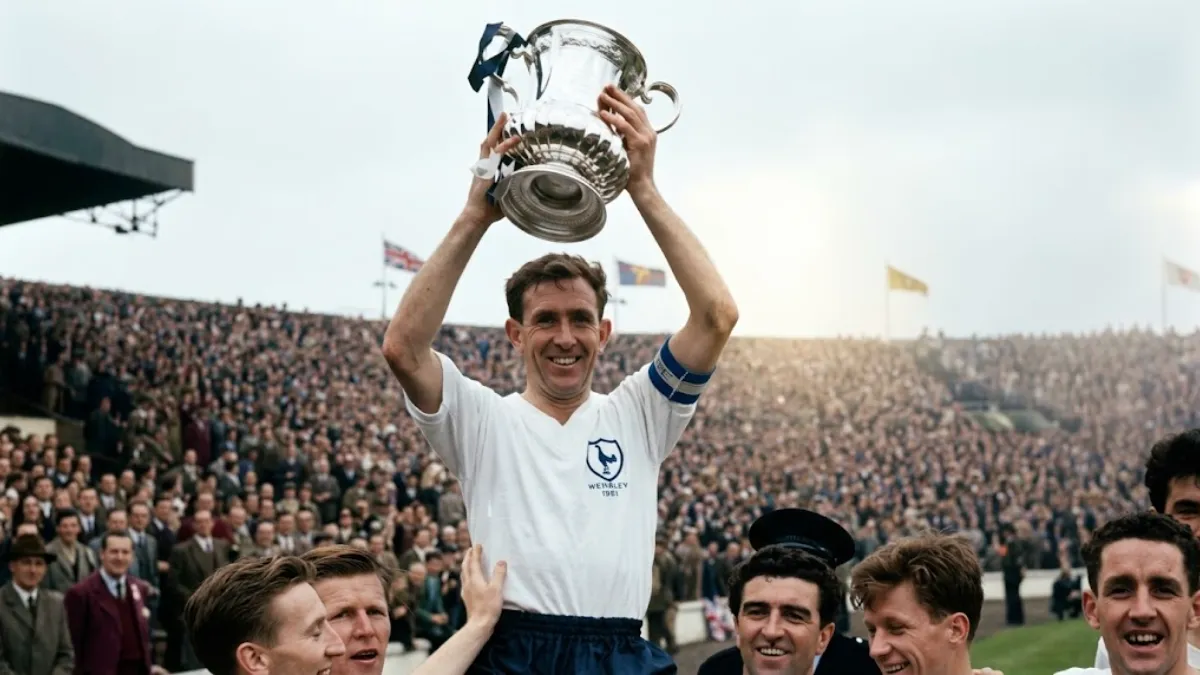
It was fate that this remarkable individual became the captain of the greatest club side in England at the time — the legendary Tottenham Hotspur, who achieved a historic ‘double’ in the 1960/61 season.
However, Blanchflower was not merely a charismatic speaker. On the pitch, he dazzled with his exceptional game vision and positional awareness as a playmaker. He had a unique ability to control the tempo of a match, raising the intensity whenever necessary. Within the Spurs midfield, Danny brought a cunning football intelligence that complemented the talents of Dave Mackay and John White perfectly.
Conflicts, character, and transfer record
Blanchflower's journey began at Belfast’s Glentoran, where the young player bore the amusing nickname 'Rabbit.' By 1949, he made the move to England, joining Barnsley. It was here that a characteristic trait emerged: his uncompromising nature regarding football philosophy. A rift developed with manager Angus Seed over archaic training methods — the team wasn’t spending enough time with the ball.
In 1951, the midfielder transferred to Aston Villa, playing 155 matches before taking a life-changing step in 1954 by signing with Tottenham. The transfer cost the Londoners a significant £30,000, making him the most expensive midfielder in British football history at that time.
Remarkably, even at the club he loved, Blanchflower often found himself at the centre of underlying tensions. His inviting manager Arthur Rowe saw in him a kindred spirit, shared his vision, and promptly handed over the captain’s armband: “He’s a natural leader with a commanding presence that inspires genuine respect.” However, within a season, Rowe was forced to resign due to health issues.
A painful internal struggle for control erupted at the club, involving even future England manager Alf Ramsey. Ultimately, the reins were handed over to first-team coach Jimmy Anderson. Relations between Blanchflower and the new boss became tense; during the 1956 FA Cup semi-final against Birmingham, the captain unilaterally took on coaching duties on the pitch, sending centre-back Maurice Norman up front when the team was behind. The plan failed spectacularly, the team exited the competition, and Danny was benched for the next match. Soon after, Anderson also resigned due to health issues.
By then, Blanchflower had been stripped of the captaincy twice, reinstated twice, and had his transfer request turned down while two managers left due to health complications. The situation with the Spurs was anything but serene.
The golden era of Bill Nicholson and innovative ideas
Everything changed in 1958 with the arrival of Bill Nicholson. Initially, the manager also sent the headstrong midfielder to the reserves, but eventually, they found common ground. They clearly defined their respective responsibilities, with the manager overseeing matters from the sideline while the captain took charge on the pitch. Blanchflower re-established himself as an unquestionable leader.
The quality leap in the 1959/60 season blossomed into a triumphant campaign in 1960/61, as Tottenham won their opening 11 league matches. Danny’s bold prediction shared with teammates at the season's start transformed into reality — a historic 'double' loomed. The league title was clinched with ease, and in the FA Cup final, Spurs dispatched Leicester with confidence. This triumph's significance cannot be overstated: prior to Tottenham, no club had achieved the 'double' in English football for 64 years. For perspective, this feat has only been replicated by ten clubs in the following sixty-plus years.
The following year, the captain led the club to a second FA Cup victory against Burnley, scoring a penalty in the final. The season after, Tottenham clinched the European Cup Winners' Cup, becoming the first English club to win a continental trophy.
Blanchflower was named Football Writers' Association Player of the Year twice, in 1958 and 1961 — a distinction achieved by only eight other players since the award's inception in 1948. He represented Northern Ireland 56 times, remarkably reaching the World Cup quarter-finals in 1958, where he was named in the tournament's best XI.
A tactical innovator, Danny was ahead of his time. His son Richard recalls a quip his father made: “He claimed he invented the wall at free kicks because the Northern Ireland goalkeeper was so poor.” Furthermore, Danny conceptualised a penalty taken as a pass long before Johan Cruyff: during the World Cup qualifiers in May 1957 against Portugal, he rolled the ball forward from the spot to a charging Jimmy McIlroy, who scored. Ironically, a conservative referee made him retake the kick.
His commitment to principles extended to every aspect of his life; he became the first person in history to publicly decline participation in the popular television show This Is Your Life, stating plainly:
I consider this show an invasion of privacy. No one will force me to do something I don’t want to.
Life after the pitch and a bitter goodbye
It seemed a natural progression for Blanchflower to pursue a career in management after retirement, yet coaching never truly captivated him. He helped the staff at Tottenham for several years, briefly managed the Northern Ireland national team and Chelsea in the 1970s. However, he found genuine acclaim in sports journalism, television analysis, and writing.
Danny left a profound impact in two distinct fields. On the pitch, he was an intellectual, inspiring captain who orchestrated one of football's major shocks of the mid-century. Off it, he was a brilliant columnist, whose witty pieces in the Daily Express stood alongside works by Hugh McIlvanney and Peter Woolridge.
The early death of this football giant at the age of 67 was a devastating blow for British sport. In his later years, Danny battled Alzheimer’s disease — a relentless affliction methodically eroding the cognitive faculties of the mind. The cruel irony was that this illness struck down a man whose intellect was widely regarded as one of the brightest and most astute in the history of English football.
