Assessing the effectiveness of Fifa's leadership is a complex topic that often leads to heated debates. However, a ranking of post-war presidents from best to worst offers an objective perspective on the organisation's evolution and challenges.
The debate over who is the least effective leader in Fifa's history remains subjective and varies widely depending on viewpoints. Instead of presenting definitive calculations, here are some dry facts and information regarding each leader's tenure.
Ranking of Fifa's post-war presidents
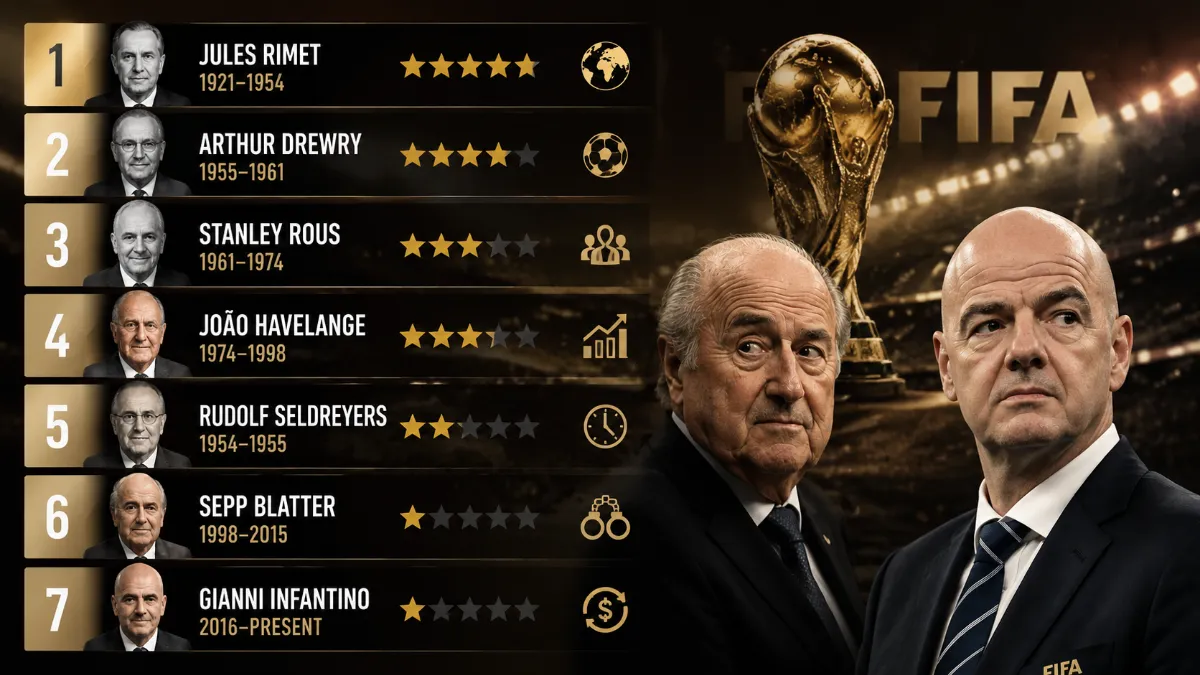
1. Jules Rimet (1921–1954)
The principal architect and founder of the World Cup. His ideological vision of uniting nations through sport earned him international respect and a nomination for the Nobel Peace Prize in 1956.
2. Arthur Drewry (1955–1961)
A former chairman of Grimsby Town, he led the organisation for five years. Remembered as a stable and reliable official, his tenure coincided with the 1958 World Cup in Sweden.
3. Stanley Rous (1961–1974)
He brought stability and actively expanded tournaments, but his reputation was tainted by his refusal to isolate South Africa during the apartheid era and the boycott of the 1966 World Cup by African nations.
4. Joao Havelange (1974–1998)
The architect of modern global Fifa. The Brazilian expanded the organisation beyond Europe and gave a significant boost to the game in Asia and Africa, but also laid the groundwork for commercialisation and corruption scandals.
5. Rudolf Seeldraeyers (1954–1955)
He served for just over a year and died in office, managing to avoid scandals or large-scale reforms during his brief tenure.
6. Sepp Blatter (1998–2015)
His presidency ended amid the largest corruption scandal in Fifa's history, controversial selections for the 2018 and 2022 World Cups, and a series of investigations involving his closest aides.
7. Gianni Infantino (2016 – present)
Initially elected as a reform candidate after Blatter's departure, he has faced criticism for radical changes to tournament formats, contentious policies, and commercial decisions.