A bustling outdoor bar in Las Vegas is where bartenders skillfully juggle ice-filled bottles while precariously balancing pyramids on their heads, and strangers easily become lifelong friends over a drink. Conversations with people from all corners of the globe inevitably steer towards the topic of football.
The game governed by Association rules (known as soccer) unequivocally tops the charts as the world's most popular sport, comfortably outpacing rugby and American football which remain in the global top ten. The worldwide triumph of football is often attributed to the marketing prowess of the Premier League or the influences of FIFA and UEFA, yet its universal appeal was established well before the commercial boom of the 21st century. The secret lies in its genius simplicity: the basic rules can be grasped by any onlooker in just a few minutes, and the game requires minimal costly equipment—any round object will do.
However, this success is rooted in something much deeper. Human nature seems fundamentally drawn to ball games. Although the modern codification can be traced to medieval pastimes on the British Isles, remarkably similar competitions developed independently across different continents centuries before the advent of European regulations.
Hunting beaches and clan battles: ball games among the Native Americans of North America
Among Native American tribes in North America, most competitions involved sticks. Traditional games with descriptive names, like the Mohawk "tewaaraton"—"little brother of war"—provided tribes a substitute for bloody armed conflicts, resolving territorial and inter-clan disputes on the sporting field.
However, amongst the Algonquin and Powhatan tribes, there existed an authentic foot-based game—"pasukwakhogah"—which literally translates to "they gather to play ball with their feet".
Matches unfolded over vast grounds: the width of the pitch on sandy beaches or forest clearings could stretch half a mile, with goals standing a full mile apart. In these ball battles, up to 1,000 participants clashed, painted for war and adorned with ritual ornaments—partly for intimidation, partly to avoid blood vengeance and recognition after fierce skirmishes. European colonists in the early 17th century, witnessing these contests for the first time, noted with amazement that, despite the scale and ferocity, Native American "pasukwakhogah" was far more organised and less prone to injury than the wild medieval pastimes of English crowds.
Rubber gods and bloody myths: Mesoamerica and the Caribbean 'batey'
Further south, pre-Columbian Mesoamerica birthed one of humanity's most enigmatic sporting cultures, pioneered by the Olmecs who thrived from 1200 to 400 BC. The very word "Olmec" in the Nahuatl language means "rubber people"; these were the innovators who learned to blend latex from rubber trees with the sap of morning glory, creating the technology for making elastic rubber.
The Mesoamerican ball game was played on substantial stone courts shaped like an 'I'. Archaeological finds in the Chiapas lowlands and 2020 excavations at Etlatongo (Oaxaca region) pushed the origins of these structures back to 1650–1374 BC, proving that the traditions formed long before the rise of Olmec metropolises.
While the exact rules have not survived, reliefs on temples, pottery paintings, and the sacred epic of the K'iche' people, "Popol Vuh", help reconstruct the picture. A heavy solid latex ball, ranging from 13 to 30 centimetres in diameter and weighing from half a kilogram to an incredible seven kilograms, was introduced into play using the hands; afterwards, only thighs and buttocks were permitted to touch it. Duel format games saw participants playing one-on-one, in pairs, or small teams, with hitting a rubber ball through a high stone ring on the wall of the court providing immediate victory.
The game was imbued with sacred meaning, intertwined with the creation of the world. According to the legend in "Popol Vuh", divine twins Hunahpú and Xbalanqué descended into the underworld of Xibalba and played ball against the lords of death, freeing their father—the maize god—and ascending to the sky as the sun and moon.
Due to direct associations with the movement of celestial bodies and fertility, the game was accompanied by sacrificial rites: stone reliefs at the arenas of Chichen Itza prominently depict scenes of decapitation of participants. Although historians debate exactly whom was sacrificed to the gods (either the winning team's captains for supreme honour or the defeated), among the Aztecs, sport maintained a practical purpose. Monarchs and nobility kept permanent teams of players, resolving territorial disputes without bloodshed, while the crowds placed colossal bets on their favourites.
In the Caribbean basin, the Taíno people practiced a related game—"batey". On central village squares, surrounded by carved stone idols, teams of 10 to 30 people threw a dense rubber ball using elbows, shoulders, thighs, and knees, strictly avoiding the use of hands. If the ball touched the ground, it meant losing a point, creating a dynamic similar to modern volleyball. Competitions served as both entertainment for chiefs and a referee in disputes between communities.
The Eastern canon: the rise of 'cuju', Burmese dance, and samurai 'kemari'
On July 15, 2004, then FIFA president Sepp Blatter shocked historians with the sensational claim that football originated in the Chinese city of Zibo (in Shandong province). He referred to the ancient Chinese pastime "cuju" ("kick the ball with the foot"), which dates back to the Warring States period (5th–3rd centuries BC). Later, FIFA refined its rhetoric, recognizing "cuju" as the oldest documented ball game in human history (mentioned in military treatises of the Han era), while clarifying it had no influence on the European codification of the 19th century.
"Cuju" endured in China for over two millennia, only declining during the Ming dynasty (1368–1644). The game branched into two main forms. In the competitive version, two teams of 12 to 16 players aimed to hit a leather ball into circular netted targets on high poles without using their hands. Under the Song dynasty, an aesthetic version emerged, removing the goals, instead scoring points for technique, acrobatic tricks, and exquisite juggling (known as "seshou"), with penalties for clumsy movements or loss of rhythm. Emperors constructed playing fields right within their palaces, poets penned odes to masters, and military garrisons employed competitions for drill practice.
In Southeast Asia, similar traditions transformed into "sepak takraw" (Malaysia and Thailand) and the Filipino "sipa", where a lightweight rattan ball is volleyed over a net using the feet.
In Myanmar, around 1,500 years ago, "chinlon" emerged—a meditative, non-contact art form designed for royal amusement. Six participants gather in a circle, rhythmically keeping the rattan ball airborne while showcasing virtual acrobatics at the intersection of martial arts and traditional choreography.
In Japan, the tradition of "kemari" took root during the Asuka period (6th–8th centuries). Participants dressed in traditional silk garments step onto a sanded area known as "mariniwa", bounded at the corners by four sacred trees—cherry, maple, willow, and pine.
Four main masters ("mariashi"), with their assistants, keep a soft, deer-skin ball ("mari") weighing 150 grams airborne. The game lacks winners and losers; it is a spiritual ritual where harmony and the perfect trajectory of the ball's flight are paramount. To this day, at Shinto shrines, priests hold "kemari" matches, counting touches up to astrologically sacred numbers—120, 360, or 1,000 contacts.
African combat sports and ancient manoeuvres
In Africa, traditional competitions primarily developed around martial arts: Senegalese "lutte" (wrestling), Nigerian "dambe" boxing, or ritual stick fighting. Team games with sticks were also present—Moroccan "axeltag" with a leather ball or Ethiopian "genna", where teams aim to drive a wooden ball over a 300 by 200 meter field. South African "dibeke" combined foot strikes with hand passing, though it tactically resembled baseball.
In the Mediterranean, the roots of team games traced back to Ancient Greece. A relief on a tombstone from Piraeus depicts an athlete balancing a ball on his thigh (this image now adorns the modern Henri Delaunay trophy presented to European champions).
Greek pastimes were not part of the Olympic Games, remaining merely entertainment for keeping fit. Games like "ourania" or "ephedrismos" had symbolic significance, while "episkyros" represented a brutal team scrimmage. Two teams of 12 to 14 personnel competed to push a ball over the opposing team's baseline ("skuros"), employing forceful techniques and grappling.
The Romans adopted this code, creating "harpastum" ("game of small ball"). It involved a hard ball stuffed with wool or feathers on a rectangular pitch. The ancient physician Claudius Galen strongly recommended "harpastum" to legionaries for building endurance and tactical acumen. The confrontations were replete with grappling and throws to the ground, eventually bridging the gap to medieval Italian realities.
The Florentine revolt: the revival of calcio on the sands of Santa Croce
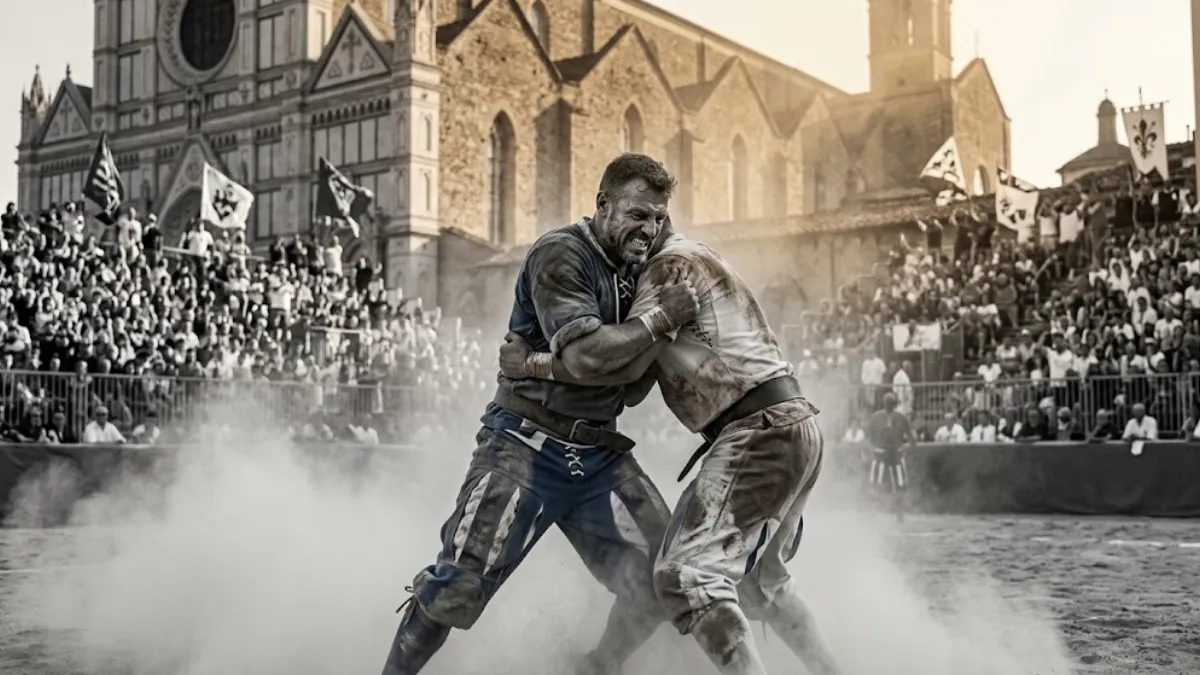
The direct descendant of the ancient "harpastum" is the famed "historical Florentine calcio" (calcio storico Fiorentino). Emerging on the Piazza Santa Croce in the 15th century as training for young soldiers, the contest quickly morphed into a privilege of the nobility. Future popes Clement VII, Leo XI, and Urban VIII participated, as did offspring of the Medici family.
The most legendary match took place on February 17, 1530: the Florentines took to the square during the height of the city’s siege by the forces of Emperor Charles V, showcasing absolute fearlessness and disdain for the threat before their enemies. In 1580, Count Giovanni de’ Bardi codified the canonical rules: participants could only be noble gentlemen aged 18 to 45, possessing impeccable reputations and athletic builds.
After a lull in the 18th century, the game was revived by Italian fascists. In May 1930, party official Alessandro Pavolini organised a tournament to commemorate the 400th anniversary of the historic siege, reinstating de' Bardi's regulations. Nationalists intentionally promoted the term "calcio" over the English name, seeking to assert Italian priority in the invention of football, while journalist Gianni Brera outright claimed that the British merely rediscovered the ancient game of the Apennines.
The rules of Florentine calcio remain harsh to this day. On a sandy arena measuring 100 by 50 meters, two teams of 27 fighters battle it out: four goalkeepers, three defenders, five midfielders, and fifteen forwards. Substitutions are prohibited even in the event of serious injuries.
Each match lasts 50 minutes and begins with a total brawl among forwards: punches, elbows, and chokeholds are allowed (only kicks to the head and crowd attacks on a single player are prohibited). The forwards' objective is to physically neutralise their opponents, after which the remaining players pick up the ball with their hands or feet, aiming to score into a wide net across the field ("caccia"). A throw that goes over the net bestows half a point on the opponent.
Every June, four historical districts of Florence—"Azzurri" (Santa Croce), "Bianchi" (Santo Spirito), "Rossi" (Santa Maria Novella), and "Verdi" (San Giovanni)—dress in medieval costumes to fight fiercely for the title of the city's best district.
Invisible threads: the Indigenous 'marn grook' and the nature of play
In Australia, the phenomenon of "marn grook"—a pastime of the continent's Indigenous peoples with a thousand-year history—developed concurrently. Aboriginals used a ball stuffed with opossum fur, competing in high jumps ("high-marking") and long kicks.
Tom Wills, who formulated the rules of Australian football in 1859, spent his childhood among the children of the Djab Wurrung tribe and was fluent in their language. Historians continue to debate how much Indigenous rituals influenced the creation of the AFL code, yet for Indigenous Australians, this connection remains a sacred cultural bridge across the ages.
Ancient pastimes have always been based on two fundamental pillars: individual virtuosity with the ball and territorial competition for space. Kicking, catching, and throwing bring primal joy, while the face-off between two sides satisfies humanity's inherent competitive nature. As writer Terry Pratchett astutely noted:
The essence of football—and this is the most important part—is that it never is just about football.
Attempts to draw a direct lineage from ancient civilisations to modern tournaments are naive: such games have independently arisen throughout human history, akin to the phenomenon of Egyptian and Mesoamerican pyramids—a universal response of the human mind to the thirst for competition.
Rugby harmoniously accumulated team-based strategies, but Association football has emerged as the absolute pinnacle of this evolution. It perfectly balances the exquisite art of ball control with the uncompromising battle for territory. Humanity was fated from the dawn of time to step onto the grass and strike a ball.
