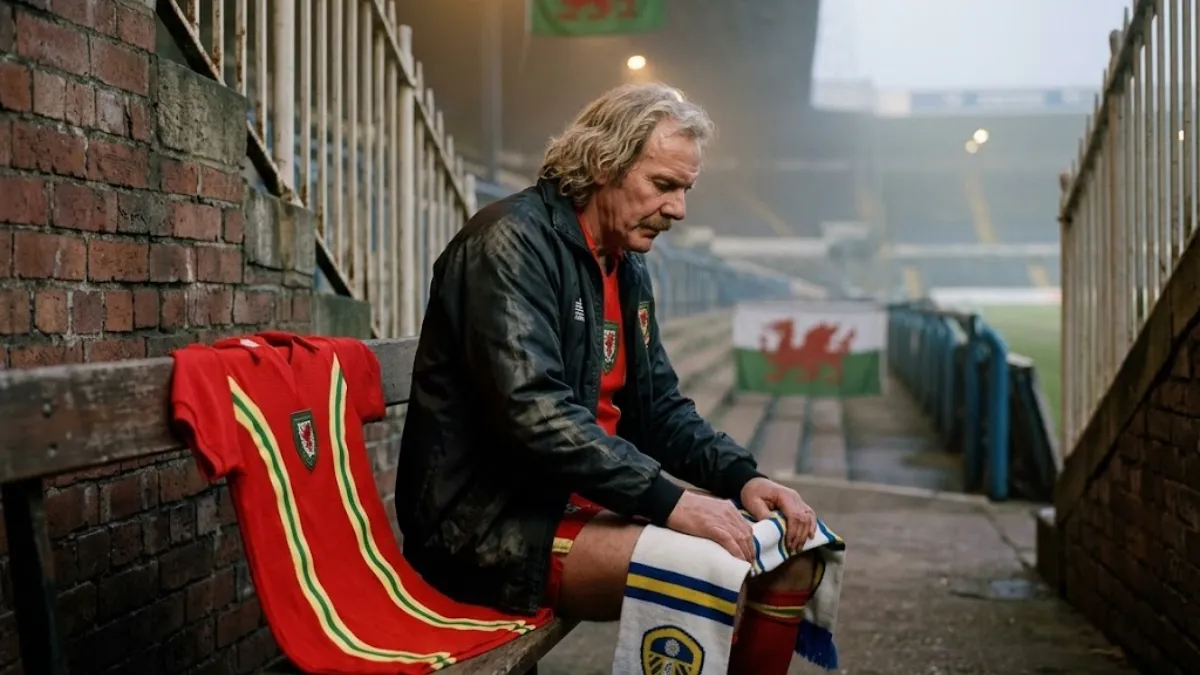
The Welsh football community has suffered an irreparable loss. In January 2026, at the age of 75, one of the most dedicated knights of Welsh sport passed away — former Leeds United, Tottenham and Coventry City midfielder Terry Yorath. For decades, he remained the indomitable backbone of the Welsh national team and the embodiment of the fighting spirit of the entire nation.
In recent years, Welsh football has lost a significant number of its titans from the spirited team of the seventies. Defender Joey Jones, goalkeeper Dai Davis, and relentless winger Leighton James have left our earthly stage, and in 2026, refined defender Rod Thomas also passed away.
The unyielding team was unimaginable without the legendary tactical triangle in midfield: Yorath, Flynn, and Mahoney. Terry Yorath, Brian Flynn, and John Mahoney (cousin of another Welsh legend, John Toshack) dominated the heart of the pitch in every match. But without a doubt, Terry was the undisputed leader of this football crew.
This squad always overachieved, exceeding the mere sum of their individual talents. Their names were known by every child in Wales, though modern Premier League fans might be less familiar with them.
It was this iron-clad midfield partnership that almost secured Wales a place in the World Cup finals in 1978, until a controversial handball by Scottish forward Joe Jordan at Anfield in 1977 dashed that dream. In the same memorable year, Yorath captained Wales to a famous victory over England at the packed Wembley Stadium, where Leighton James scored the only goal.
In 1980, the captain repeated this feat, leading Wales to a resounding 4-1 thrashing of the English in Wrexham, with an unstoppable James once again tormenting the English defence.
We mustn't forget that in 1976, Wales reached the quarter-finals of the European Championship. In a fierce playoff battle against Yugoslavia at home ground Ninian Park in Cardiff, Yorath missed a penalty. That night, Terry led the team in the iconic red-yellow-green kit, which Welsh fans still remember with deep fondness and nostalgia.
“Victory at any cost”: A steely grip in Yorkshire and classy capital
At club level, Yorath earned a reputation as a tenacious fighter. He was the perfect fit for the famous Leeds United under Don Revie in the early seventies — a team never short of toughness and character.
Terry wasn’t always a starter, but over nine seasons, he established himself as an incredibly reliable team player. In European finals and key cup matches at Wembley, playing for Revie’s team required more than just the ability to tackle hard; that competitive spirit certainly helped.
Yorath became the first Welsh footballer in history to play in a European Cup final, an event that occurred in 1975 on Parisian turf against Bayern Munich. Unfortunately for the Yorkshire club, the final turned into a drama as they stumbled at the final hurdle, succumbing to the German giants.
In that Paris clash, following a fierce tackle from Yorath, Swedish defender Bjorn Andersson of Bayern suffered a severe leg break, yet the referee did not show Yorath a red card. For Terry and all of Leeds United, there was only one commandment: victory at any cost.
Throughout his time at Leeds United, Terry made 199 appearances, covering virtually any troublesome positions on the field. He bore similarities to Paul Madeley in his versatility but acted with a level of aggression beyond his own. Yorath never shied away from the ferocity with which he battled for that legendary side.
Billy Bremner, Johnny Giles, Jack Charlton, Paul Reaney, and Yorath himself were fiercely averse to defeat. They were not there to quietly observe the tricks of George Best, Peter Osgood and other stars of the era — they went out determined to win every confrontation.
Later, the Welshman donned the captain's armband at Coventry City, before moving to London to sign with Tottenham Hotspur. In the capital, the midfielder shared the pitch with recognised football aesthetes like Glenn Hoddle and Ossie Ardiles — an impressive company for a lad whose childhood was spent in modest surroundings on Pontypridd Street in the working-class Splott area of Cardiff.
The golden team of the nineties, tragedy in Cardiff and personal scars
Upon retiring from playing, it was only natural for Yorath to transition into coaching. Taking the reins of the Welsh national team, he assembled a host of world-class talents: Ryan Giggs, Ian Rush, Mark Hughes, and Dean Saunders.
Under his guidance, the Welsh team experienced a golden period, achieving sensational victories over Germany and Brazil.
However, a fateful incident marred the journey to the 1994 World Cup. In a crucial qualifier against Romania at Cardiff's stadium in 1993, less celebrated defender Paul Bodin from modest Swindon Town stepped up to take a penalty. His powerful strike hit the crossbar and flew into the field, leaving the Welsh side without a trip to the USA. Both the team's mentor and the unfortunate Bodin never fully recovered from that psychological blow.
Off the pitch, life dealt Terry severe blows. In his 2004 autobiography, “Hard Man Hard Knocks”, he candidly recounted his deep sorrow over the loss of his son Daniel in 1992 and the horrific Bradford City stadium fire in 1985, where he was acting as player-manager.
Memories of the stadiums and the pantheon of the immortal
Yorath is deeply respected far beyond his native Wales. Fans of all the clubs he fought for remember his name with warmth and pride, while Leeds United supporters hold him in brotherly regard.
On January 17, 2026, during a League One match between Bradford City and Cardiff City, fans from both teams gathered for a touching tribute. The packed home ground of Bradford recalled Terry’s bravery during the 1985 fire tragedy, while two thousand Cardiff City supporters stood and chanted the name of this national hero, who had also served as the club's head coach in the mid-nineties.
In the next home fixture for Cardiff City against Stockport County, the ceremony was repeated. Additionally, over the years, he had managed Swansea City, Huddersfield Town, and Sheffield Wednesday — the spirit of Yorkshire and the heart of Wales were indeed stitched into his very genetic code.
During the funeral service, a wreath in the blue and yellow colours of Leeds United adorned the veteran's coffin, complemented by a large floral tribute in the shape of the Welsh flag. Many of his football battle comrades gathered to bid farewell to the legend.
Speaking after the memorial service, renowned presenter and comedian Elis James remarked that it was a great honour to deliver the eulogy:
The Welsh team of the eighties and nineties — that is exactly what made me fall in love with football forever. He was an integral part of every great moment in Welsh football from the seventies to the nineties — first as captain, then as head coach. For me, he is etched on the Mount Rushmore of Welsh football.
Rest in peace, Terry. Gorffwysa mewn hedd.
