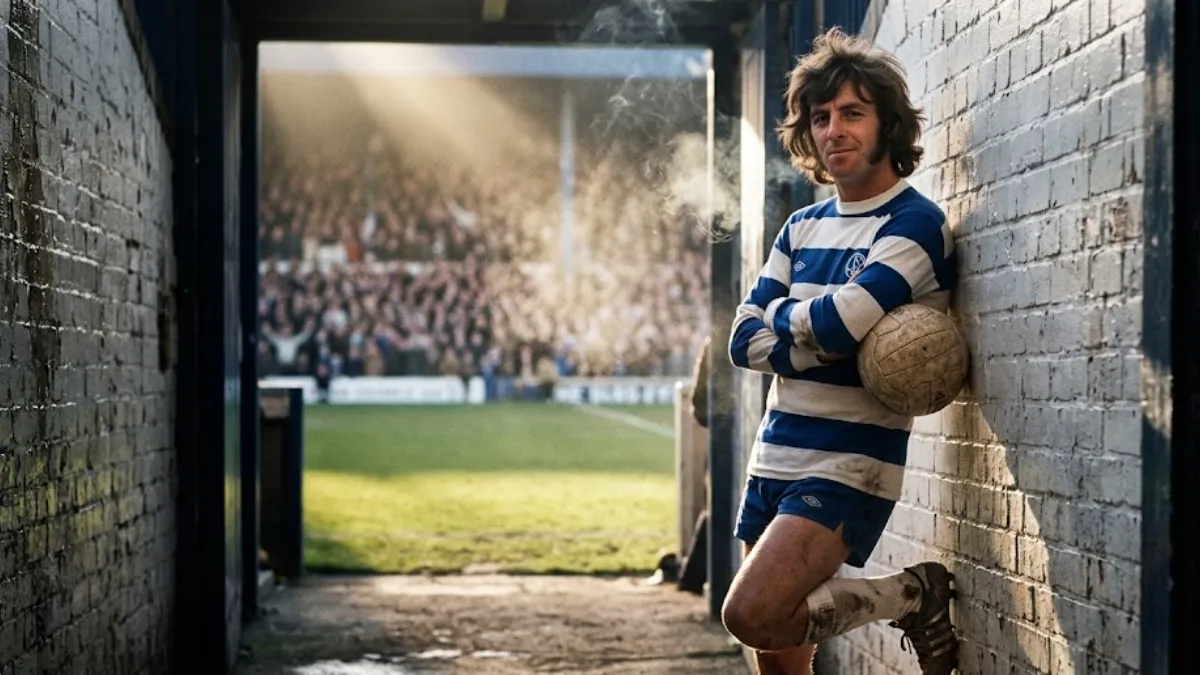
The secret to getting the most out of someone like me? Just don’t tell me what to do. - Stan Bowles
Life is woven from pivotal moments, crossroads, and situations that dramatically alter one's fate. Each of us makes a choice: to ignore them, embrace a new challenge, or bitterly regret our decisions for years to come. Half a century later, one can't help but wonder: what was Stan Bowles feeling about his actions on Wednesday, May 15, 1974, when he was substituted in the 55th minute of the England versus Northern Ireland match at Wembley Stadium? Could he have acted differently, and would it have been worth it?
His professional journey began at Manchester City in 1967, just as the club stood on the brink of a historic rise. The young forward struck twice in each of his first two matches for the club, and many were eager to predict a glittering career at the pinnacle of the game.
However, over the next 15 appearances stretching across three seasons, the forward failed to find the net even once. This saw Stan relegated to the fourth division with humble Bury, before moving to Crewe Alexandra in 1970.
Fate presented him with a splendid opportunity at a top team, but he couldn't seize it. The arrival of Francis Lee dampened Bowles' progress, and his relationship with the managerial duo of Malcolm Allison and Joe Mercer was far from harmonious.
A series of off-pitch incidents sowed seeds of doubt among the Manchester City hierarchy. However, the affable Mercer would cross paths with Bowles again, while the phrase "off-field incidents" would become an enduring companion in any discussion about the talented player.
London renaissance: the rise of a national favourite
It was at Crewe that Stan found his way back to top-flight football. He was fortunate to meet manager Ernie Tagg, who genuinely admired the forward's abilities, understood his delicate nature, and granted him complete freedom on the pitch.
A swift move to Carlisle United followed, and in September 1972, Gordon Jago, then manager of Queens Park Rangers, bought Bowles’ contract for a whopping £112,000.
Thus, one of the brightest and most unconventional stars of the 1970s emerged on the English football stage.
Bowles was brought in to replace the previously misunderstood rebel of the club, Rodney Marsh, who liked to say:
If it wasn’t for Alf Ramsey, I would have played a hundred games for England.
Within a season, Bowles triumphantly returned the London side to the First Division. Once in the top flight, the team not only established themselves but also captured the nation’s attention. Viewers discovered a rare football gem: Stan became a key component of a squad where the experience of David Webb, Frank McLintock, and Terry Venables intertwined beautifully with the youthful exuberance of Gerry Francis, Dave Thomas, and Don Givens. But ultimately, it was Bowles who drew the crowds, with fans flocking to see his dazzling tricks and magic.
With the sought-after freedom, Stan asserted himself as one of the most technically gifted players in the history of English football, possessing remarkable coordination. His left foot was akin to a magic wand, capable of unlocking any defensive fortification.
His dazzling performances during the 1973/74 season earned him the long-awaited international recognition, making his debut for England in a match against Portugal in April 1974, in what was Alf Ramsey's last game in charge of the national team.
The appointment of Dave Sexton as manager for the 1975/76 season elevated the team’s game to a new level.
The greatest drama of 1976 and a European record
Progress culminated in a phenomenal second-place finish in the league, with the "R's" finishing just a point behind Liverpool, who were primed to establish dominance in English football for the next fifteen years.
That season marked the twilight and absolute peak of Stan’s career, as the club nearly pulled off a tremendous upset. The forward played 37 league matches, and fans still ponder: had he played the missing five games, would the Rangers have mustered the two points needed for the title? Even the most cautious punter would back that bet, while the adventurous Stan would have staked it all.
His star continued to shine brightly in the subsequent European season. The club reached the quarterfinals of the UEFA Cup, while Bowles established an all-time record for British players in a single European campaign, scoring 11 goals.
However, following the historic silver in 1976, a rapid decline ensued. By the end of the 1978/79 season, the team was relegated from the top division, and soon their leader departed as well.
Nevertheless, for several seasons, English football fans delighted in the artistry of a true magician, who managed to elevate a modest club from West London to a notable stature on the sporting map.
Aside from a sensational League Cup victory in 1967, broadcast live on BBC, the Rangers never reached for the stars. Now, however, firmly entrenched in the elite, they had become everyone’s "second-favourite team."
Their free-flowing, attacking football was mesmerizing. Who could forget Gerry Francis’s goal against Liverpool in the opening match of the 1975/76 season, heralded as "Goal of the Season" by Match of the Day?
Clash with Clough, recognition at Brentford, and the formula of genius
The parting with his beloved club was bittersweet: in 1979, he spent half a year in the reserves due to an ongoing position battle with new manager Tommy Doherty. Seeking a big break, Stan found himself amid the pressures of Nottingham Forest under the authoritarian Brian Clough.
The finale of this union was predetermined: the forward left the team in disgrace after the manager forbade him from playing in the farewell match of legendary John Robertson. Nonetheless, Stan departed not empty-handed, having secured the sole major trophy of his career - a European Super Cup winner's medal after triumphing against Barcelona.
Stan's career climaxed at Brentford and Leyton Orient. In West London, the veteran experienced a true renaissance, earning the title of "Player of the Year" at Brentford in 1982. Remarkably, in recent polls, fans from both Queens Park Rangers and Brentford unequivocally voted Stan as the greatest player in the respective club’s history.
Reflecting on Bowles’ career, it’s hard not to recall the insight of his Brentford teammate Bob Booker:
We classified players like him as luxury players: when he wasn’t in the mood, it felt like you were playing with ten men, but when he was at it, it was like having twelve men on the pitch.
Indeed, fans fondly remember those rainy Tuesday nights in Stoke, when the forward was evidently disinterested. Football was never Stan’s top priority - why should he give it his all?
But on those days when his eyes sparkled, people were captivated by football, falling in love with it all over again. It was for such unique talents that viewers froze in front of their TV screens, jumped off their sofas in living rooms, erupted with joy, cherishing those moments for life. Only a genius of Stan Bowles's calibre could evoke such emotions.
A shadow of roulette: the destructive passion of a street hero
For someone who loved football far less than football loved him, the forward played an astonishing 507 matches over seventeen years of professional career. The paradox of Stan’s perception - the reason people either adored him fiercely or regarded him with indifference - lay in the fact that he never fully committed himself to the game.
He bore the relentless blows to his legs, brutal tackles from hardmen and managed to withstand years of physical punishment. His impeccable sense of balance and explosive pace allowed him to evade the most ferocious tackles in the blink of an eye. He did all this for the love of the game but never truly devoted his mind and soul entirely to football. Something else always existed in his life:
I see football as a door to entirely different possibilities. Football doesn't use me - I use football.
In reality, Bowles’ “other possibilities” often involved dog racing at White City Stadium or underground betting shops in Shepherds Bush.
Stan suffered from a severe gambling addiction and inevitably ended his career with enormous debts. In his autobiography, he estimated that he squandered an astronomical sum – upwards of £750,000 on betting.
His club's management was aware of his weakness from the outset: at QPR, they attempted to combat the issue in a unique way - they paid his salary directly to his wife, took care of household bills, while only giving the forward a small amount of pocket money.
However, gambling addiction proved to be a heavy ailment, the nature of which was poorly understood in the 1970s. It wasn't until Paul Merson's public breakdown and confession in 1994 that society grasped the profound destruction gambling could wreak on individuals, obliterating any sporting prospects.
As for the incident on May 15, 1974, that fateful day saw Stan walk out on the England squad. Acting caretaker manager Joe Mercer decisively stated that a player who turns his back on the national team should never wear the "Three Lions" jersey again.
Days later, Bowles called the manager asking for forgiveness and a second chance, but staunch Mercer stood firm.
Later, Don Revie would recall the forward to the national side in 1976 and 1977, but Stan's international career remained a tale of unrealised potential. Blaming solely the managers would be unjust. Stan should have allowed the manager to do his job: giving the opportunity for a smooth replacement to fellow forward Frank Worthington and debuting for the national team without unnecessary scandal.
Stan was idolised for the sheer joy of watching him play. His journey at Queens Park Rangers is a grand saga of lost triumph in the seventies. Witnesses recalled that spotting Bowles in the local pubs of Shepherds Bush or at the betting shop was just as easy as finding him on the pitch at Loftus Road.
He was a genuine boy from the street, and the people adored him for his absolute openness and lack of barriers.
Regrettably, he could never devote his whole life to football. Fans still mourn the heights this phenomenal forward could have reached instead of a meagre five caps for the national side. Behind the scenes of his fate lay inner demons and personal dramas that the public were unaware of.
However, every Saturday, as he stepped onto the pitch, Stan Bowles brought his all - incredible talent, daring mischief, and profound emotions, baring his rebellious soul to the spectators. And it was for this genuine sincerity that the terraces adored him with all their hearts.
