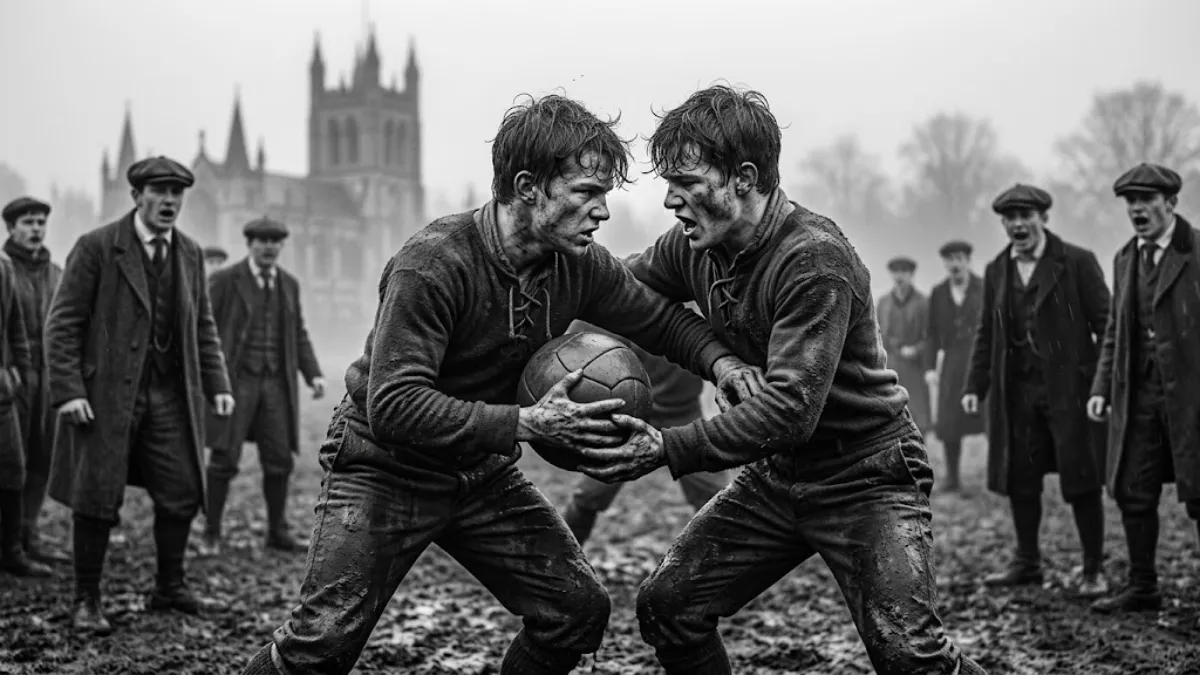
Many fascinating stories start in a pub, and this one is no different. However, it's not about a traditional English pub, where regulars debate the origins of their beloved game over a pint, but rather a bar in Las Vegas, famous for its flair bartending.
Not long ago, during a casual chat about sports, a local bartender chimed in with a smug question:
Do you even know why American football is called football?
After a detailed explanation involving the English roots of rugby, soccer, and collegiate leagues, he cut in without a hint of humility:
No, it’s much simpler: the ball is exactly one foot long!
Such pseudo-explanations can be surprisingly persistent, reminiscent of ridiculous urban myths about the origins of words. However, this myth collapses under scrutiny. The standard length of an American football is strictly regulated and measures between 11 and 11.25 inches — hardly close to a full foot (12 inches). Interestingly, a rugby ball ranges from 11 to 12 inches, which suggests that if naming was determined by ball size, rugby would have far more claim to the title of football. In reality, this misunderstanding emerged as a clumsy attempt to answer European fans’ perennial question: how can a game called football exist where the ball is handled by hands 95% of the time?
This amusing debate highlights a more significant issue: billions of people watch various forms of football without truly understanding their origins, how they intertwine, and why they share the same name.
A terminology maze: how 'soccer' became British slang
Today, for the majority, the term 'football' evokes images of FIFA’s game (Association Football). However, the global family includes rugby union, rugby league, American, Australian, and Gaelic football. Until the 1960s, British newspapers divided their football sections into clear columns: 'Association', 'Rugby Union', and 'Rugby League'. Before World War I, the term 'football' colloquially referred to any form of rugby in the UK, and television commentators for rugby league used this term until relatively recently.
This is why many of the oldest clubs still retain letter prefixes in their official names. Teams like 'London Welsh', 'Nottingham', or 'St Helens' carry the abbreviation RFC (Rugby Football Club), while 'Sunderland', 'Bradford City', and 'Bournemouth' are officially known as AFC (Association Football Club). Other clubs — such as Chelsea and West Ham, as well as rugby teams like 'Barbarians' and 'Harlequins' — settled for the neutral FC, leaving fans to guess which football they refer to.
The Victorians rightly viewed soccer and rugby as two branches of one tree. To avoid confusion, students at Oxford University created a distinctive slang by adding the ending '-er' to the abbreviated forms (similar to how British slang has 'fiver' and 'tenner' for five- and ten-pound notes). Rugby became simply 'rugger', while Association Football morphed into 'assoccer' before evolving into the familiar 'soccer'.
The term 'soccer' is a wholly British invention, and English fans should not be annoyed when Americans use it. Traditionally, the term is attributed to Oxford student Charles Refford-Brown, who allegedly responded in 1863 that he would play 'rugger' instead. However, historians generally regard this tale as myth.
Wild origins: medieval mob football and Norman 'la soule'
No modern football code appeared by magic in the 19th century. Each represents a link in a centuries-long evolution of communal games widespread in northwestern Europe, primarily the British Isles, since the early Middle Ages.
When medieval football is mentioned, memories of the so-called 'mob football' immediately spring to mind — chaotic, fierce brawls between entire villages, echoes of which are still alive in Derbyshire (Ashbourne), Northumberland (Alnwick), and the Orkney Islands (Kirkwall).
In the western counties of Wales, a similar ancient pastime existed called 'cnapan'. It involved most of the male population from two neighbouring parishes, who aimed to transport a small ball, boiled in animal fat for slickness, to the doors of their local parish church by any means necessary.
In France, a similar game known as 'la soule' saw parishes square off against one another, attempting to pass a leather or wooden ball, stuffed with rags, moss, or horsehair, towards the boundaries of an opponent's church. Often players took to wielding sticks, echoing the Irish game of hurling. These contests were notoriously violent and frequently resulted in serious injuries, leading authorities to impose restrictions; for example, a 1412 decree limited the ball's size, mandating that it be manageable enough to hold in one hand. Such games nearly disappeared by the 19th century, finally fading out by 1945, although enthusiasts revived a tournament in Normandy in 2011.
However, to reduce early football history solely to festive brawls is fundamentally inaccurate. Mob football was often associated with church festivals like Shrove Tuesday or weddings. Alongside it, another, far more organised form of game was brewing in Britain.
The first chronicles and monarchs' bans
The first written mention of a football-like game was made in 1174 by cleric William Fitzstephen, secretary to Thomas Becket. In his treatise 'Description of the Noblest City of London', he noted that after midday, the city’s youth would flock to the fields for the 'famous game with a ball'. Although the description was vague, by 1280, a court chronicle in Northumberland recorded a tragic incident where during a match, one Henry collided with an opponent and accidentally impaled himself on a knife hanging from the latter's belt.
By 1314, the game had become so noisy and dangerous that the Lord Mayor of London, Nicholas de Farndon, issued a strict edict banning football within the city limits. In 1363, King Edward III banned football, handball, and hockey by royal decree, insisting that subjects engage in archery for the crown’s defence instead.
In each locality, the rules remained unique. In some places, players were allowed to catch the ball with their hands, while in others, kicking was the only method permitted; in some villages, goals were anything from driven stakes to chalk lines on the ground. The nature of the balls also varied: where hand games dominated, solid and small balls were used, and for foot games, larger inflatable leather spheres were crafted.
From the 14th to the 18th century, the eastern counties of England (Essex, Cambridgeshire, Norfolk, Suffolk) prospered with 'camp-ball'. Matches were played on designated fields ('camping closes'), involving 10-15 participants, and the ball resembled a cricket ball. Players primarily threw the ball with their hands, with flank players functioning like modern NFL blockers, preventing opponents from reaching their running teammates.
Despite the dominance of hand play, the Latin-English dictionary 'Promptorium parvulorum' of 1440 distinctly defines camp-ball as a form of football. In the southwest, in Cornwall, similar contests were termed 'hurling to goals' and have endured to this day as folklore festivals in St. Columb Major and St. Ives.
Scotland didn’t escape football’s allure either. The oldest football in the world, dating back between 1537 and 1542, is carefully preserved in the Stirling Museum, discovered during restoration work beneath the rafters of Stirling Castle in 1981. Records from the royal archives even show a receipt for the purchase of leather balls specifically for King James V.
Football also gained mention from William Shakespeare. In 'King Lear', the playwright dismissively refers to 'base footballers', while in 'The Comedy of Errors', a character laments: 'Am I so round that you kick me like a football?' The word 'spurn', used by the bard, meant 'to kick', indicating the prevalence of kicking in the version of the game familiar to him.
A significant breakthrough in understanding the game came in 1581, when Richard Malcaster, headmaster of Merchant Taylors' School, first recognised football's immense educational value and meticulously described contests of small teams with clear roles, led by a referee ('judge of the parties') and a coach ('training master'). This directly shows that civilised football took shape long before the Victorian era.
Monarchs even used the ball in high politics. In 1618, King James I issued a manifesto known as the 'Book of Sports', mandating that his subjects play football every Sunday after church, defying strict Puritans who sought to ban all amusements on the Lord's day.
In 17th-century Scotland, ministers struggled against Sunday match enthusiasts. Presbyterian theologian Samuel Rutherford, outraged by parishioners playing ball right outside the temple in Anworth, even built a stone ridge across the field. Modern archaeologists from the Scottish Football Museum have uncovered these stones, fully validating the reverend's historical records.
School codes: from Eton’s closed walls to Harrow’s mud
In the 18th and early 19th centuries, the enclosure acts and the Industrial Revolution stripped the working class of open space and time. Rural pastimes began to fade, surviving only in enclaves, such as Yorkshire around Sheffield. The preservation of football culture became the domain of elite boarding schools. Gentlemen had ample leisure time, and the concept of 'muscular Christianity' touted sport as the key tool for character and moral development.
Each school adapted the game to fit the architectural features of their yards.
At Rugby School, a cult of physical contest emerged. The legend of how pupil William Webb Ellis picked up the ball and ran with it in 1823, breaking the rules, has long been deemed a beautiful fabrication without supporting documents. The first real rules of rugby were recorded only in August 1845 by three senior students, including the headmaster's son William Delafield Arnold.
At Harrow School, since 1858 (and in fact much earlier), a peculiar ball resembling a traditional meat pie — a flattened ellipsoid with an 18-inch diameter — was used. The game primarily involved feet, with players only allowed to catch the projectile after it had been struck by an opponent in the air, and a legal move (‘boshing’) was defined as a sharp shoulder push without using the elbows.
Eton College birthed two distinct sports. The first, the famous 'Eton Wall Game', started at a brick wall built in 1717. On a narrow five-metre strip of mud, teams fought fiercely for the right to press the ball with their foot against the wall, scoring a notch ('shy') and throwing the projectile at a target — the trunk of an old tree or a garden gate.
The second, far more popular, was the Eton Field Game, whose rules emerged in 1847. Here, a round ball was used, handling was banned, and teams were strictly limited to 11 players. It was characterised by a complex offside rule and a tackle-like system of scoring with a 'bully' at the goal line.
At Winchester College, football ('Winkies') developed in narrow enclosed nets: dribbling was strictly forbidden, hitting above the shoulders was only permitted from the air, and players were disallowed from touching the ball twice consecutively. The rules were so convoluted that the press once likened understanding local regulations to the complexity of Grandmaster Kasparov's chess matches.
This seclusion led to a deadlock when school graduates converged in universities. When they found themselves in Cambridge at the end of the 1830s, they couldn’t organise a match, as each played by their school’s laws. In 1848, a group of students devised the first compromise — the 'Cambridge Rules'. They abolished Eton's tackling approaches, prohibited running while holding the ball, and stretched a rope between the posts to function as a goal. However, schools harshly rejected the proposal: Eton conservatives disdainfully labelled rugby a 'plebeian brawl', while rugby enthusiasts denounced the Eton field code as a 'feminine pastime'.
A split in the tavern: the Sheffield phenomenon and the birth of modern rules
By the late 1850s, London was swept by a wave of independent adult club formations, such as 'Forest' (later renamed 'Wanderers'), established by brothers Charles and John Alcock. The inconsistency in rules demanded prompt action. In the autumn of 1863, representatives from a dozen capital clubs gathered at London’s Freemasons' Tavern and established the Football Association (FA). Arthur Pember was elected as the first president.
Meetings turned into a battleground. The bone of contention was 'hacking' (brutal kicks to an opponent’s shins) and the throwing of the ball.
The lobby advocating for rough physical play led by the 'Blackheath' club fiercely defended the right to maim others, claiming that abolishing tackles would obliterate the true bravery of Britons. However, FA secretary Ebenezer Cobb Morley insisted on implementing the principles established at Cambridge. As a result, proponents of the rugby model dramatically exited the meeting. A historical watershed moment occurred: association football and rugby finally diverged.
Rugby enthusiasts formed their own Rugby Union (RFU) in January 1871, gathering representatives from 21 clubs at a restaurant on Regent Street (a delegate from 'Wasps' simply got lost while looking for the venue, and a representative of 'Ealing' was stuck in a pub, missing the historic assembly).
At first, the Football Association struggled. The new rules appeared to be watered-down compromises, resembling a diluted version of rugby. By 1867, only ten clubs remained under the FA's banner, with only three capital teams adhering to the regulations. Salvation emerged from the north — from Sheffield.
In 1857, Nathaniel Creswick and William Prest founded the legendary 'Sheffield' (the world’s oldest football club), creating the revolutionary Sheffield Code. Their local rules were far more dynamic than London’s: they allowed heading, used a crossbar for goals, introduced penalties and corner kicks, and abolished tackles and kicking down opponents. The club's secretary, William Chesterman, wrote to the FA in 1863, declaring:
I see no sporting sense in running and hitting a man on the legs, risking maiming him for life.
Over the next decade, Sheffield’s rules dominated England. By conducting a series of friendly matches, FA and Sheffield began to merge: London progressively adopted corner kicks, penalty rules, a strict ban on field players using their hands (1870), and the limitation of goalkeeper privileges (1871).
By 1877, both parties arrived at a consensus on introducing the ball from out of bounds, and the Sheffield association officially adopted the FA laws. At this moment, European football attained its modern canonical shape.
The last tectonic shift on the British Isles occurred in 1895 when 22 northern rugby clubs broke away from the RFU due to a ban on 'compensation for lost working hours' for factory players. This resulted in the 'Great Split' in rugby, spawning professional rugby league (Northern Union) and conservative amateur rugby union.
The Emerald Isle: the birth of Gaelic football
Simultaneously, a cultural survival drama unfolded in Ireland. The ancient game of hurling dates back to epic tales of the Iron Age about the hero Cuchulainn. However, by the mid-19th century, traditional rural contests ('caid') were on the brink of extinction under the pressure of English rugby and football being imposed by the British colonial administration.
To protect this national treasure, teacher Michael Cusack and farmer Maurice Devin took action. On November 1, 1884, they founded the Gaelic Athletic Association (GAA) in a hotel in the town of Thurles.
The organisation initially focused on athletics, but then standardised its own version of football. The rules were based on those of the Limerick club 'Commercials', harmoniously blending elements of traditional caid, hand and foot striking with fluid ball control. Thus emerged a distinctive, proud sport that became a symbol of the Irish national revival.
From Melbourne to Harvard: antipodes and overseas gridiron
Similar processes unfolded on the opposite side of the globe. In colonial Australia, settlers brought the rules of Eton, Harrow, and Rugby.
In 1858, Rugby School graduate Tom Wills urged compatriots to form clubs so that cricketers would not lose form in winter. Together with Cambridge alumni William Hammersley and J.B. Thompson, they crafted the laws of Australian Football (AFL).
Many historians point to tremendous similarities between these rules and the traditional indigenous game 'marn grook', which Wills played as a child with the jabwurrung tribe. Discussions about the extent of indigenous influences continue today, but it was indeed the mixture of catching the ball in the air, hand striking, and jumping that created spectacular Australian football.
In North America, Ivy League students also began with chaotic brawls like 'Bloody Monday' at Harvard.
On November 6, 1869, Rutgers and Princeton organised the first official student match under English association rules, playing with a round ball and finishing 6-4. However, in 1874, Harvard played a series of matches in Boston against Montreal's McGill University under rugby laws. The oval ball and physical contest appealed to Americans.
A key figure in this transformation was Yale University team captain Walter Chauncey Camp. At the 1880 convention, he proposed revolutionary innovations: he eliminated the classic rugby scrum, replacing it with a static 'line of scrimmage', introduced a system of four downs, and reduced team numbers to 11 players. Thus, American football ('gridiron') was born, marked by a checkered field.
In Canada, a similar reform was initiated by John Burnside in 1903, creating Canadian football with 12 field players and three downs.
Each of these world sports evolved from a common British root — centuries-old communal ball games. The degree of hand or foot use does not make one game more legitimate than another. All carry the genetic code of shared passion, and the historical size of the balls in overseas bars has nothing to do with it.
This is the true genealogy of world sport.
This is the great football heritage.
