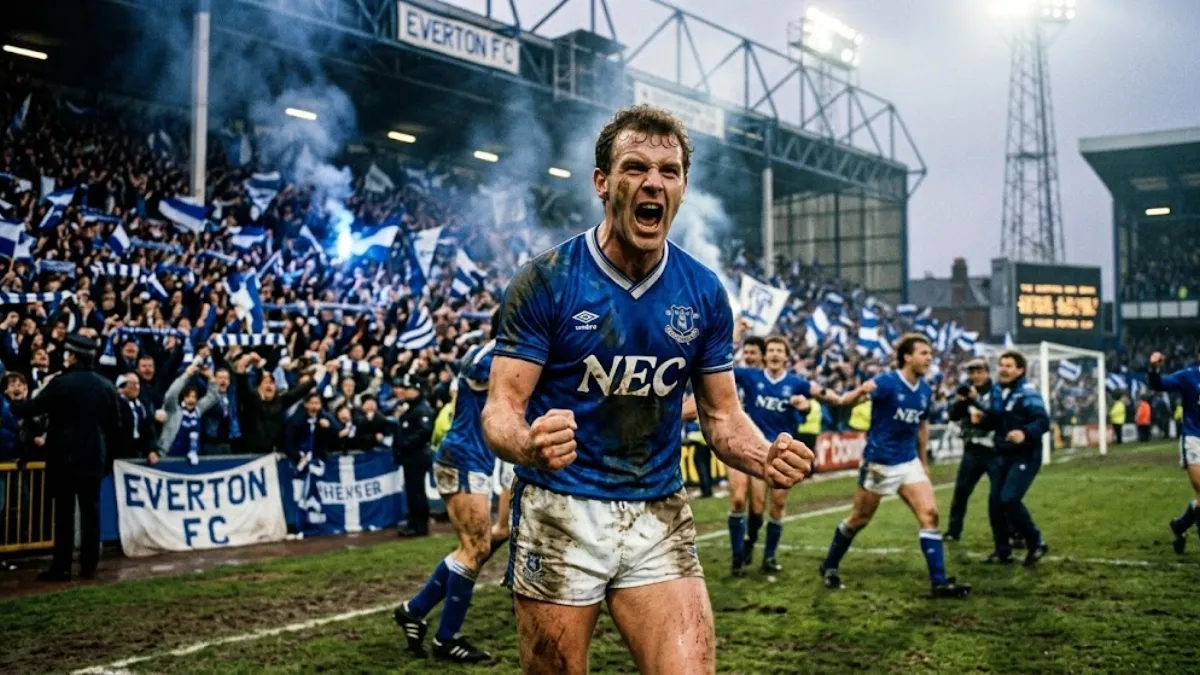
I went out onto the pitch when I really shouldn’t have, but I was asked to. They were injecting me in all different parts of my body – straight into my knee, into my stomach, anything to get me on my feet and back on the pitch. The team desperately needed me, – Andy Gray
In that same match in February 1985, the electrifying atmosphere at Goodison Park saw Everton secure a decisive victory against Watford. Gary Stevens scored a brace, while Trevor Steven and Kevin Sheedy added to the scoreline, propelling the Toffees towards a historic season that would see them crowned champions of England and conquerors of the Cup Winners' Cup.
However, the player who celebrated each of those four goals with the most fervour was none other than the central figure of the team, Andy Gray. His jubilant celebrations involved more than just a customary pat on the back; he would leap onto his teammates, igniting a frenzy of joy across the pitch, despite the fact that he hadn’t scored a goal for Everton since September 15, 1984.
This was the essence of Andy Gray. Acquired by manager Howard Kendall for a mere £250,000, Gray's near-peak form was expected to deliver goals, dynamic playmaking, and an unquenchable thirst for victory. It was these qualities that transformed the young, developing side into much more than just the sum of its parts. With the guidance of veterans like Gray and Peter Reid, the youthful Toffees soaked up wisdom and experience, striving for glory under Kendall’s ambitious leadership.
Early ascent, injuries, and record burden
Before moving to Goodison Park in November 1983, Gray's promising career had been marred by a string of disappointments. In 1977, he showcased his phenomenal talent by winning both the PFA Players' Player of the Year and Young Player of the Year awards, a rare double matched later by only Cristiano Ronaldo and Gareth Bale in England.
That very season, he shared the Golden Boot as the league's top scorer with 25 goals, but soon after, a steady decline followed. His reckless playing style, characterized by his willingness to throw himself at any ball, resulted in frequent injury spells. This relentless bravery teetered into recklessness.
From 1978 onwards, Gray found himself sidelined for a quarter to a third of the matches each season. His devotion to the game became less a virtue and more a burden.
Nevertheless, in September 1979, Wolverhampton Wanderers decided to break the British transfer record by signing Gray for a staggering £1.47 million – a sum monumental for that era. It occurred at a time when the national transfer record had fallen four times in a single year. Following a breakdown in communication with Aston Villa manager Ron Saunders, Gray jumped at the opportunity.
His debut season was a success, scoring the winning goal in the League Cup final against formidable Nottingham Forest. Yet, soon he was again tagged as 'fragile' and a 'liability', netting just 24 goals in 86 league matches over the next three seasons while the Wolves slipped between divisions.
Ironically, his former club, Aston Villa, thrived during those years, clinching the league title in 1981 and the European Cup in 1982.
Finding a home by the Mersey
A true footballing rebirth awaited Gray in Liverpool. Aware that joining Everton was his last chance to reinstate himself at the top level, he fully committed himself to the team. This decision ensured his name would be etched in the legends of Goodison Park. He found a mental kinship with Liverpool akin to his Glasgow roots, where the port city's charm and shared wit made him feel at home almost instantly.
Kendall’s strategy hinged on Gray’s desire to prove his worth. Just months prior, he had signed Peter Reid from Bolton for just £60,000, another fine talent whose progress had been hampered by injuries. The young Toffees rallied around these battle-hardened veterans, whose leadership and determination inspired great achievements.
The following 19 months embodied the footballing dream for Gray. In 68 matches for the club he cherished, he secured the First Division title, the FA Cup, the European Cup Winners' Cup, and the Charity Shield, scoring 25 goals along the way.
He had a knack for scoring crucial goals. Fans will always remember his incredible header in the FA Cup quarter-final against Notts County, the decisive header in the 1984 FA Cup final against Watford, and a stunning finish in the Cup Winners' Cup final against Rapid Vienna in 1985. Among his highlights were two emphatic headers in a crucial March match against Sunderland at Goodison Park that same triumphant season.
The pinnacle of his performances was the European Cup Winners' Cup semi-final against Bayern Munich in April 1985. No other evening at the Liverpool ground resonated like that night. Trailing 1-0, the Toffees launched a remarkable assault on the German goal, with Gray providing two assists and scoring a goal himself, leading Everton to a 3-1 victory that secured their first European final. The roar of the crowd that night was unforgettable. Gray famously stated:
Everyone has that match in their memory to take with them to the grave.
For him and the 49,476 supporters present, that match was indeed the clash against Bayern.
Very few players can rival Gray’s ratio of games played to trophies won. His influence extended beyond goals, marked by his leadership, team spirit, and infectious desire to win.
Decline at the peak and eternal recognition
But the fairy tale ended abruptly. At the start of the following season, Kendall delivered troubling news in person to Gray at his home: the club had signed prolific Leicester City striker Gary Lineker for a record £800,000. Moreover, Adrian Heath also returned from injury. The manager candidly confessed that he could no longer guarantee a starting position for the veteran. This news hit hard for Gray and the fans who had grown to adore him. Supporters rallied to petition for his retention, yet to no avail – he returned to Aston Villa.
Perhaps Kendall was right: he had drained every last ounce of physical fitness and luck from Gray. Upon returning to Birmingham, he scored just five goals in 54 outings, and the club dropped out of the top tier. A stint at West Bromwich Albion followed before he secured one last Scottish title with Rangers, scoring five goals in 14 appearances, before concluding his career at Cheltenham Town.
Gray's style—rooted in aggression, self-sacrifice, and risk—inevitably led to declines. He had started his journey with Dundee United in the Scottish Cup final at just 18, making a name for himself in English fields. His international career was modest: just 20 caps and seven goals for Scotland. Despite the wealth of talent around during the years from '78 to '86, he never participated in any of the three World Cups for which Scotland qualified, a glaring oversight by the coaching staff.
Nevertheless, the Scottish striker made his mark by scoring in three different cup finals for English teams. In the 1984/85 season, he led Everton, who rose from obscurity to dethrone their mighty neighbours Liverpool and provide the city with pride during a dark period of economic and social crisis.
Gray played 68 matches for the club he loved, and that loved him in return, his journey a mix of profound lows and exhilarating highs, allowing fans to experience greatness.
