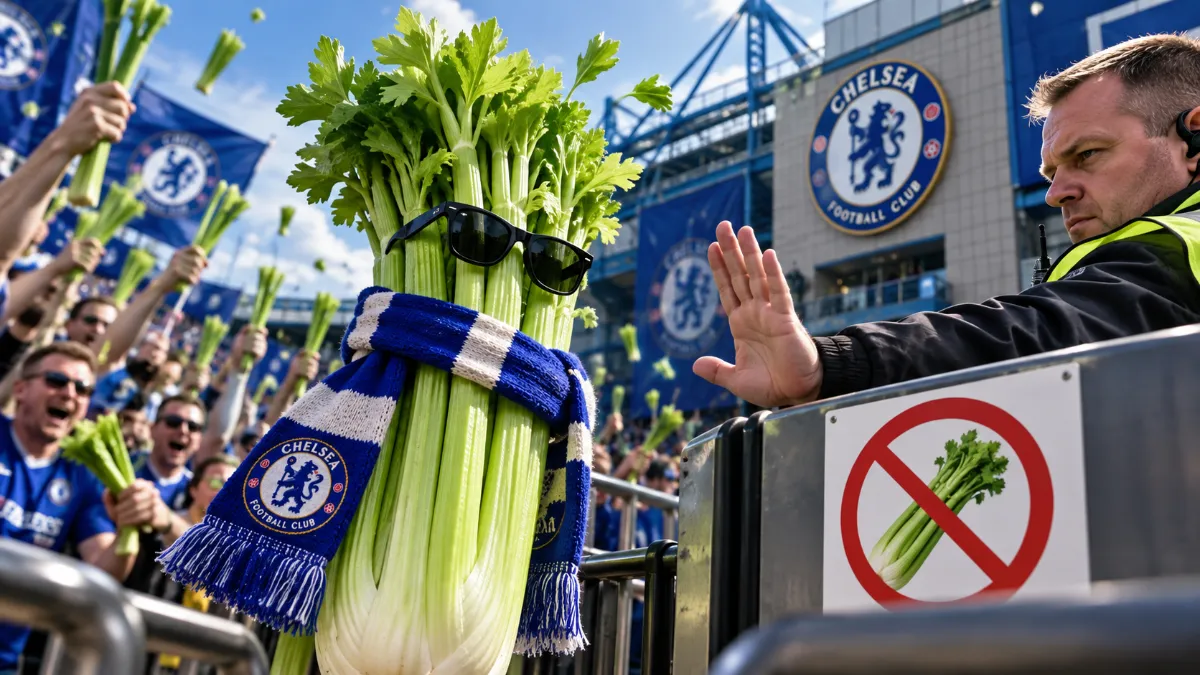
Every major club has its odd traditions, but Chelsea fans have taken it to a level where the club had to officially ban… celery. This peculiar vegetable made its way into matches, waved in the air and even flung into crowds to a ludicrous tune.
Things took a turn when the celery began landing on opposition players.
And that's when the joke wore thin.
Why celery, though?
There's no definitive answer — and that’s perhaps the best part of the story.
Celery first entered the Chelsea fan culture in the early 1980s, and by mid-decade, British media were already noting the habit of fans bringing it to matches and hurling it from the stands. The origins of this curious tradition remain shrouded in mystery, with the true history uncertain.
One popular theory traces back to an old London pub song, Ask Old Brown To Tea, which featured celery and a rather daft gag about how it could be used for “tickling” someone.
In the early 80s, Chas Hodges from the duo Chas & Dave recorded a version of the song. According to the popular fan narrative, famous Chelsea supporter Mick Greenaway obtained a cassette during a club trip to Sweden in 1981, played it incessantly, and eventually the tune made its way to the terraces. It’s a charming tale and plausible too, though evidence for this specific origin is scant, with older fans recounting alternative stories.
What happened next is typical of football terraces when a decent song emerges.
The lyrics were simplified.
And the song was turned into a bit of an absurdity.
Thus emerged the infamous "Celery" chant — short, raucous, and so utterly mindless that it fit perfectly into the English football atmosphere.
Following a series of cries of “Celery!”, the line followed: “If she don’t come, I’ll tickle her bum” — “If she doesn’t come, I’ll tickle her bum… with celery.” Yes, that’s right. The entire fan anthem revolved around an utterly silly sexual innuendo involving a vegetable. This chant was firmly embedded in British media by the 1990s.
An ode to vegetable madness
Singing alone proved insufficient.
Fans began bringing actual celery.
At home games, away days, in pubs, on trains — it was held aloft, passed around, broken into pieces, and thrown above the crowd.
From the outside, it resembled an agricultural version of pyrotechnics.
The tradition gained particular flair during large away trips. Ahead of the 1998 Cup Winners' Cup final in Stockholm, a group of Chelsea fans famously cleared out a local greengrocer’s stock of celery. About 50 English supporters sat in a square, belting out Ten Men Went to Mow before simultaneously jumping up to create a massive green confetti moment. Swedish onlookers initially regarded it as a collective madness.
Eventually, they couldn’t help but laugh and even applaud. Years later, Chelsea would recount this story in fan memories of Stockholm.
The celery in court
The issue lay in the fact that things were funny only as long as the vegetables were flying among friends.
However, when it started landing on unsuspecting heads, the humour suddenly shifted.
In 2002, three Chelsea fans were removed from the stands during an FA Cup semi-final against Fulham. The charge itself deserves a spot in an English football museum — they were apprehended for “throwing celery without lawful excuse.”
Yes, that actually happened.
In the end, magistrates decided on merely issuing good behaviour warnings, acknowledging the peaceful atmosphere of the match and the fact that the celery hadn’t directly reached the pitch.
But the hint went over the fans’ heads.
The final straw was Arsenal
On 25 February 2007, Chelsea faced Arsenal in the League Cup final in Cardiff.
Arsenal players complained that during corner kicks in the first half, they were pelted with celery. Two additional officials noted the flying vegetables in reports from other Chelsea matches.

This led to an investigation by the Football Association.
In March, Chelsea declared: enough is enough.
The club officially warned fans that celery was henceforth banned from Stamford Bridge. Anyone found with suspicious greenery might not be permitted entry, and throwing it risked a ban.
In their statement, the club reminded fans that throwing objects at a football match is a criminal offence.
Even when that object is celery.
The most amusing part came next.
Chelsea provided fans with a phone number to report anyone spotted with the banned vegetable, assuring confidentiality for callers.
Picture England in 2007.
— Hello, Chelsea security service?
— Yes.
— There’s a bloke with celery here.
Vegetable banned, tradition persists
The funniest thing? Celery remained, despite the ban.
While it was no longer allowed to be thrown on the pitch, as a symbol of old Chelsea fandom, it didn’t just disappear.
In 2012, Florent Malouda, reminiscing about the title parade following the Champions League triumph, specifically mentioned the London streets and celery. During the 2015 title parade, Didier Drogba was even spotted on an open-top bus with a bunch in hand, tossing celery into the crowd, much to the delight of photographers.

Thus, the club made a journey from “bring celery to the stadium — we might not let you in” to Drogba gleefully launching the very vegetable into the crowd during the celebrations.


And perhaps therein lies the charm of enduring football traditions.
No one really remembers who first came up with this nonsense.
But forty years on, everyone knows: if celery is flying down the streets of west London, there’s a good chance Chelsea are celebrating somewhere nearby.