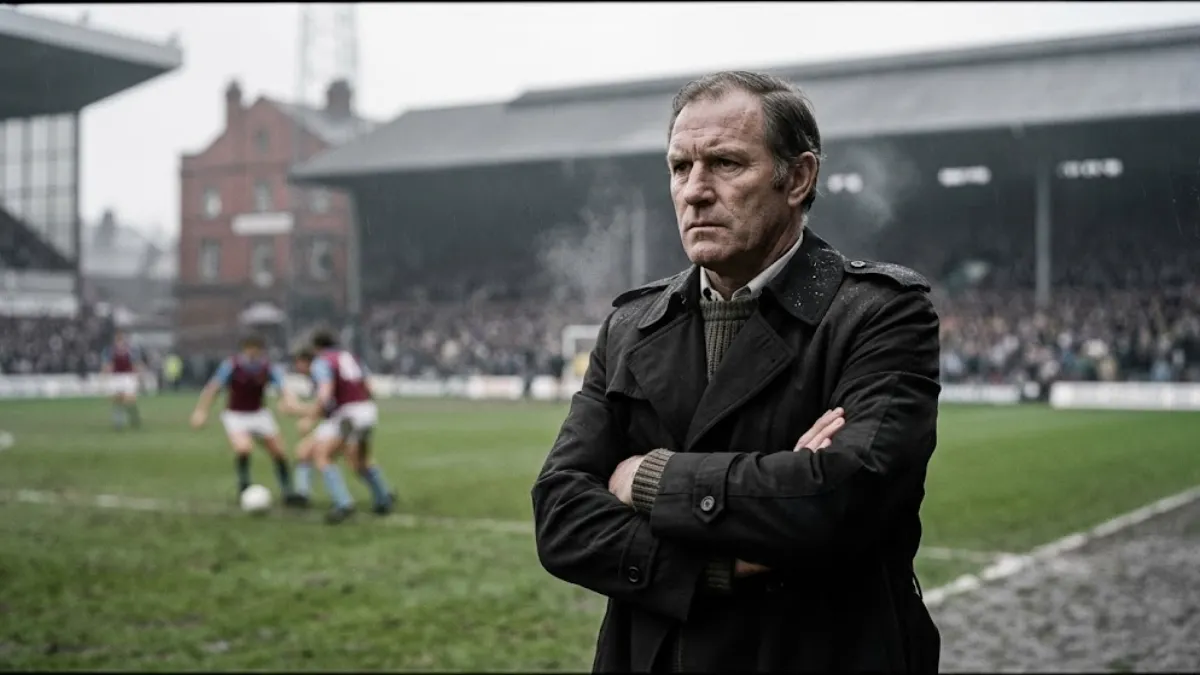
To truly grasp the dramatic events that shook Aston Villa throughout the 1980s, one must look back a full decade to the early 1970s.
Under the stewardship of Tommy Docherty, the Birmingham club faced its first-ever descent into the third tier of English football. The team endured a long and arduous struggle for survival, only making their way back to the old Second Division in 1972, thanks to pivotal signings like Ian Ross, Chris Nicholl, and Ray Graydon.
This year marked a turning point for several reasons. The club proudly opened its new training ground at Bodymoor Heath, and the youth team, featuring emerging talents like Bryan Little and John Gidman, claimed the prestigious Youth Cup. It seemed the club was robustly on the path to long-term success.
However, the journey to the 1980s proved to be much more winding. Once it became clear that Crow had reached his limit, the club brought in a specialist who would become the driving force behind all club processes for an entire decade.
Ron Saunders' iron will: revolution on and off the pitch
This man was Ron Saunders, a monumental figure who defined life at Villa Park from 1974 to 1984. By 1975, he had triumphantly returned Aston Villa to the top flight of English football, orchestrating an incredible final run that saw the team secure 19 points out of a possible 20. To top it off, Saunders led the club to a League Cup victory, defeating Norwich City in the final at Wembley, making him a national hero in the eyes of the fans.
On the pitch, he established a bold playing model that, in retrospect, was more innovative than it was perceived at the time. He implemented a tactical scheme of 4-3-1-2, positioning the tireless Bryan Little just behind two strikers. This tactical maneuver allowed Little to net 24 goals during the 1974/75 season.
Meanwhile, off the pitch, Saunders was pushing for complete control over club affairs. He clashed with the then-chairman Doug Ellis, who was opposed to this absolute authority.
A critical tipping point came when Saunders secretly signed Frank Carrodus behind Ellis’ back. Lines were drawn, and amid sporting triumphs and behind-the-scenes struggles, the outcome became inevitable: Ellis was forced out by the end of 1975.
Saunders never hesitated when it came to conducting a ruthless squad overhaul, regardless of past glories. A prime example was the dramatic League Cup final against Everton in 1977, which was decided in a third replay. Captain and trusted ally Chris Nicholl scored the decisive goal, but was unceremoniously shown the door immediately after, as were many others who had contributed to the club’s success.
Saunders cleared the deck for new heights, setting his sights on far more than a mere national cup. By the summer of 1981, only Dennis Mortimer and Gordon Cowans remained from that celebrated 1977 squad, with the latter not even starting in that memorable Wembley match.
Fans expected shrewd Scottish striker Andy Gray to lead the line, but the manager had other ideas. After joining from Dundee United, Gray became a revelation with 29 goals in the 1976/77 season, earning him the unique double of PFA Player of the Year and Young Player of the Year. However, Saunders personally forbade him from flying to London for the awards ceremony, a move that felt hypocritical given that the manager had previously interrupted a post-season trip to the Caribbean to collect his own Manager of the Year trophy.
Though Gray maintained his composure, tensions boiled over after a UEFA Cup tie against Barcelona in 1976 when the manager publicly accused him of feigning injury and betraying the team’s interests. Their working relationship began to fracture, and as key players like Ken McNaught, Jimmy Rimmer, Allan Evans, and Tony Morley joined the squad, Gray’s days at Villa Park were numbered.
The golden triumph of fourteen: conquering English football
By September 1979, Gray had left Birmingham, and as the 1980s approached, Aston Villa found themselves in dire straits for forwards. The formidable attacking trio of Gray, Little, and Deehan disbanded almost overnight: Gray was gone, John Deehan was sold to West Bromwich Albion, and Bryan Little was sidelined by a series of serious injuries, shocking fans with a transfer request to local rivals Birmingham City.
Ultimately, Little stayed, but neither he nor promising youth Gary Shaw were the target men the manager desperately needed.
Saunders attempted to acquire Mick Ferguson from Coventry City, while chief scout Tony Barton urged the signing of the incredibly young Ian Rush. Neither option panned out, and by summer 1980, the club opted for Peter Withe, who would prove to be the missing piece in the championship puzzle.
Having previously finished eighth and seventh in the First Division, few predicted that Aston Villa would clinch their first title since 1910 during the 1980/81 campaign.
Gary Shaw’s rise with five goals in August set the tone for the entire season. The arrival of Withe perfectly linked the attack, providing space for Shaw and the electrifying Tony Morley. The latter scored a goal against Everton that was hailed as the goal of the year by Match of the Day, later celebrating with an audacious two-finger gesture towards his own bench.
Behind the attacking trio lay an unbreakable spine rarely seen in club history: Mortimer, Des Bremner, and Cowans in the middle; the granite central defensive duo of Evans and McNaught; and the wall that was Jimmy Rimmer in goal.
The journey to glory wasn’t without its obstacles: the team was eliminated from the League Cup by modest Cambridge United and lost three times to the brilliant Ipswich Town under Bobby Robson. Their third defeat at Villa Park led to Saunders' famous challenge:
“You want to place a bet against us, do you?”
His intuition proved correct: Ipswich faltered during the run-in, winning just once in five matches, and even a defeat to Arsenal at Highbury on the final day did not prevent the title from being secured—largely thanks to a slip-up from a competitor against Middlesbrough, where Bosko Jankovic bagged a brace. Saunders climbed to the pinnacle of English football, utilising an astonishingly tight squad of just 14 players throughout the marathon.
The mutiny on the ship and Tony Barton's Rotterdam fairytale
However, the victor was not content to rest on his laurels. In the summer of 1981, the club made one signing, Andy Blair, leading the manager to go to war with the board, openly accusing them of misusing funds. His arguments were solid: entrance to European competitions had brought in £540,000, and they received a similar amount in insurance payouts following Bryan Little’s premature retirement.
The situation reached boiling point when West Midlands police launched a large-scale investigation into financial irregularities surrounding the construction of the North Stand at Villa Park.
A dramatic climax came during a volatile board meeting in February 1982. Saunders lost the bureaucratic skirmish: chairman Ron Bendall notified the manager of the premature termination of his three-year contract. Effectively, he was fired but given a delay. To the horror of players and the stands, Saunders immediately resigned and, as an act of exquisite revenge, took the managerial helm at St. Andrews with bitter rivals Birmingham City.
His departure amid a title defence seemed madness, especially as Aston Villa were embarking on their maiden European Cup adventure. Under Saunders, the English club had comfortably dispatched Icelandic side Valur and broken through the Iron Curtain, eliminating Berlin’s Dynamo.
Successor Tony Barton, a former scout, solidified their position in the quarter-finals against Dynamo Kyiv, convincing the board to appoint him on a permanent basis. The semi-final against Belgian side Anderlecht was marred by crowd troubles, but Villa held firm, thanks to a crucial goal from Tony Morley at Villa Park (1-0 on aggregate) and advanced to the final, where they faced fearsome Bayern Munich.
The final in Rotterdam quickly entered the annals of football history. Just nine minutes in, veteran Jimmy Rimmer suffered a neck injury and had to hand the gloves to inexperienced stand-in Nigel Spink. The young goalkeeper produced a series of remarkable saves, thwarting Bayern's relentless attacks alongside the steel-like partnership of McNaught and Evans.
And on the 67th minute, Peter Withe converted Morley's cross, forever etching the club’s name among the European Cup winners. Just a decade separated the team from the indignity of third division.
In the summer of 1982, while the World Cup echoed in Spain, only two players from the new European kings made the squad. Withe played precisely zero minutes for England, while defender Allan Evans featured for Scotland in the opening match against New Zealand but never returned to the pitch. Fierce competition and the conservatism of national team coaches relegated Shaw, Morley, Mortimer, McNaught, and Bremner to the sidelines, understandably fostering their frustration.
The return of 'Deadly Doug' and the Italian lesson
Meanwhile, a significant revenge was underway in Birmingham: businessman Doug Ellis was methodically preparing his return to power. Frustrated that the greatest triumphs of the club had occurred without him, the executive declared it his sacred mission to save the organisation from a debt of £1.8 million. Ellis' return would shape the club's destiny for the rest of the decade.
The 1982/83 season turned into a grueling slog across six competitions. The excessive burden drained the team; the players looked fatigued in one competition after putting in a shift in another. This was exacerbated by Barton’s inability to carve out a distinct managerial style and Ellis’ reluctance to spend in the transfer market.
A loss in Tokyo to Uruguayan side Peñarol in the Intercontinental Cup was somewhat offset by winning the European Super Cup against Barcelona (who were without the injured Diego Maradona). However, domestically, the club meekly finished sixth.
Barton never escaped Saunders' shadow, and the final nail in both eras came in the quarter-finals of the Champions Cup against Juventus. The Italian giant—featuring six members of the World Cup-winning team of 1982, as well as Michel Platini and Zbigniew Boniek—delivered a harsh lesson in tactical and technical superiority to the English side.
Gary Shaw later lamented that, even as he left the pitch, he continued to catch whiffs of expensive perfume from Claudio Gentile. The benchmark set by Saunders became unattainable for Barton's reign—Villa would not return to the prestigious European tournament until 2024, a whopping 42 years later.
By the 1983/84 season, Barton was on shaky ground: many believed Ellis retained the manager purely for his compliance and manageability. The man who had guided the team to its crowning heights faced the dire fate of witnessing the catastrophic collapse.
Barton secured minor signings from the board, ranging from the unremarkable Steve Foster to promising Steve McMahon, but ultimately failed to instil a coherent philosophy within the squad.
The club was beset by bad luck. During pre-season training, Cowans suffered a severe leg break, followed by Gary Shaw sustaining knee injuries that kept him out for most of the season, preventing him from returning to his previous formidable form.
Simultaneously, the golden team was being progressively dismantled. Not all departures seemed justified, and the sale of crowd favourite Tony Morley to arch-rivals West Bromwich hit fans hard.
While all the strings were pulled by Ellis, the public backlash fell squarely on Barton. Dismissing the manager marked the end of the glorious chapter in their history. This tragedy extended to Barton’s life; after managing Northampton Town in the fourth division briefly, he sadly passed away at just 56 years old.
Chaos and shattered hopes: the descent into the Second Division
The 1984/85 season began with the search for a crisis manager, but the position at Villa Park became a role many established specialists avoided. Ron Atkinson, David Platt, and Kit Symons all turned down the offer. Desperate to find a respected figure, Ellis unexpectedly handed the reins to young Graham Turner, who had previously managed modest Shrewsbury Town.
The coach insisted to the press on his complete independence, but his appointment seemed the perfect opportunity for the chairman to personally intervene in sporting matters.
Turner lacked authority among the experienced veterans. In a centre of the storm, the manager admitted his defeat. The chairman advocated for rejuvenation in the squad, bringing in promising newcomers Martin Kionn and Steve Hodge, in addition to local academy talents—Tony Dorigo, Mark Walters, and Tony Daley.
The most striking and somber symbol of the era was the bewildered captain Dennis Mortimer, who lifted the modest Birmingham Senior Cup for Villa's reserves—exactly three years after that triumphant final in Rotterdam.
To understand the nature of what was happening, one must appreciate the habits of Doug Ellis, nicknamed “Deadly Doug.” The executive justified decisions as business necessities, but long-serving club secretary Steve Stride astutely remarked that the chairman could not resist any transfer deal.
These chaotic transfers undermined the coaching staff's efforts. After selling Morley, the club parted ways with Paul Rideout, who scored 15 goals that season, offloading him to Italian side Bari. Steve Hodge was brought in as a pairing with McMahon, but McMahon was sold off at a profit straight away; when an enticing offer arrived for ageing Peter Withe, he was let go, only to be replaced by an ageing Andy Gray. The lack of strategic vision plunged the recent European champions into a morass of managerial confusion.
In the 1985/86 season, Turner narrowly escaped being sacked. The situation was saved by a deep run in the League Cup and the appointment of veteran Ron Wylie as senior coach. In came midfielders Andy Blair and Steve Hunt, but the league campaign concluded disgracefully in 16th place. Their cup fairytale turned into a nightmare when the team sensationally exited in the semi-finals to understated Oxford United. The fall into the abyss became inevitable.
Five defeats in the first six matches of the 1986/87 season sealed Turner’s fate. Tasked with salvaging the situation was the authoritative Scottish manager Billy McNeill. However, halting the runaway train would prove insurmountable.
Gary Shaw met new arrival Harry Thompson at training with the bitter remark:
“You’re a bit late, big man.”
The club was engulfed in anarchy. McNeill ultimately lost control entirely; the climax of this chaos came when three players were sent off in a match against Southampton, and an abysmal stretch of just two wins in 21 matches ensued. An attempt to secure survival with the signing of 19-year-old forward Warren Aspinall from Everton merely highlighted the prevailing panic. Aston Villa crashed out of the top flight—precisely five years after conquering the summit of Europe.
Rising from the ashes: Graham Taylor's mission
In the summer of 1987, Graham Taylor, who had earned a brilliant reputation managing Watford, took on the task of clearing the ashes. Assuming the role of the highest-paid manager in club history, the forthright coach described the current state of affairs as chaotic.
Taylor became the miraculous cure that the club desperately needed. He was the first person since Saunders to rein in the self-important Ellis. The manager played the game with greater finesse than his predecessor: adeptly appealing to the chairman’s vanity while establishing an iron discipline within the locker room.
The 1987/88 season was all about total overhaul. Taylor utilised 26 players, with key figures being powerful striker Alan McInally and the mid-season signing of future England captain David Platt.
The team was inconsistent but managed to clinch promotion on the decisive day, drawing away against Swindon Town, missing the first place to a resurgent Millwall. Taylor transformed the squad. For the first time in years, the atmosphere around the ground brimmed with the scent of hope and the grandeur of past triumphs from 1981-1982.
The return to the First Division in the 1988/89 season proved tough: the club hovered just above the relegation zone, winning only twice in the last 15 matches. However, Taylor had earned enough trust for fans to look upon discussions of generational change with acceptance.
There were reasons for optimism: McInally and Platt combined for 37 goals in all competitions, while the addition of defender Derek Mountfield solidified the defence. In Birmingham, a robust core had finally formed.
As the tumultuous decade came to a close, Aston Villa managed to catch its breath. The club regained its status as a full-fledged competitor in the elite, led by a strong manager and a hungry squad, promising supporters a significantly less stormy 1990s.
Does the relegation five years after winning the European Cup diminish that great accomplishment? Absolutely not. Was this failure a shock? Undoubtedly. Could the catastrophe have been averted with sound leadership? Quite possibly. Football is cyclical, and Aston Villa's turbulent saga of the 1980s serves as an illustrative historical lesson.
