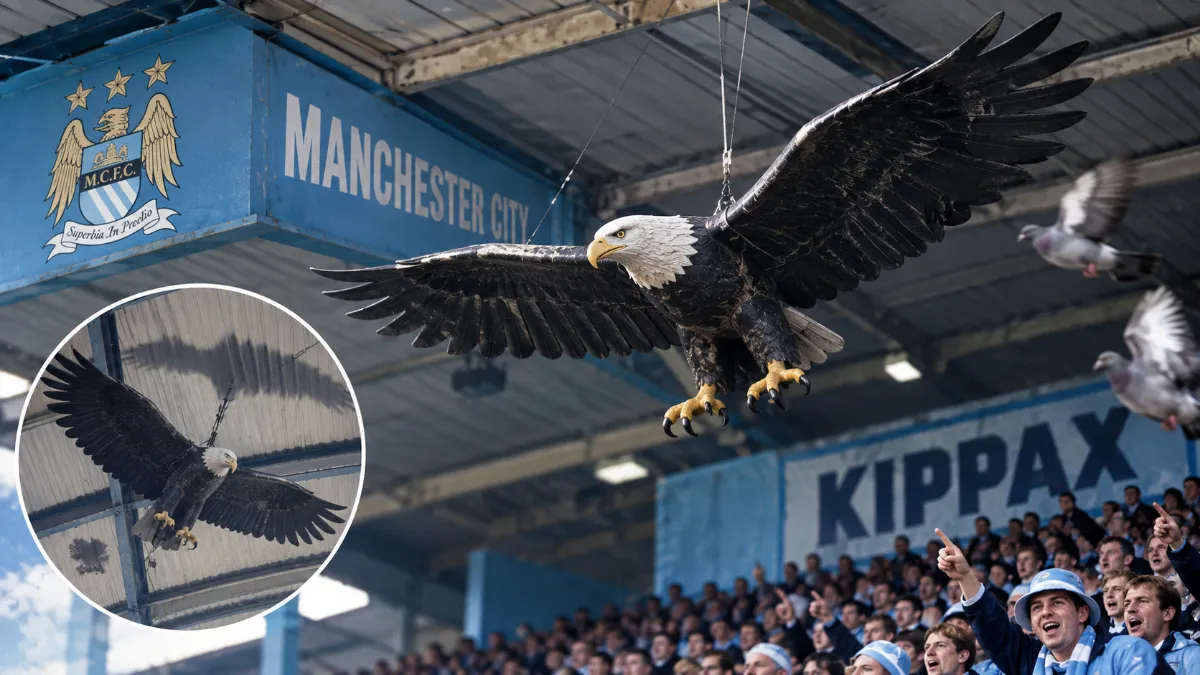
At Manchester City's revamped Kippax stand, a rather surprising issue has emerged — an influx of pigeons. To shield their fans from this feathered nuisance, the club has taken a rather novel approach by hanging a plastic eagle from the roof. Supporters have embraced their new mascot, giving it names and weaving it into the rich tapestry of Main Road folklore.
The old Main Road was replete with legendary quirks. The boisterous Kippax, temporary seating, peculiar nicknames, and passionate fan rituals painted a vibrant picture.
Yet, perhaps one of the most absurd additions was this oversized plastic eagle perched above the stands.
This eagle's purpose wasn’t for aesthetics.
Its role was to combat the pigeon problem.
After the Kippax was remodelled in the 1990s, a cosy home for the birds was created under the expansive new roof.
For the pigeons, it was ideal.
Warm.
Dry.
High up.
For the fans below, however, it was a far less delightful experience.
The issue was decidedly down-to-earth: the birds took residence and made a mess on the supporters.
In response, the club chose a straightforward solution.
They hung a plastic predator.
A large plastic eagle.
The assumption was simple: the pigeons would catch sight of this formidable silhouette and opt for somewhere less daunting.
Whether it worked flawlessly remains a mystery.
However, this eagle quickly gained a reputation of its own.
Fans began affixing nicknames, with 'Eddie the Eagle' among the most beloved.
Another popular choice was 'Hudson Hawk'.
What started as a mere deterrent transformed into a cherished part of Main Road lore.
This quirky significance highlights the charm of the old English stadiums compared to their modern counterparts.
Today, every detail of a new arena is scrutinised by designers, marketers, and architects.
Back in the day, however, things were far simpler.
Faced with a problem, the solution was handled on the ground.
Pigeons bothering the fans?
Just hang a plastic eagle.
Over time, the supporters would create their own legends around it.
Strangely enough, superstitions started to emerge surrounding the bird.
Some fans associated its presence with positive streaks for the team.
Others simply embraced the eagle as a part of Kippax's character.
It hung there through match after match, season after season.
It never held any official status.
Yet that made it all the more distinctly 'Main Road'.
The stadium was a medley of peculiarities.
Constantly undergoing renovations.
New sections added to old.
Temporary structures would pop up.
Some seats were exposed to the elements.
Others were soaked in rain.
And above one of the stands dangled a plastic predator, aimed at guarding fans from pigeon droppings.
When Manchester City left Main Road in 2003, they took with them an entire slice of this somewhat whimsical folklore.
Yet, the story of the eagle lives on.
Not the most fearsome symbol in the club’s history.
But perhaps one of the most practical.
It didn’t guard the goals.
It didn’t bring home trophies.
And it certainly wasn’t real.
It simply tried to ensure that Manchester City supporters had a pleasant matchday experience.