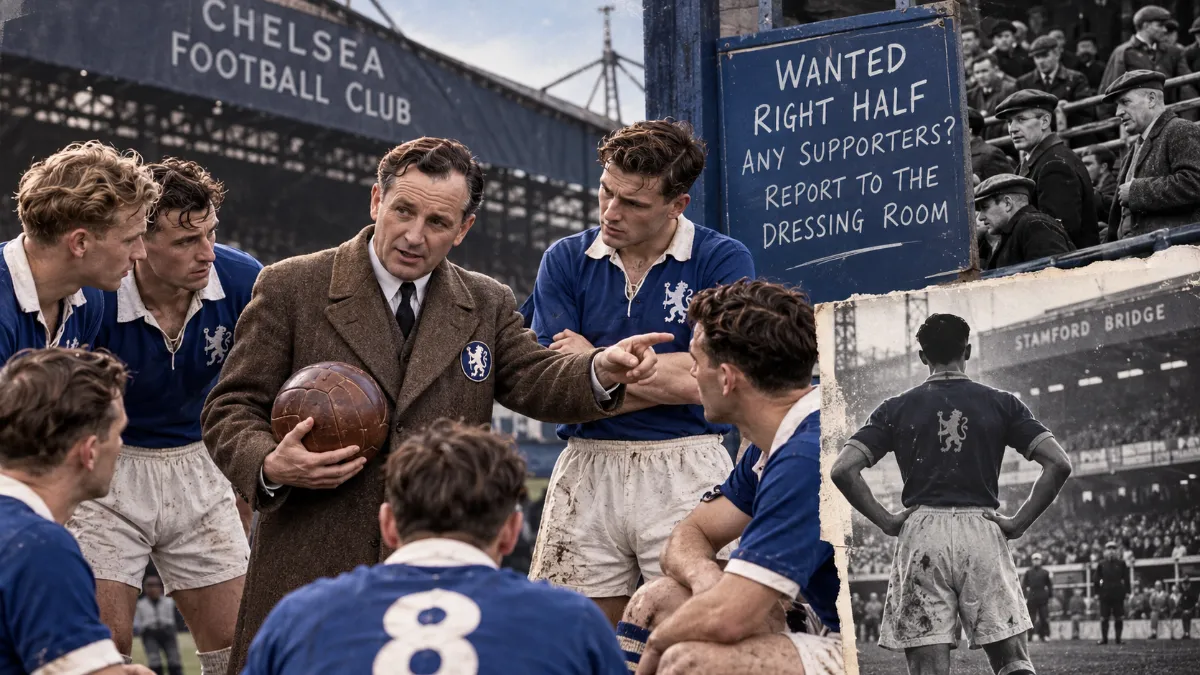
During World War II, Chelsea sometimes had to confirm their lineup just hours before a match. Players were serving in the army, working in military factories, and might simply not get a release.
On one such occasion at Stamford Bridge, a young man appeared claiming:
I'm a player from Motherwell. I can help.
After a quick check, it turned out he was listed as a registered player.
He was handed a kit.
However, just moments after the starting whistle, it became clear that Chelsea had been seriously duped...
War football operated under wild rules
With the outbreak of war, the regular English league was halted.
Regional competitions took its place, and players were allowed to temporarily play for other clubs if their military service took them far from home.
This meant squads turned into a patchwork.
One minute you'd be a Liverpool player.
The next, you're sent down south by the army.
On Saturday, you're free and suddenly playing for Chelsea.
During the war years, the likes of Matt Busby, Joe Mercer, Billy Liddell, and George Hardwick strutted their stuff on Stamford Bridge this way.
However, not every time did a star turn up; sometimes, someone just off the street would show up.
Sometimes they looked for players among the spectators
At the time, Chelsea's manager was Billy Birrell.
A typical Saturday for him might unfold like this:
Thirty minutes before kickoff.
One player stuck on duty.
Another denied leave.
A third one entirely missing.
There was no one to play.
In such cases, a notice board at Stamford Bridge might read:
Urgent. Is there a right winger in the crowd? Please come to the changing room.
Yes.
A professional football club might actually look for players in the crowd just half an hour before the match.
And once, the perfect candidate replied
The young lad claimed he was from Motherwell.
This sounded plausible to Birrell.
As a Scotsman himself, he knew Scottish players well, and during the war, they frequently found themselves in varied locations.
The club quickly verified his details.
Indeed, such a player existed.
Everything checked out.
They told him to come back the next day in case he was needed.
And he was needed.
The first warning sign – the shirt
Before the match, Birrell entered the changing room.
He glanced at the newcomer.
And felt a twinge of concern.
There he was, with his shirt sticking out over his shorts.
According to the coach's recollections, at that moment he thought the lad looked like someone who had only ever seen football boots in a shop window.
But there was no turning back.
There were no other players.
He had to field him.
The first touch confirmed all suspicions
The match began.
The ball found its way to the new Chelsea player.
He attempted to do something.
And Birrell realised right away:
This wasn’t a Motherwell player.
In fact, it seemed he wasn’t a footballer at all.
Later, the coach remarked that the new lad's very first kick confirmed all his fears. Fans quickly noticed that one of their blue-shirted players was significantly lacking in skill compared to the rest.
Laughter erupted.
But he continued to play.
Because essentially, there was no one to replace him.
A genius tactical plan emerged at half-time
Birrell gathered the team in the changing room.
Just picture that tactical discussion.
No playing down the wing.
Shut off the spaces.
Move the ball faster.
And most importantly:
Do not pass to him anymore!
This wasn't because he was struggling to get into the match.
Or that he was tired.
No, it was because he was a complete imposter.
And the plan worked quite well.
The Chelsea players simply pretended their teammate didn't exist.
Until one player forgot...
In the second half, someone unwittingly passed him the ball.
The fraud prepared to control it.
And couldn't even stop it.
The stadium erupted in laughter.
According to Birrell's memories, this drew one of the loudest reactions of the entire match.
Probably at that moment, it became painfully clear to even the person seated in the last row.
The best part – he even got paid
For participating in war matches, the invited footballer was entitled to 30 shillings.
So it turned out to be a brilliant scheme.
You walk into Stamford Bridge.
You claim to be a professional player.
They believe you.
You get to play for Chelsea.
You can’t kick a ball to save your life.
Your team stops passing to you.
You get your money.
And you walk away.
Modern-day agents just came a bit too late!
Who was this mysterious player?
The most unfortunate part is that history has left us without the name of this intriguing character.
In Birrell's tales, he remains simply the young man who seized the chaos of war football and somehow slipped through a superficial vetting.
We don’t even know whether he was a fan, a casual player, an ordinary adventurer, or just someone who saw the notice and thought:
Why not?
Nevertheless, he got his match for Chelsea.
Even if his teammates had to specifically agree not to pass to him at half-time.
And this perfectly illustrates wartime football
Back then, such episodes could only happen because no one had a clue who would take the field until the last minute.
A match could see someone like future Manchester United manager Matt Busby emerge.
On another, the captain of the England national team.
And then suddenly a random guy rocks up, claiming to be a Motherwell player, and gets handed a shirt.
One thing’s certain though – Matt Busby could play!