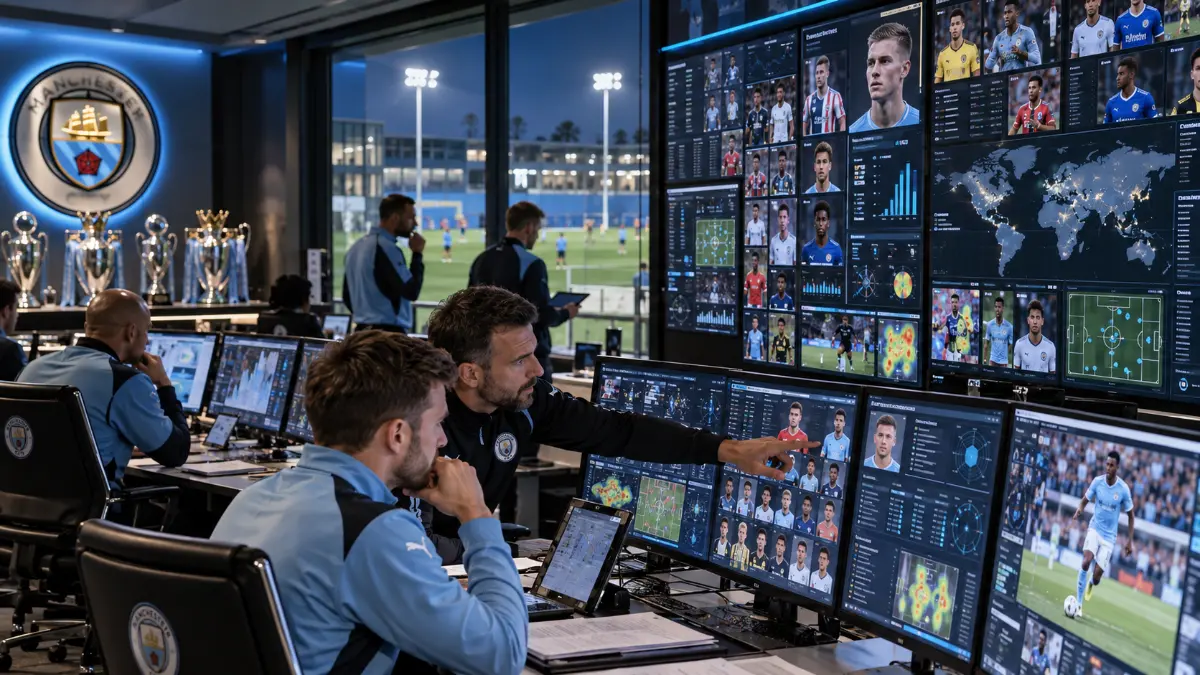
Manchester City are using a sophisticated data analytics system to discover players, reduce transfer risks, and prepare for future squad refreshes.
The club has access to a database of around 650,000 players globally, but crucially, it is the club's experts and scouts who ultimately make the final decisions on transfers, not algorithms.
BBC Sport were granted unprecedented access to City’s internal workings, revealing how the club has adjusted their squad following their treble triumph in 2023.
What does it take to win?
At the heart of Manchester City's analytics department lies a simple question: what does the team need to succeed?
The process consists of three key stages:
- Identifying suitable players;
- Assessing their current performance;
- Determining the player’s potential to develop at Manchester City.
The club evaluates players across various dimensions: skills, attributes, the current playing system, and the demands of the manager.
After this, analysts seek to establish not just how good a player is now but how much they could improve after joining City.
From 650,000 players to a handful of candidates
The initial pool of around 650,000 players is significant. When the club identifies a position and the profile of the required player, analytical filters narrow down the list to approximately 20 to 50 candidates.
For example, City categorise full-backs into three types: defensive, those who drift infield, and those who play high and wide.
The analytics list then undergoes cross-referencing with traditional scouting, usually revealing substantial overlap between the two lists.
Subsequent analysis further narrows the candidate list to about six.
Next, specialists examine injury history, physical metrics, and behavioural traits of the players.
The outcome is an acquisition pack—a detailed report on each potential signing.
Even obvious transfers undergo scrutiny
A prime example is the transfer of Elliott Anderson from Nottingham Forest.
At first glance, the 23-year-old English midfielder seemed like a natural fit for a club of City’s stature. However, his stats initially didn’t jump off the page, enough to elevate him into main transfer targets.
The issue lay in Forest’s playing style.
They often played in transition and didn’t dominate possession like Manchester City do. Consequently, Anderson had fewer opportunities to showcase his talents in the final third.
Analysts modelled his potential role within a team that maintains possession and operates closer to the opponent’s goal.
Ultimately, the additional data, combined with insights from scouts and club specialists, reassured City that the transfer held low risk.
The club paid around £116 million for Anderson.
How the system helped find Alvarez
Another illustrative case is Julian Alvarez.
Initially recommended by scouts, the analytics department then delved deeper into his performance metrics.
Given that the Argentine league doesn’t rank among the top five European leagues, the standard evaluation model limited his assessment. As a result, City conducted further analyses on his influence in games and outcomes for River Plate.
The club concluded that Alvarez was capable of becoming a key player for a top-half team in one of Europe’s major leagues within approximately two and a half years.
Despite the model valuing him between £26 million and £40 million, City purchased the forward for roughly £14 million.
In 2024, Alvarez was sold to Atletico Madrid for £81 million.
Husanov wasn’t even in the top 50 initially
A similar narrative unfolded with Abdulkodir Husanov.
The defender didn’t initially make the top 50 candidates for Manchester City. However, further analysis revealed impressive physical attributes, particularly his ability to cover significant distances.
Yet, Husanov needed improvements in his ball control.
After joining City in January 2025, his performance in this area reportedly saw significant improvement.
Doku demonstrated another analytical impact
In the selection of Jeremy Doku, the system played a crucial role.
Pep Guardiola was keen on securing a direct winger capable of attacking space and taking on defenders. Key criteria included:
- Entries into the penalty area;
- Ball recoveries post-pressing;
- Successful dribbling percentage;
- Pressure applied on the opponent in their half.
Doku met most of these requirements.
However, his entries into the penalty area were initially one of his weaker metrics. Post-transfer to City, improvements were observed in this aspect—offering a prime example of how analytics not only identifies players but also aids in their development.
Data doesn’t replace scouts
City’s director of football, Txiki Begiristain, emphasises that data forms only one part of the broader decision-making process.
“Data plays a role in decision-making, but it’s just one piece of the overall picture.”
According to Begiristain, statistics cannot fully assess a player’s character, mentality, or behaviour.
“That’s why we study the data, but we rely on the experience of our scouts and other professionals.”
It’s this combination of both approaches that empowers the club to make informed decisions.
City anticipates sale moments
The analytical system is not solely for acquisitions.
The club monitors the performance of its players and can identify declining trends two to three years before actual sales.
This proactive approach helps in determining when a player needs replacing, thus facilitating the decision on whether to fill the gap with an academy product or a new signing.
This methodology has enabled City to effectively conduct a major squad overhaul following their treble-winning campaign in 2023.
Only four players remain after the treble
The Manchester City squad has evolved considerably over recent years. From the team that secured the treble in 2023, just four players remain.
Key figures such as Kevin De Bruyne, Kyle Walker, Riyad Mahrez, and Ilkay Gundogan have departed.
Nevertheless, the club used data to foresee the natural decline of certain players and prepare the next generation.
A primary aim has been to lower the average age of the squad without sacrificing their ability to compete for titles.
The new generation is ready to compete
According to club data, Manchester City now possess the third youngest squad in the Premier League, behind Newcastle and Chelsea.
Simultaneously, the team has acquired seasoned players at the highest level, including Gianluigi Donnarumma, Marc Guehi, Enzo Fernandez, and Elliott Anderson.
City’s analytical model suggests the current squad will reach its peak level in about two to three years.
The club believes that they are already capable of challenging for the championship title.