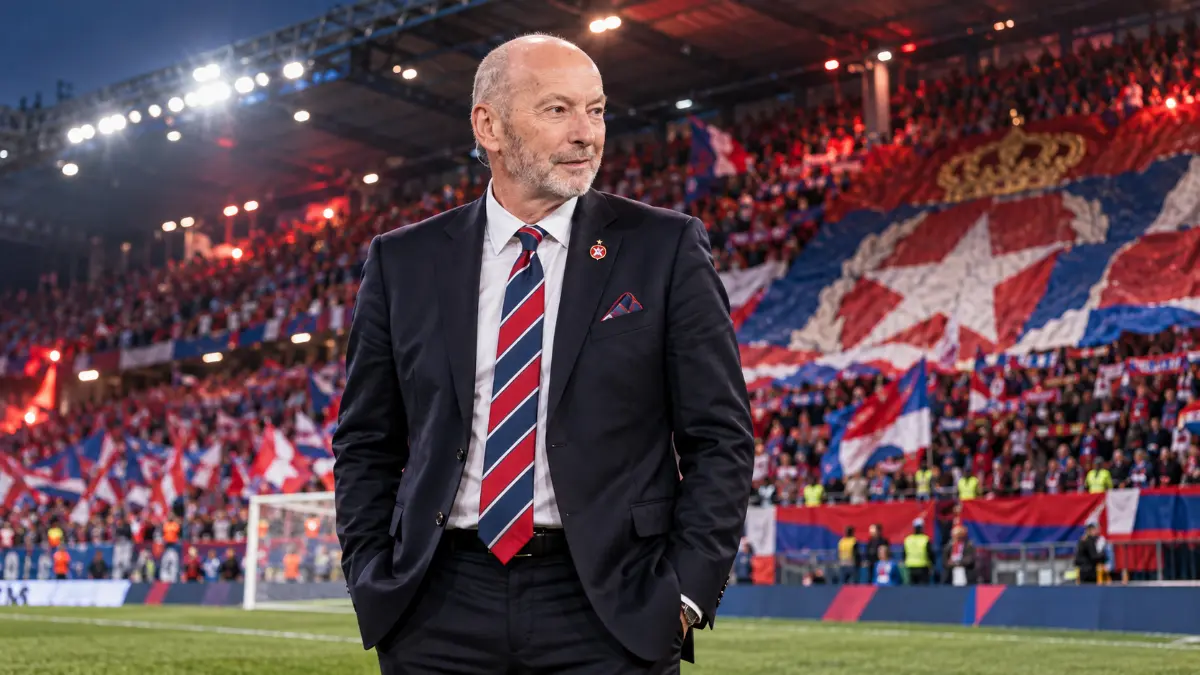
Former Liverpool Chief Executive Peter Moore has discussed his time at the Merseyside club, Jurgen Klopp's legacy, the challenges facing Arne Slot, potential changes in Liverpool's ownership structure, and his new role at Polish club Wisla.
Moore spoke at the Portugal Football Summit and subsequently gave a detailed interview to Flashscore.
Klopp understood Liverpool
According to Moore, Klopp's success hinged on his deep understanding of the club's culture and the expectations of its supporters.
"For me, Jurgen understood Liverpool. What do I mean? He understood the supporters. He knew the style of football they wanted to see."
Moore emphasised that Klopp continued a long-standing tradition at the club — playing intense, entertaining football.
He linked this philosophy to the legacy of Bill Shankly, who promoted the 'pass and move' approach, highlighting legendary players like Ian Rush, Kenny Dalglish, John Barnes, Robbie Fowler, Steven Gerrard, Luis Suarez, and Fernando Torres.
"Jurgen was the ideal coach and created a team that could play just like that. It was an intense style, and the training had to match that level of intensity."
Under Klopp's management, Liverpool won the Champions League in 2019 and claimed their first league title in 30 years in 2020.
Moore on Slot's challenging second season
Turning to Liverpool's current state, Moore shared that he now views the club purely from a fan's perspective.
"I'm just a fan. I’ve never met Arne Slot. Aside from Alisson, Joe Gomez, and Virgil van Dijk, I've never met this team."
Moore noted that Slot managed to take over after Klopp and clinched the championship title right away.
However, his second season proved to be considerably tougher.
"It was very hard to fill Jurgen's shoes, but Arne did that. He played a style reminiscent of the past, with the players he had, and we won the league."
Moore suggested that issues could arise if fans lose faith in the head coach.
"Unfortunately, at Liverpool, when the supporters lose faith in a manager, it is very hard for him to regain it."
He also highlighted the unique bond Liverpool fans have with their managers.
"We become more attached to our managers than our players. They become legends for us."
What’s happening with Amazon and potential ownership changes?
On the topic of reported investments tied to Amazon and Jeff Bezos, Moore expressed his thoughts.
He pointed out that the arrival of a major investor acquiring a significant stake in the club naturally raises questions about future ownership structure.
"You don't buy such a percentage for billions without some pathway to full ownership."
That said, Moore was sceptical about Bezos being the driving force behind this narrative.
"The Amazon story is a bit amusing because Jeff Bezos has hundreds of investments. He has never once mentioned Liverpool."
Moore acknowledged Amit Bhatia, associated with an investment group and a long-time figure linked to Queens Park Rangers.
"He is a football person; he loves the game."
Moore added that mutual acquaintances had recently met with Bhatia and spoke positively of his football approach, highlighting him as a figure to watch concerning Liverpool's future.
Moore on the multi-club model
The former Liverpool chief also discussed the evolution of multi-club structures.
He explained that the model allows for player movement between clubs, loans, knowledge exchange, shared operational resources, and the transfer of specialists within the system.
However, Moore doubts whether such a model always justifies the significant financial investments.
Regarding FSG, he noted that the group had brought Michael Edwards back with an eye on acquiring another club.
"FSG are very, very experienced investors. If they don’t see the benefit of purchasing another football club and the synergy with Liverpool, they will say it’s not worth their time."
How football has changed in the USA
Moore, who moved from the UK to the USA in the 1970s, recalled a time when football was primarily viewed as an immigrant's game.
He mentioned coaching children in Ohio as a youth and later working with Reebok.
Moore highlighted the pivotal moment that the 1994 World Cup represented, prompting the USA to commit to establishing a professional league, which led to the formation of Major League Soccer (MLS).
He believes football is now deeply embedded in American culture.
Moore pointed out the impact of Premier League broadcasts, the 'Welcome to Wrexham' and 'Ted Lasso' series, as well as streaming platforms.
"There isn’t a league in the world that I can’t watch."
Why Moore ended up at Wisla
Moore is currently a co-owner of Polish side Wisla Krakow.
He described how his involvement with the club began unexpectedly through a partnership with a video game developer in Krakow.
The developer introduced him to Wisla's owner, Jaroslaw Krulewski. Moore started advising the club’s management, leading to his ownership stake.
"Next thing he said was that he wanted me to become an advisor, and I had a stake in the club. We like that."
Moore shared his impressions of the atmosphere at Wisla matches.
He likened Polish football to the one from the 1970s and 1980s, filled with pyrotechnics, banners, and passionate support.
"This is football in its most primal sense, and I love that."
However, he noted that the supporters' culture has become more family-friendly and organized.
Moore pointed out that matches often see families in attendance, and among the active supporters are doctors, lawyers, and dentists.