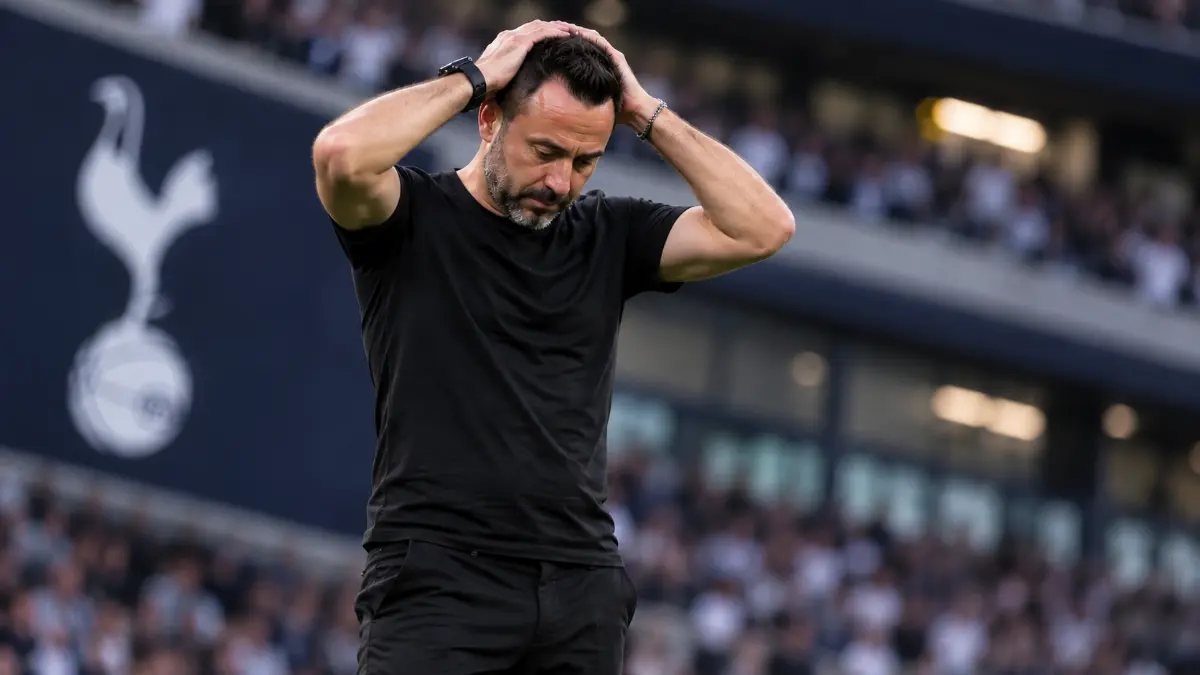
Tottenham are back where they least wanted to be. Following a 3-2 defeat at the hands of Aston Villa, Roberto De Zerbi's side has plummeted into the relegation zone. With only two points, two goals scored, and no wins in the Premier League after five matches, the situation is grim.
For a club that splashed over £300 million on a squad overhaul in the summer, this dismal start is particularly alarming. The issues facing Tottenham extend beyond mere results; doubts are rising over whether De Zerbi's tactical philosophy suits this squad and if he can turn things around quickly enough.
From saviour to scapegoat
De Zerbi took charge at Tottenham in March 2026, stepping into a club in dire need of salvation. After managing to stave off relegation, he was handed the reins to rebuild the team in the summer.
The financial commitment was substantial, bringing in players like Sandro Tonali, Mateus Fernandes, Savio, Omar Marmoush, Mykhailo Mudryk, and Jan-Paul van Hecke to London.
The plan seemed straightforward: with a fresh manager and a revamped squad aimed at a full pre-season, the team that narrowly avoided relegation would be transformed into a competitive outfit.
However, the opposite appears to be happening.
After five games, Tottenham sit on zero wins, with two draws and three defeats—their goal difference now standing at 2-8. This dire form has led to one burning question: is the problem with the adaptation of new players, or is De Zerbi failing to implement his vision effectively?
1. Too many new signings at once
A major factor in Tottenham's struggles could be the scale of the squad transformation.
With a significant portion of the squad changed over the summer, the new players need time to gel, adapt to the manager's demands, and cope with the rigours of Premier League football.
De Zerbi himself has highlighted that the team is still in the early stages of this project, frequently mentioning the late integration of some newcomers and physical issues stemming from pre-season training.
Yet, this reasoning comes with its own issue. Tottenham have already spent a fortune, and the expectation is not just to play attractive football in the future but to achieve results now.
2. The main issue is the attack
The most alarming stat early in the season isn't the number of goals conceded; it's the complete lack of scoring.
Prior to the match against Aston Villa, Tottenham hadn't netted a single goal in the league. After five matches, the team has mustered just two strikes.
Interestingly, the issue isn’t a total lack of possession or chances.
After a goalless draw with Everton, De Zerbi noted that while the team started well, they failed to shoot often enough and made poor decisions in the final third. Despite 14 attempts on goal, only one forced Jordan Pickford into a meaningful save.
This is a critical concern. While the team may control the ball and circulate it near the box, a lack of decisive action renders possession meaningless.
Thus, one of the primary criticisms of De Zerbi lies here.
3. De Zerbi's football takes time—and Tottenham have little of it
In his most fruitful periods, De Zerbi crafted teams that excelled in complex possession play, building from the back through short passes and enticing opponents into pressing.
While this system slowly bore fruit at Brighton, Tottenham's context is fundamentally different.
When a manager steps into a club teetering on the brink of relegation, the space for experimentation becomes severely limited. Any mistake in the early phase of attack can lead to dangerous counterattacks. A loss of confidence compels players to play more cautiously, and when a team struggles to score across multiple matches, the psychological pressure grows exponentially.
De Zerbi himself acknowledged a psychological block within the team after the winless streak began.
It creates a vicious cycle: complex system → mistakes → no goals → lost confidence → increased caution → further errors.
4. De Zerbi has yet to find the right balance
The match against Aston Villa particularly highlighted these issues.
Tottenham appeared competitive at times, but after conceding goals, they lost control of the match. Ultimately, they fell 3-2 at home, with late goals proving to be too little too late.
De Zerbi continues to experiment in search of the optimal player combinations.
The influx of new talent necessitates positional competition and constant adjustments to combinations.
This can be advantageous for a manager, but for a team in crisis, it spells potential trouble.
Especially when players struggle to grasp roles regarding ball progression, chance creation, and finishing.
5. Big transfers increase pressure on the manager
In the summer, Tottenham's board did everything possible to eliminate De Zerbi’s primary excuse.
He now has a new squad, talented players, ample training time, and management backing.
This means that the continuation of poor results will be directly linked to the manager.
GOAL highlighted that De Zerbi received significant support in the transfer market, with high-profile signings such as Tonali, Mateus Fernandes, Savio, Marmoush, Mudryk, and others.
The more a club invests in a manager's vision, the higher the expectations for immediate results.
Can De Zerbi be sacked?
Currently, there are no signs that Tottenham's hierarchy plans to part ways with the Italian immediately.
Before the defeat to Aston Villa, reports indicated that management was reluctant to make hasty decisions regarding the manager's job.
Moreover, De Zerbi signed a long-term deal, and the club viewed his appointment as the inception of a new project.
However, today's loss shifts the context.
Now Tottenham find themselves in the relegation zone, winless after five games, with a difficult run of fixtures ahead.
On October 10, they will travel to face Manchester United, followed by a home tie against Coventry on October 19, an away game at Chelsea on October 24, and finally a home clash against Crystal Palace on October 31.
If results continue to falter, the question of sacking De Zerbi will become increasingly serious.
Especially if there is no noticeable improvement in performance.
Why sacking him now could also be risky
Tottenham also face the opposing dilemma.
Sacking De Zerbi a few months after a major squad overhaul would virtually admit that the project has failed once again.
They would need either a manager to revamp the entire football philosophy or someone capable of working within the framework of the current squad.
Furthermore, the new manager would inherit the same players, the same injuries, and the same lack of cohesion.
This might compel management to allow De Zerbi a little more time.
Former midfielder Danny Murphy suggested before the Aston Villa match that he didn’t expect the Italian to be sacked even with a defeat, believing management would grant him time until autumn to turn things around.
However, following the 2-3 loss, the pressure has intensified.
What about the Championship?
It’s crucial not to jump to conclusions based on five matches.
Currently, Tottenham is indeed in the relegation zone: 18th place and a mere two points from five matches. However, the season has just begun, making the current standings far from definitive.
That said, alarming indicators do exist.
- Firstly, the team already battled relegation last season.
- Secondly, the new season's start has been a continuation of that crisis, rather than an improvement.
- Thirdly, the team’s scoring woes are apparent.
- Fourthly, significant money was spent in the summer, creating high expectations.
- Fifthly, the psychological pressure on the players is becoming evident.
However, there are compelling arguments suggesting that things could still improve.
With a significantly refreshed squad, De Zerbi has been equipped with players who align with his vision. If the team can finally convert chances and stabilise defensively, a string of victories could swiftly lift their league position.
Additionally, upcoming matches offer opportunities to collect points directly against relegation rivals.
As such, it is more accurate now to frame the discussion not around inevitable relegation but the real threat of repeated struggles for survival, should the current trend continue.
What will be decisive for De Zerbi
In the coming weeks, it’s crucial to monitor more than just the points tally.
There are four indicators that will reveal if Tottenham is genuinely beginning to emerge from their crisis:
1. Goals
If the team continues to struggle in front of goal, the pressure on the manager will inevitably rise.
2. Quality of chances
It's essential not just to have possession but to create real goal-scoring opportunities.
3. Reaction after conceding
Tottenham are currently losing control too often after conceding.
4. Results against direct rivals
These matches will play a pivotal role in determining the team's position in the lower half of the table.
Conclusion
The challenges De Zerbi faces at Tottenham do not stem from a singular error on his part. They are a compound of various factors: a massive squad overhaul, lack of cohesion, execution issues, injuries, psychological pressure, and the complexity of the playing style he’s attempting to instil.
Five matches in, the situation is already looking serious: Tottenham occupy 18th place, with two points and a goal difference of 2-8.
Yet, dismissing De Zerbi right now doesn't seem like a clear-cut solution. The club has heavily invested in his vision, and they still need to establish if this squad can, over the coming weeks, evolve into one that consistently collects points.
The critical question for Tottenham now is:
Is De Zerbi genuinely building a new team—or is the club on the brink of another lost season, while waiting for this squad to finally click?
We will start to find the answers in the forthcoming October fixtures.