After more than two years away from the touchline, Jurgen Klopp officially returned to management, debuting as Germany's head coach in a crucial UEFA Nations League clash against the Netherlands.
The German coach had long maintained that he might never return to the dugout. Following his emotional departure from Liverpool in May 2024 after nine demanding years at Anfield, Klopp took a role overseeing global football at Red Bull. However, after the national team's disappointing showing at the 2026 World Cup and Julian Nagelsmann's dismissal, calls came for Klopp to rescue the national side. His new four-year contract spans preparation for Euro 2028 and the 2030 World Cup, yet the immediate challenge lay in Amsterdam.
Adding an intriguing subplot to the match was the managerial duel: Xavi Hernandez was at the helm for the Netherlands, making his own debut after leaving Barcelona in May 2024. Among the Dutch starting XI were three of Klopp's former charges at Liverpool — Virgil van Dijk, Ryan Gravenberch, and Cody Gakpo.
Personnel experiments and a tough debut
Klopp surprised the German footballing community by naming a squad of 44 players; Augsburg goalkeeper Finn Dahmen was the only player slated to feature in all four autumn fixtures, with two separate groups of players preparing for the back-to-back matches. This decision allowed for the inclusion of fresh talent and aimed to prevent player burnout, although it wasn’t without its drawbacks. Jamal Musiala suffered an injury during the warm-up, while Kai Havertz exited the pitch within half an hour following a heavy challenge from Quinten Timber.
In the starting line-up, there were both historic milestones and debutants:
- Joshua Kimmich played his 115th match for the national team, surpassing Toni Kroos (114) to take seventh place in Germany’s all-time appearances;
- Philipp Troy, Freiburg’s right-back, received his first call-up and immediately contributed with a notable performance;
- On the 30-minute mark, a cross from Troy was intercepted by Jan Paul van Hecke, but the deflected ball was coolly converted by Borussia Dortmund’s Felix Nmecha, marking the first goal of a new era.
This goal sparked fierce debate, as during the attack, Brian Brobbey was down on the pitch, with the home crowd demanding the ball to be put out of play. Nonetheless, the German side pressed on within the referee's jurisdiction.
Familiar pressing and a missed victory
Prior to Havertz's enforced substitution, Klopp utilised an agile attacking model: forwards dropped deep to collect the ball (Nadiem Amiri often found himself closer to the opposition's goal), while the full-backs charged down the flanks. Karim Adeyemi and Kevin Schade led the offensive thrusts. Following Havertz's exit, Eintracht's Yunus Abnyutalib brought fortifying energy and seamless pressing to the team’s movements.
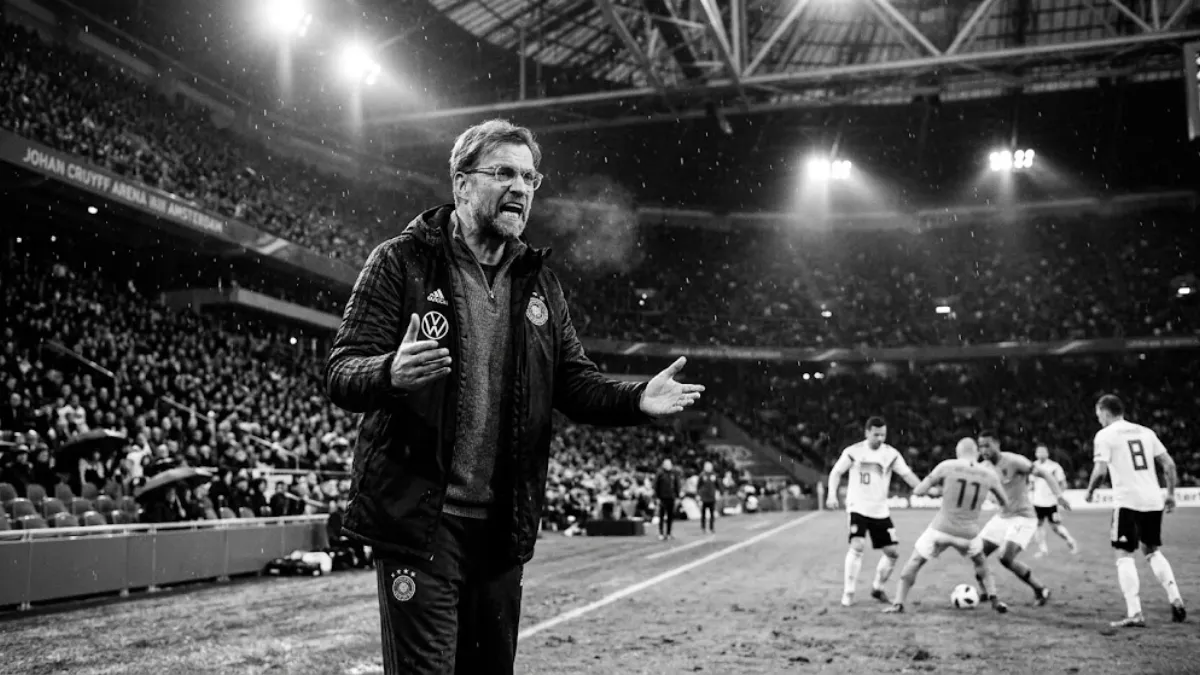
Klopp directed the game with his characteristic passion from the touchline, rallying his side into collective pressing with fervent gestures. In the first half, the German coach broke into a wide smile as he witnessed Adeyemi squander a golden chance in front of an empty net, reminiscent of his legendary reaction to Lucas Leiva’s miss in a Merseyside derby.
However, in the second half, the Dutch took control, registering 14 shots on goal compared to Germany's five (7-0 in terms of shots on target). Hernandez's team amassed an impressive 3.18 xG — Netherlands hadn’t failed to exceed 3.0 expected goals against top-30 FIFA-ranked teams since June 2019 (3.10 against England).
Such relentless pressure finally bore fruit in stoppage time: Serge Gnabry lost possession near the touchline, allowing Ruben van Bommel to dart down the left and deliver an inch-perfect cross to Gakpo, who volleyed home to level the match at 1-1. This result was a fair reflection of the contest.
I’ve been in this profession long enough to know that creating a recognisable style of play takes significantly longer than two days of working together, Klopp stated post-match. We’ve only scratched the surface; we need to dive much deeper. What’s important is that everyone felt we’re on the right path to forming a solid unit. There were plenty of encouraging signs, but in sport, results are paramount: we can’t draw the next 500 matches in a row, or I might as well return to playing padel.
Germany displayed their fighting spirit and notable commitment, something that had been lacking during the summer World Cup. Klopp's return to the managerial fold has re-energised German football, offering a robust impetus for renewal.