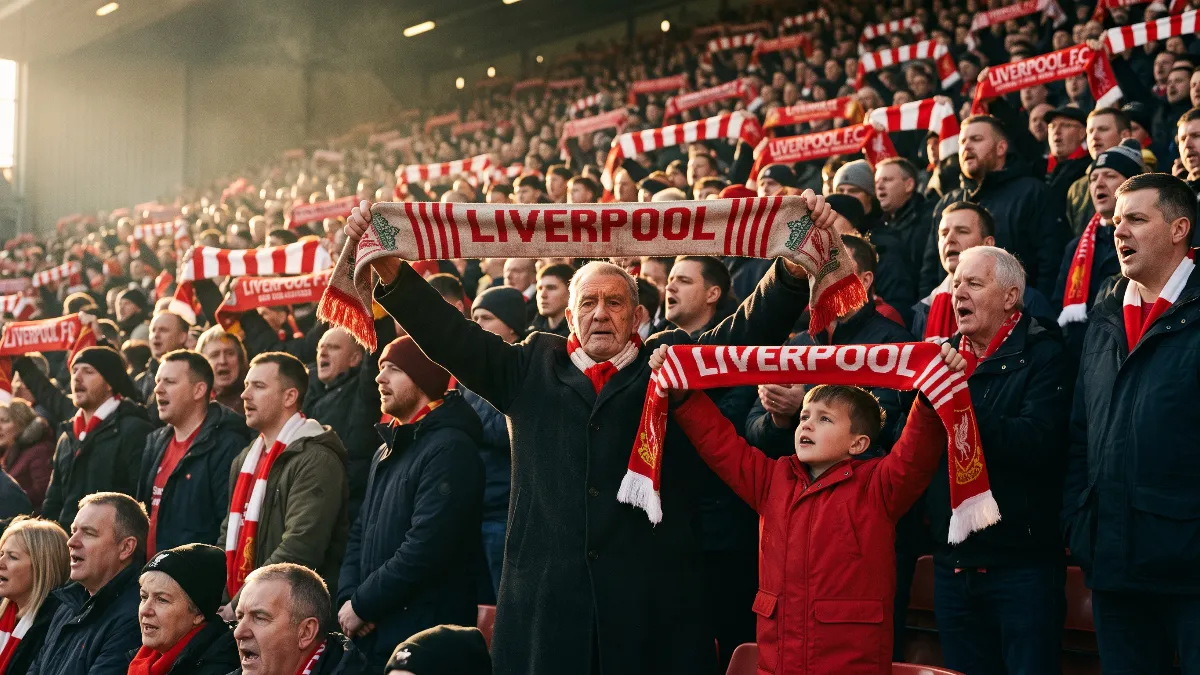
Step inside almost any stadium around the globe, and you’ll be greeted by thousands of scarves: draped around necks, pinned to railings, hoisted high above heads, and stretched across entire stands. It’s surprising to think that scarves were never originally designed as football paraphernalia. Initially, they served a practical purpose, providing warmth against the damp and chilly British winters, but over the years, club colours have transformed a simple wool accessory into a powerful symbol of club identity, tradition, and an unbreakable connection between generations.
How fans expressed their allegiance before scarves emerged
Football fans didn’t suddenly wake up one day realising that every person at the ground needed a scarf. Back in the late 19th and early 20th centuries, British stadiums already had their own methods for showcasing club loyalty: fans would pin ribbons and rosettes, wear coloured caps, and wave handkerchiefs, often accompanied by wooden rattles in their club's colours.
Context plays a vital role here, particularly in terms of contemporary fashion. Old archival photographs from British terraces reveal crowds filled with men donned in dark, formal coats, shirts, ties, and hats. Attendees looked like they were heading to a Sunday service or an official reception rather than a football match. Back then, football shirts were not available as fan attire, posing a challenge for supporters on how to stand out in a sea of similar dark tones.
Colour became a lifeline, with scarves perfectly suited to this role. They could be worn over day-to-day smart attire, remaining conspicuous from afar. Affordable and easy to care for, they served a practical need beyond the stadium.
The birth of the 'granny scarf'
The football calendar unfolded during the harshest winter months, with spectators spending long hours standing in exposed areas, unsheltered from rain, wind, and snow. A warm woollen scarf was a saviour during those dreary evenings.
As clubs began to associate themselves with specific colours, fans started knitting scarves in those shades. Thus, the phenomenon known as the 'granny scarf' emerged. The early versions of this fan gear bore little resemblance to mass-produced items. Mothers and grandmas crafted them at home, using basic knitting techniques — simple banners of alternating colours, devoid of logos or intricate patterns.
A hand-knitted scarf evolved from being a mere item to a cherished family heirloom, holding the warmth of home, memories of first matches, and connections to loved ones. These treasured pieces were preserved for decades and passed down through generations: a father would take his son to the same terrace where he once stood, with the same family scarf draped around the boy’s neck in the club's unwavering colours.
Evolution from stripes to club logos
The first documented instances of fans wearing traditional striped scarves date back to the 1930s. Archive footage from 1934, showing a cup match between Arsenal and Crystal Palace at Highbury, clearly features a supporter sporting a classic striped scarf. By January 1951, scarves had become even more personalised; during a match at Highbury against Carlisle United, a fan was photographed with a scarf embroidered with the names of his favourite Arsenal players.
By the 1960s, clubs recognised the tremendous potential of this trend. Hand-made production gave way to the British textile industry, with factories in Nottinghamshire and Leicestershire beginning the mass manufacture of fan merchandise. Even in the 1960s, Manchester United began featuring their Red Devil mascot on match programmes and scarves, several years before this iconic symbol officially appeared on the club crest in 1970.
A breakthrough in technology occurred in 1978 when jacquard knitting machines were adapted to weave emblems directly into the fabric. Manchester United immediately ordered a batch of 25,000 pieces, followed by Liverpool, Everton, and Arsenal. The industry then witnessed explosive growth, leading to scarves adorned with intricate designs, team names, and detailed emblems. By the early 1980s, the tradition had crossed over into continental Europe, becoming a cornerstone of fan visual aesthetics in Spain, France, Germany (Bayern Munich, Borussia Dortmund, Schalke), and the ultra movement in Italy. Later, the trend even took root in the warm climate of Major League Soccer in the USA, with scarves becoming an essential part of the fan experience for D.C. United and Columbus Crew.
Protests, commemorative events, and the half-and-half scarf phenomenon
Over time, the functionality of scarves expanded; they became a megaphone for expressing opinions. In 2010, Manchester United supporters, protesting against the Glazer family, brought back the club’s historic colours of Newton Heath by donning green and yellow scarves. A memorable image showcased David Beckham exiting Old Trafford in a green and yellow scarf after a Champions League match against AC Milan. Similarly, in Spain during the celebrations for Barcelona’s 2026 championship victory, Fermín López raised a scarf inscribed with 'antimadridista' to proudly highlight club rivalry.
Scarves have also become symbols of mourning. Following the tragedy at Hillsborough in 1989, fans laid scarves from hundreds of clubs across the gates at Shankly. In July 2025, when Liverpool forward Diogo Jota and his brother Andre Silva tragically died in a car accident, football fans united at Anfield, leaving scarves from various teams as a gesture of solidarity. Likewise, scarves have linked the globe in commemorations for teams like Chapecoense in 2016 and during annual memorials for the Munich Air Disaster in Manchester in 1958.
The commercial side of scarves has also evolved, with match scarves featuring the symbols of both teams, tailored for cup finals or European outings. The fan community has voiced differing opinions over the 'half-and-half scarves', which present the colours of two rival teams. For tourists and neutral observers, these are seen as delightful mementos; however, for die-hard supporters, wearing the colours of a rival in high-stakes games like Liverpool vs Everton or Arsenal vs Chelsea is deemed unacceptable.
The strength of the stands and a multi-million-pound industry
The true visual power of scarves is unveiled during collective chants in the stands. When tens of thousands of fans raise their stretched scarves high above their heads while singing 'You’ll Never Walk Alone' at Anfield or during Borussia Dortmund’s legendary 'Yellow Wall', the stadium transforms into a monolithic sea of club colours.
Today, merchandise sales are raking in millions for football giants, with revenues surging into the hundreds of millions of euros. According to UEFA’s financial report on club finances for the financial year 2025, the European leaders in merchandise sales are as follows:
- Barcelona – 277 million euros
- Real Madrid – 231 million euros
- Bayern Munich – 189 million euros
- Manchester United – 172 million euros
- Arsenal – 151 million euros
- Liverpool – 148 million euros
- Tottenham – 102 million euros
- Galatasaray – 99 million euros
- Chelsea – 95 million euros
- Paris Saint-Germain / Manchester City – 88 million euros
The scarf has journeyed from a humble woollen item that shielded supporters from the biting English wind to a sacred emblem. While its material has remained largely unchanged over the century, its meaning has evolved: beginning as simple apparel, it has become a powerful symbol of belonging to the football family.
