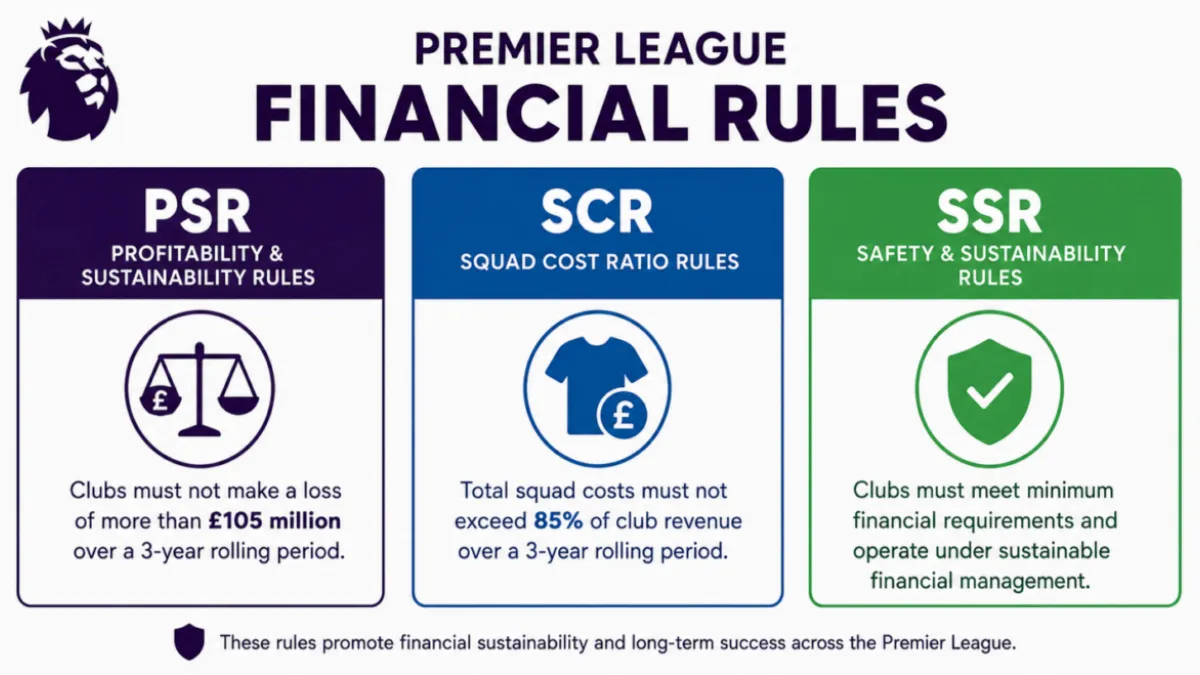
The English Premier League has officially moved on from the old regulations of profitability and sustainability (PSR), ushering in a new era defined by the SCR (Squad-Cost Ratio).
What is SCR?
SCR is a fresh system of financial control that links a club's expenses on its first team to its overall income.
- The calculation formula is straightforward: squad expenses are divided by adjusted income and multiplied by 100%.
- Squad expenses encompass player and manager wages, transfer amortisation, agent fees, and write-offs due to injuries or player devaluation. Notably, costs for youth academies, women's teams, infrastructure, and off-pitch staff are excluded from this total.
- Adjusted income includes revenues from ticket sales, broadcasting rights, commercial deals, player transfers, and income from hosting non-football events at the stadium (such as concerts).
- Limits: the standard threshold in the Premier League is set at 85% of income. Clubs participating in UEFA tournaments face a stricter limitation of 70%.
Key differences between SCR and PSR
Unlike PSR, which imposed a fixed loss limit of £105 million over three years, SCR offers a more flexible and responsive framework.
- Income linkage: clubs with higher earnings can spend more in absolute terms.
- Single-season assessment: the cycle of three years has been scrapped, eliminating the risk of one poor financial year adversely affecting clubs for multiple seasons.
- Buffer zone: clubs benefit from an updated buffer of 30%. In the inaugural season, they can spend up to 115% of their income, but exceeding the 85% threshold results in a financial penalty, while sports sanctions (like points deductions) apply only when surpassing the 115% limit.
Who stands to gain from the new regulation?
Clubs with modern multifunctional venues, such as Tottenham, are likely to reap the most benefits, as hosting concerts and other sporting events directly boosts their adjusted income.
Conversely, teams like Newcastle and Aston Villa may find it challenging to make significant financial leaps funded by their owners, as their spending is strictly confined to current commercial revenue levels.