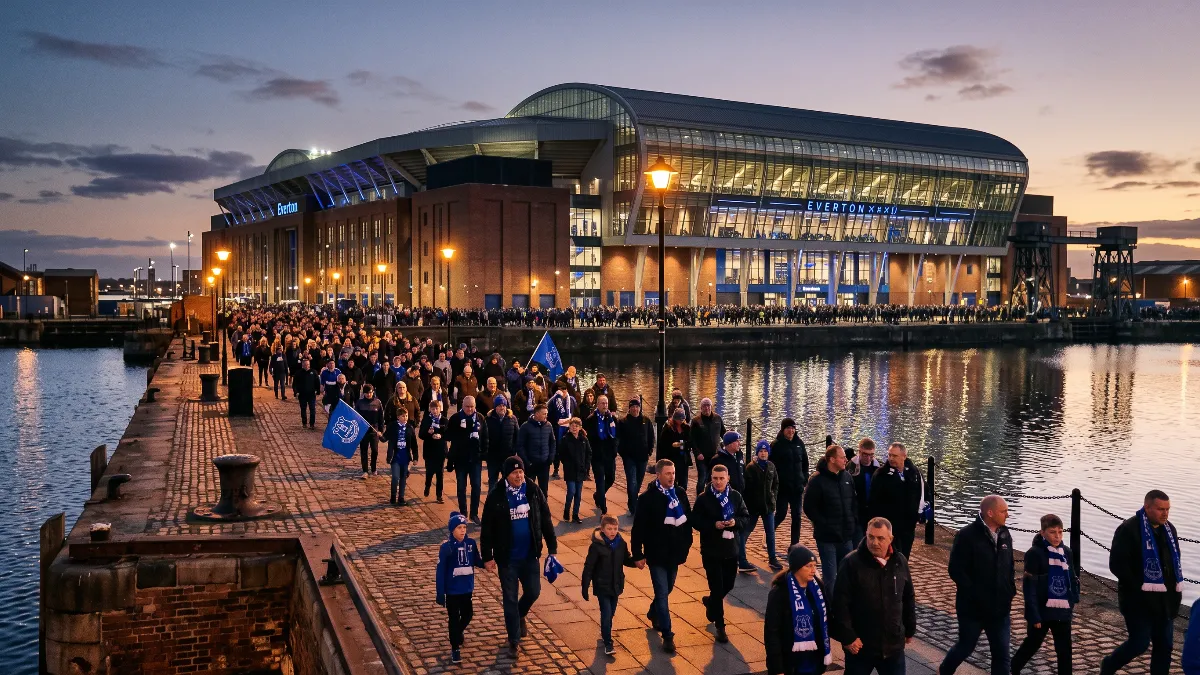
Less than two years after Everton came under The Friedkin Group's control, the American owners have announced their willingness to consider selling the controlling stake in the club.
The company's official statement underlines:
The Friedkin Group is exploring new investment options for Everton Football Club, including a potential sale of the controlling stake. Owners will only negotiate with parties capable of advancing the club and will continue to provide full support to Everton throughout the process.
This wording leaves room for various outcomes: a direct sale of control, bringing in a minority investor, or maintaining the status quo if a worthy offer doesn't emerge.
Why the club is more attractive than in 2024
The key difference between the current situation and the negotiations of 2024 is the fully completed and operational state-of-the-art stadium on the waterfront, boasting a capacity of 52,888. The venue is already generating steady revenue from ticket sales and commercial areas. In March 2025, the club secured a long-term refinancing deal worth £350 million, optimising the loan structure taken out for construction.
While debts remain, they are now manageable. The 2024 deal was valued at over £400 million, but the current asking price has not been disclosed. Any potential new investor will need to clearly differentiate between the value of the shares, debt obligations, and the budget for squad development.
Below are the key candidates and investment models poised to enter the race for the club.
1. John Textor: a removed barrier and longstanding interest
The American businessman publicly attempted to acquire Everton in 2024, but at the time, his 43% stake in Crystal Palace hindered the process. In July 2025, Eagle Football sold that stake to Woody Johnson, completely removing any conflict of interest within the Premier League. However, Textor will need to provide strict funding guarantees, as in March 2026, Eagle Football disclosed details of its agreements with creditors Ares and Michel Kang, meaning Textor's project will be assessed on real liquidity rather than just his longstanding affection for the club.
2. The consortium of Andy Bell and George Downing
This duo of British businessmen and lifelong Everton supporters submitted a detailed proposal in 2024 with the backing of respected partners. Their enormous advantage is a flawless understanding of the club's values and the trust of the fans. However, emotional investment alone won't be enough; the consortium will need to update its model around the refinanced stadium and prove partners are ready to fund transfers.
3. The consortium led by Vache Manukyan
The London financier headed a consortium in 2024 made up of Middle Eastern and American capital. At that time, the group offered around £400 million entirely through equity, firmly refusing to take on debt financing. Manukyan's name has resurfaced in the media following Friedkin's statement, although no official offer has yet been made.
4. MSP Sports Capital
MSP is already deeply integrated into Everton's infrastructure, having funded the construction of the new stadium and possessing detailed knowledge of the club's financial documentation. However, being a creditor does not equate to being an owner. To acquire control, the company would need substantial equity partners.
5. Vici Private Finance
This investment group, represented by former Everton vice-chairman Keith Harris in 2024, claimed to possess significant private funds for closing debts. However, any potential bid will require a new audit for transparency regarding the beneficiaries.
6. A new American consortium of sports franchises
This widely adopted model sees a leading investor teaming up with institutional partners (similar to the RedBird acquisition of Milan, which involved the owners of the New York Yankees). This model effectively distributes financial burdens, although it necessitates a well-balanced voting power within the hierarchy.
7. Private Middle Eastern capital
This doesn't necessarily involve sovereign wealth funds, but rather wealthy family offices, venture firms, or management structures like Bahrain's Investcorp. Such groups have colossal resources, but any project will require stringent coordination for sustainable development.
8. Multi-club ownership
Acquiring Everton as a flagship within a global football network. Here, the regulatory questions arise; UEFA's rules for the 2026/27 season strictly govern club influence and cross-ownership in European competitions. Fans will also demand clear guarantees that the Merseyside club will not become a secondary appendage in someone else's system.
9. A minority investor while retaining The Friedkin Group
The Friedkin Group isn't obliged to sell control. A path akin to the Arctos deal with PSG is possible: securing a non-controlling stake for liquidity infusion into infrastructure while keeping full strategic and sporting control in the hands of the current owners.
10. A specialised partner in stadium monetisation
This model is similar to the Sixth Street alliance with Real Madrid, where the investor injects hundreds of millions of euros in exchange for a share of revenue from non-football events, catering, and concerts at the new arena. This does not affect the sporting structure but provides an immediate financial boost.
The key challenge for any contender is the stringent Premier League regulations, where checks now extend to deals involving shares of 25% or more. The Friedkin Group has not set rigid deadlines, meaning the club will only transfer to those who can not only close the transaction but also steer it confidently into the future.