Manchester United enter the first international break of the season in a dismal emotional state, having only managed five points from five Premier League matches. A late equaliser from Matheus Cunha salvaged a point against Fulham (1-1) at Craven Cottage, but it extended the team's woeful run following disappointing results against Manchester City and Brighton.
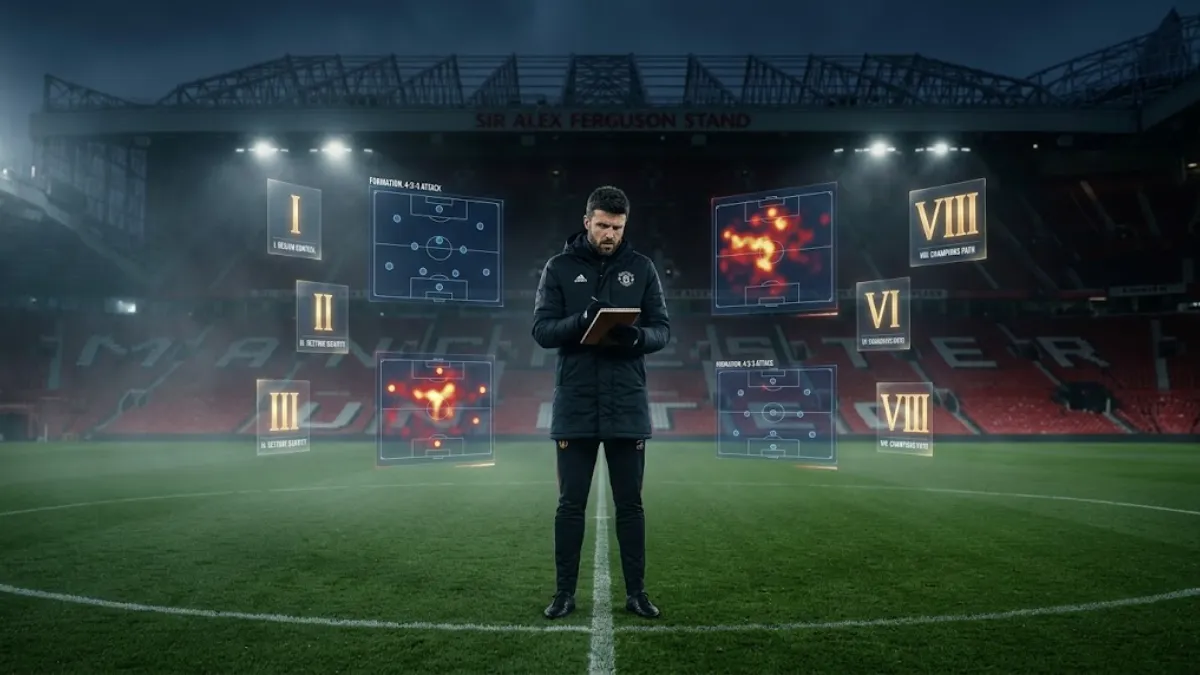
With speculation mounting regarding the future of the head coach, Michael Carrick has exactly three weeks to reshape the team ahead of their home clash against Tottenham. To steer the club back onto winning ways, the manager must tackle eight fundamental tactical challenges.
1. Regain total control in midfield
The primary issue for United in London was not a lack of desire, but a complete loss of control over the match tempo. While the team can hold possession, they fail to dictate the game's rhythm. As soon as the opposition cranks up the pace, United's midfield becomes hopelessly stretched.
This is paradoxical, given the quality players at the coaching staff's disposal:
- Bruno Fernandes remains the key creative playmaker;
- Kobbie Mainoo excels at making decisions under pressure and progressing possession;
- Youri Tielemans and Andrey Santos provide depth and variety;
- Carlos Baleba was signed from Brighton as one of the league's best disruptors.
The problem for Carrick lies in the lack of balance. In the game against Fulham, the midfield operated in isolation from the attack. When Fernandes received the ball, there were no passing options available, and the home side's midfielders pressed the United defence with ease.
This doesn’t require a revolution – a clear allocation of roles is necessary: one player needs to cover the ball line, another should slice through spaces with passes, and the third must shield the areas behind advancing full-backs. United urgently need to establish a cohesive line rather than a disjointed collection of names.
2. Establish a coherent attacking structure
Individually, United’s attacking array is bursting with talent, yet the collective pattern is unclear. Cunha prefers to drop deep for build-up play, Bryan Mbemo attacks space and drifts to the flanks, Benjamin Sesko acts as a traditional striker, while Fernandes seeks to orchestrate from the centre.
Cunha's crucial late goal highlighted a systemic issue: when the Brazilian takes up central forward positions, he must often drop back just to touch the ball. The attack becomes fluid, but the penalty area lacks bodies, and opposition centre-backs feel no pressure.
Carrick needs to implement clear rules: who holds the high line, who shifts to the flanks, who penetrates the box first, and where width comes from. The names of the attackers may rotate from match to match, but the core principles must become sacrosanct.
3. Bring Sesko back into the fold and give him trust
Benjamin Sesko’s injury severely impacted the attack in London. In his debut season, the Slovenian striker scored 12 goals across competitions, sharing the title of the team’s top scorer with Mbemo. For the 23-year-old, it’s a solid start, yet his potential as a prolific scorer remains underutilised.
Sesko cannot thrive without systematic support. He requires regular deliveries into the box, partners making runs for second balls, and geometry that showcases his athleticism. The Slovenian alters the behaviour of opposing defenders: they cannot afford to mark Cunha or Fernandes tightly, fearing a forward burst from behind.
In the upcoming fixtures, Carrick should abandon a chaotic rotation of the Slovenian for versatility. Sesko needs consistent minutes in the starting XI – he flourishes when partners instinctively understand every movement he makes.
4. Eliminate regular lapses after half-time
The painful loss of concentration in second halves has become a diagnosis. At Craven Cottage, the visitors went into the break without conceding, but fell apart after the restart. Fulham ramped up the aggression, United lost momentum, culminating in the comical own goal from Lisandro Martinez following a long-range strike from Kelvin Bassi.
The issue is not just the ricochet but the lack of initiative: team pressing broke down, possession was lost, and players simply failed to keep up with second balls. Cunha’s comments regarding a lack of energy were countered by Carrick’s insistence on a fighting spirit, recalling the late surge.
However, salvaging a draw through sheer willpower does not excuse the paralysis observed midway through the second half. The staff must address the root cause of the drop-off – is it physical fatigue, tactical passivity, or a psychological block? Manchester United cannot rely solely on heroics in added time.
5. Stop creating problems out of nothing
Seven goals scored, eight conceded, and just one victory despite a plethora of chances – that’s the summary of the first five fixtures. Against Fulham, the team registered 29 shots on goal but converted only once.
This is a typical image of a side generating plenty of noise and chaos without real control over the situation. United sometimes need to master the art of being boring. There’s no need to turn every match into a thriller.
The team desperately needs to learn how to ‘grind’ a game after scoring, control the pace, calmly circulate the ball under pressure, and eliminate errors that could flip the result. This skill will be crucial in the Champions League, where the club qualified from third place: in October, the ‘Red Devils’ face a tough away tie against Atletico Madrid. In European competitions, composure is prized above flashy attacks.
6. Bring order to defensive structures
Lisandro Martinez’s ridiculous own goal is merely the tip of the iceberg. United’s defence crumbles at the first sign of an opponent bypassing the initial wave of pressure. The gap between the lines becomes huge, exposing the centre-backs to midfield runners from the opposition.
A solid defence is the foundation of a strong attack: only when players trust their backline can they push forward boldly. Without that safety net, the attacking unit begins to look over their shoulders and act cautiously.
Carrick must definitively determine his main centre-back pairing and clearly outline the roles for the full-backs: do both advance in turn, does one slide into midfield as a ‘false full-back’, and how swiftly does a back four or five form upon losing the ball?
7. Integrate Baleba smoothly and without haste
Cameroonian holding midfielder Carlos Baleba can become a key element in the reformation, but the coach must not view him as a cure-all. The newcomer has excelled at Brighton in terms of interceptions, ball recovery, and explosive forward dribbling.
However, it’s risky to throw a new player into a mismanaged system and expect instant miracles. Baleba needs clear roles:
- Will he become a ‘cleaner’ ahead of the defenders?
- Will he free Fernandes to roam more in attack?
- Will he be responsible for the immediate transition from defence to attack?
Top-level transfers do not cure tactical ills on their own. They yield results only when the whole club system operates in harmony.
8. Use the international break for a complete reset
United have a rare opportunity for a breather: the next Premier League match isn’t until October 10, when crisis-hit Tottenham will visit Old Trafford, followed by a trip to Madrid just four days later.
Carrick shouldn’t attempt to fix everything at once. It’s sufficient to drill a few fundamental principles into his players’ heads:
- Breaking out from pressure near their own goal;
- Compactness in the central midfield triangle;
- Instant reaction and reshaping upon losing the ball;
- Basic scenario for breaking down a deep defensive block.
If Manchester United can establish a clear coordinate system in challenging moments, positive results will soon follow.