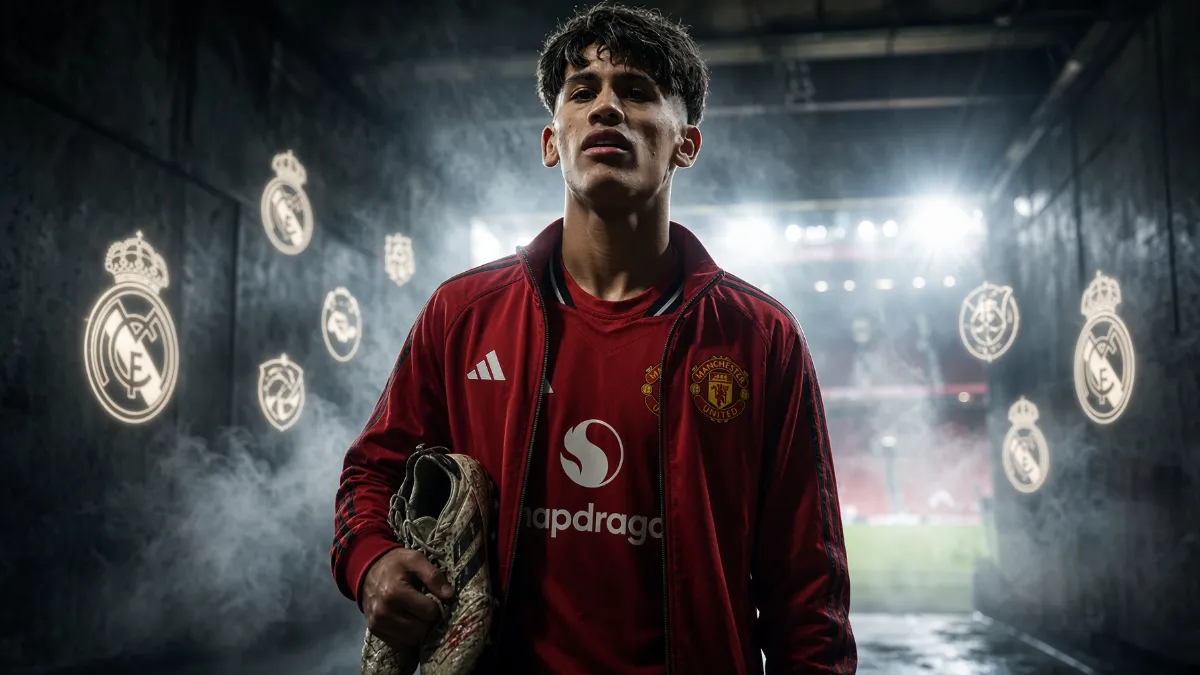
Manchester United have invested considerable resources into the development of Jay Jay Gabriel, a 15-year-old prodigy, who has now shockingly demanded a transfer just as he was on the brink of making his senior debut. This paradox has turned the situation into one of the most dramatic narratives in European football: while the club has nurtured him as a special talent, the player and his camp see the proposed pathway as a dead end.
This case is unprecedented for a teenager who has yet to play a minute at a professional level. Gabriel, who will celebrate his sixteenth birthday on 6 October, has already trained with the first team, travelled with the senior squad, participated in pre-season matches, and attracted interest from some of Europe’s biggest clubs. Real Madrid, Barcelona, Bayern Munich, and PSG are all vying for the teenager, with the Spanish giants emerging as frontrunners in the race.
No one can guarantee that Gabriel will blossom into a superstar. However, the chronicles of his rise explain why top academies across Europe are so enamoured with him.
From five million YouTube views to academy records
Gabriel rose to prominence well before his move to Manchester. At just eight years old, he was wowing audiences with his skillful footwork in football videos. A clip featuring him on YouTube in 2019 amassed over five million views, securing him the nickname 'Little Messi'.
While such hype is often bestowed on gifted youngsters following viral videos, Gabriel has backed it up with real progression:
- By the age of six, he was able to juggle a football a thousand times without a single error.
- The foundation of his dribbling was laid at the London-based Ole Futsal Academy, whose director, Alfie Brooks, has worked with around a thousand juniors and described Gabriel as the best player he has ever coached.
Futsal gifted him remarkable ball control, explosive coordination, and the ability to manipulate defenders in tight situations. His journey to the top academy was not straightforward; he had trials with QPR, Arsenal, West Ham, and Chelsea before being snapped up by Manchester United in 2022.
In Manchester, Gabriel's development accelerated rapidly. He made his under-18 debut for United against Leeds United in April 2025 at the tender age of 14 years, six months, and one day. The young striker netted a brace in a resounding 13-1 victory, becoming the youngest debutant in the club's history at that level.
There was no going back to youth teams. The following season, Gabriel scored seven goals in six starts for the U18s, prompting Ruben Amorim to integrate him into first-team training. He finished the campaign with an astonishing 20 goals in 21 matches in the Youth Premier League, earning the tournament’s Best Player award and becoming the youngest winner of the prestigious Jimmy Murphy trophy for best young player, joining the likes of Ryan Giggs, Paul Scholes, Marcus Rashford, and Kobbie Mainoo.
More than just technique: how United crafted the perfect striker
Gabriel's appeal extends beyond simple goal scoring. His standout trait is his perfect two-footedness. The lad strikes and assists with equal comfort on both feet, advancing the ball with incredible confidence and maintaining balance even when up against defenders several years his senior. If opponents double up on him, he punishes them with incisive passes.
The academy coaches specifically honed not just fancy footwork, but also the gritty aspects of the game. Gabriel was schooled in pressing, off-the-ball positioning, and timely runs. The coaching staff's mission was to mould him into a versatile senior forward without stifling his natural improvisation and unpredictability.
In the summer of 2026, Michael Carrick included the 15-year-old in the squad for the pre-season tour. Gabriel travelled with senior stars to Stockholm, earning eight minutes of playing time in a friendly against Atletico Madrid.
Upon returning to the youth level, he continued to tear through defences: scoring in his first two matches for the Premier League 2 and netting a hat-trick on his debut in the UEFA Youth League against Sabah. The club was clear: the lad needed to step up to senior football at an accelerated pace.
The tipping point: why the wonderkid has closed the door
The sticking point has been the pace of progression. Manchester United believe they have done everything possible for the teenager: training with stars, pre-season involvement, and media protection. Gabriel had been set to feature in the matchday squad against Brighton, where a senior debut was anticipated.
However, the player’s camp has felt that they are dragging their feet. The main source of dissatisfaction among the family and representatives has been the disparity between inclusion in the squad and actual playing time: during pre-season friendlies, Gabriel was treated as a passenger, left on the bench while other academy graduates were earning precious minutes on the pitch.
The timing of his ultimatum is particularly painful: instead of making his debut against Brighton, both parties find themselves embroiled in controversial transfer discussions. Moreover, legal nuances seem to play against the Red Devils:
- The player is still under 16 and is not permitted to sign a full professional contract until he turns 17 (only a scholarship agreement can be signed in October).
- His Irish passport through his father allows Gabriel to move to EU countries without the bureaucratic barriers, sidestepping the stringent post-Brexit restrictions in the UK.
Real Madrid is looking to capitalise on this situation. In contrast to the English youth system, Madrid's Castilla competes in the adult pyramid of Spanish football. For Gabriel, this presents an immediate opportunity to dive into competitive men’s football against experienced professionals, bypassing the sheltered youth leagues in England.
It's worth noting, however, that a move to Madrid or Catalonia does not guarantee an easy path: the competition is even more ruthless, and the 'Little Messi' label offers no privileges in the senior dressing room. Football has seen countless stories of youth academy prodigies fading when transitioning to the top level.
For Manchester United, losing such a gem would be a massive blow to their reputation; the club risks losing a jewel just before he makes his big break. For Gabriel, departing means burning bridges with the club that has nurtured him since he was eleven. Whether this audacious rebellion will pay off remains to be seen, with his professional career about to kick off very soon.
