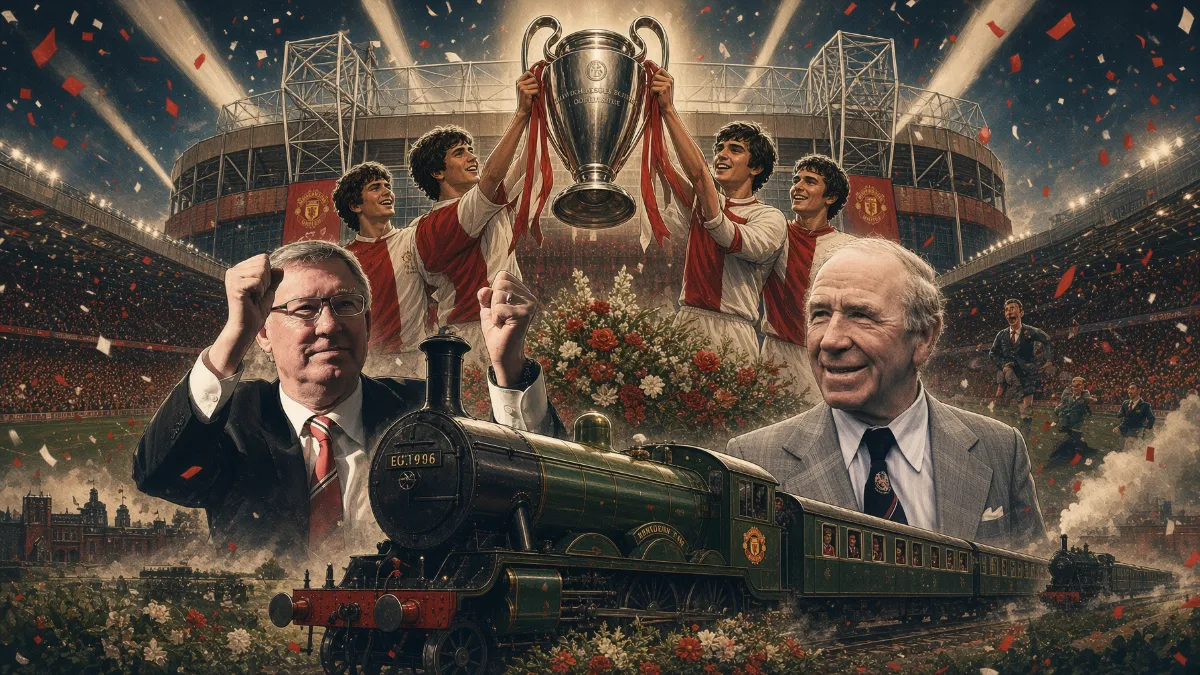
The story of Manchester United is not just a list of trophies won and legendary players. Long before Old Trafford became the Theatre of Dreams, the club was founded in 1878 as a modest amateur team made up of railway workers. What followed became a narrative of survival, tragedy, epic rebirth, and boundless ambition that shaped one of the largest football institutions on the planet.
From railway tracks to a new name
In 1878, employees from the Lancashire and Yorkshire Railway's carriage department established a football team called Newton Heath LYR. The players were ordinary railway workers who played against neighbouring businesses and local sides. Their original green and gold colours directly mirrored their railway association.
The club gradually progressed and joined the First Division of the Football League in 1892, yet life in professional football proved to be a harsh challenge. By the dawn of the twentieth century, overwhelming debts exceeding £2,600 posed a significant threat of liquidation.
A twist of fate involving a dog changed the club's destiny. Newton Heath’s captain, Harry Stafford, owned a St. Bernard named Major. Local brewery owner John Henry Davies met Stafford, intending to buy the dog for his daughter. Upon learning about the club's perilous financial state, Davies rallied a group of investors to save the team from bankruptcy.
In 1902, the team changed its name to Manchester United, severing its formal ties with the railway. The club ditched the green and gold kit in favour of the iconic red and white, which has become globally recognisable. Under the stewardship of manager Ernest Mangnall, the Red Devils claimed their first league title in 1908, lifted the FA Cup in 1909, and moved from Bank Street to the legendary Old Trafford in 1910.
The Matt Busby era and the birth of club identity
After a series of downturns and financial troubles, Sir Matt Busby took the reins in 1945. The Scottish tactician laid down a philosophy that would define the club's DNA for decades: attractive attacking football and an unwavering commitment to developing homegrown talents rather than splashing out on high-profile signings.
This led to the emergence of the legendary Busby Babes — an exceptionally gifted generation including Duncan Edwards, Bobby Charlton, Roger Byrne, and Tommy Taylor. The young team clinched back-to-back league titles in 1956 and 1957. Defying the Football League's restrictions, Busby insisted on competing in the European Cup, making Manchester United the first English club on the continental stage.
The Munich tragedy of 1958 and the rise to European glory
On 6 February 1958, the team's return from Belgrade after reaching the European Cup semi-finals against Red Star ended in disaster. The plane, refuelling in Munich, crashed while taking off in a heavy snowstorm. The tragedy claimed 23 lives, including eight first-team players: Geoff Bent, Roger Byrne, Eddie Coleman, Duncan Edwards, Mark Jones, David Pegg, Tommy Taylor, and Liam Wilan.
Matt Busby was critically injured and spent weeks in hospital. During this dire moment, his assistant Jimmy Murphy took charge of club affairs. In the first match after the tragedy at Old Trafford, a team assembled from reserves and newcomers triumphed over Sheffield Wednesday 3-0, and months later, they sensationally reached the FA Cup final.
The recovery took years. Busby returned to work, and around surviving star Bobby Charlton, a new attacking force emerged — the Holy Trinity of Charlton, George Best, and Denis Law. After securing league titles in 1965 and 1967, Manchester United triumphed over Benfica 4-1 after extra time at Wembley on 29 May 1968, becoming the first English side to win the European Cup, completing an extraordinary decade-long return from the ashes.
The revolution of Sir Alex Ferguson and the era of absolute dominance
Following Busby's departure in 1969, the club experienced tumultuous times: relegation to the Second Division in 1974, domestic cup successes under Tommy Docherty and Ron Atkinson, but a lack of consistent title contention amid Liverpool's dominance.
The arrival of Alex Ferguson on 6 November 1986 changed everything. The Scotsman eradicated discipline issues, modernised the scouting network, and rejuvenated the academy. A pivotal moment came with an FA Cup victory in 1990 against Crystal Palace (1-0), saving the manager from dismissal.
Eric Cantona's signing in 1992 delivered the club its first championship in 26 years during the inaugural Premier League season. Soon, the legendary Class of '92 emerged: Ryan Giggs, David Beckham, Paul Scholes, Gary Neville, Phil Neville, and Nicky Butt. Alongside resolute leaders Roy Keane and Peter Schmeichel, this team achieved a historic Treble in the 1998/99 season, snatching victory from Bayern Munich in the dying moments of the Champions League final in Barcelona.
Ferguson kept refreshing the squad. A new wave led by Wayne Rooney and Cristiano Ronaldo secured three consecutive Premier League titles from 2007 to 2009 and clinched the 2008 Champions League title against Chelsea in Moscow. Upon retiring in 2013 after Robin van Persie’s hat-trick against Aston Villa, Ferguson left a legacy of 20 English league titles, 13 Premier League cups, and a mentality of absolute winners.
Searching for stability since 2013
Since Sir Alex's departure, the club has entered a prolonged phase of instability. David Moyes, Louis van Gaal, Jose Mourinho, Ole Gunnar Solskjaer, Ralf Rangnick, and Erik ten Hag each claimed various trophies (FA Cups, League Cups, and the Europa League) but failed to restore regular title contention.
The crisis deepened in the 2024/25 season under Ruben Amorim, finishing in a dismal 15th place. Michael Carrick stepped in as interim manager in January 2026, making an impressive turnaround, lifting the club to third in the Premier League and returning them to the Champions League, earning himself a long-term contract in the process.
Meanwhile, INEOS, led by Sir Jim Ratcliffe, has been restructuring the club since 2024. Despite the challenges of transitional periods, Manchester United retains its status as a global superclub, leaning on its unique historical legacy, spirit, and unending pursuit of the summit.
