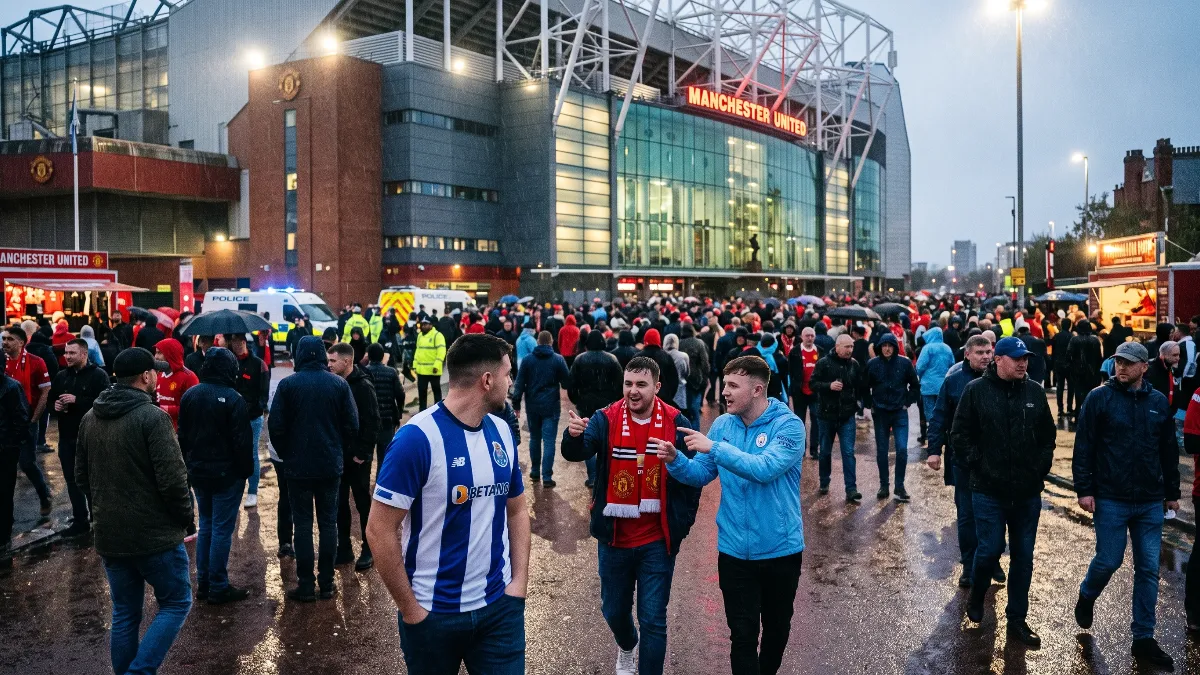
Football may not matter, but it really does.
Living in Manchester, I often find myself caught in the electric atmosphere surrounding matches at both Old Trafford and the Etihad. Despite the intensity of these rivalries, I can’t help but feel the games hold little emotional weight for me as I support neither Manchester United nor Manchester City. Yet, there's a significant "but"—most of the time, I’m accompanied by friends who are die-hard supporters of either side, and their passion undeniably adds a unique intrigue to the encounters.
After all, what kind of friend wouldn’t want their mates to experience happiness?
This Sunday, I was once again heading to the Manchester derby, this time at Old Trafford. As usual, I met friends there, fully aware of what to expect.
Winding my way through Victoria Station and passing the National Football Museum (a must-visit!), I reflected on what it truly means to be a neutral supporter, especially during such a fierce rivalry. Honestly, is neutrality even possible in football with its raging passions and storied histories?
Of course, I made a stop at Michaels for a delightful Spanish latte (well worth it), giving me more time to think about the upcoming clash in Portugal between my team, Porto, and our perennial rivals, Benfica.
I love wandering around the city before a big game, soaking in the energy and witnessing supporters cheerfully donning their scarves and shirts. It warms my heart to see different generations collectively heading to the match.
Football, for all its nuances, is about family.
Passing Manchester Town Hall and the freshly minted ‘Number 10 North’ (which, naturally, is next to a pub), I momentarily lost my train of thought absorbed by the scaffolding around the town hall, but let’s get back on track.
I enjoy pondering football not only from a tactical viewpoint, though perhaps less frequently of late, but also from a social perspective, given how deeply the sport is woven into our culture and daily lives—an inescapable reality.
Friends text me, begging me not to wear anything blue, which made me chuckle as I was indeed clad in blue—the unmistakable Porto jersey. I realise this confuses both them and my City-supporting mates, but one’s football allegiances don’t simply disappear because of context.
I boarded a packed tram to Old Trafford and made my way toward this sacred football ground—thousands of people, friends divided by colours yet united by a shared love for the game.
Eventually, I caught up with my friends, who again queried why I was sporting a Porto shirt as if it were even a question! We then embarked on the search for pre-match sustenance, which could only be described as incredibly greasy, utterly delightful, and heaped with chips.
The banter flowed freely regarding how the game would unfold: which players might score first, what’s at stake, the perennial speculation surrounding Manchester United’s manager’s future, and, of course, the undeniable appeal of a girl in a pink top, leaving Mark a tad flustered (we’ll keep his name for anonymity). Our pre-match chats delve into a myriad of topics—especially with time for a pint or two (obviously, Guinness for me).
As a neutral, I see it as my duty to tease my friends. After all, the pressure rests squarely on them—with everything, well, not exactly everything, but you catch my drift, and I relish doing just that.
As the kick-off approached, it was clear from everyone’s faces that the time for merrymaking had passed; it was time to focus on the match ahead. I had just finished my snack and decided to grab a chocolate bar—because who goes to a football match without a good chocolate fix?
Time to head in.
Upon entering Old Trafford, the anticipation is palpable. You don’t just stroll in; it’s an honour to step into this historical venue, and I genuinely appreciate that. Growing up about 1,700 miles away from Manchester, this stadium has long been on my bucket list, and despite having attended numerous matches, I still feel an emotional rush each time. Old Trafford is one of my cherished ‘ladies’, deserving both respect and admiration, especially as it is the spiritual home of Eric Cantona—a claim strong enough to make anybody swoon!
There’s always a slight chaos at the entrance, predictable given the crowds, but as you pass through the gates and ascend the stairs, you are met with an absolute behemoth—a cathedral of football, filled with wild energy and passionate fans. I’m not typically fond of red, for obvious reasons, but just like at Anfield, I’ve come to accept the colour scheme at Old Trafford.
Someone sings, a child cries for reasons unknown, two women are checking messages, and a guy randomly sketches something on his phone while I glance around to see my friends are visibly anxious. After all, it’s the Manchester derby—these matches carry a weight and significance all their own, and with both teams being giants in their own right, this clash is one for the ages. Interestingly, both outfits are in transitional phases, so unpredictability looms large.
I let them deal with their nerves while I scroll through updates, capture moments, and observe different activities both in the stands and on the pitch. There’s always a player or two who appears particularly ready during the warm-ups, and Haaland looked relaxed today, flashing smiles and gathering energy from rival fans. I sensed trouble for the United faithful, a suspicion that would later be confirmed.
Game on.
The ball zigzags back and forth, with several missed opportunities, intensifying nerves among the supporters. Then comes that ludicrous moment with Foden leading to a red card.
The home crowd erupted! Naturally, this shift meant they could seize control and assert their dominance. I noticed City fans growing increasingly anxious, while some maintained that defiant gaze unique to true sports lovers.
The game continues at varying levels of quality. As the final 30 minutes approached, a cross comes in, and Haaland does what he does best—scores (only to be deemed offside…)
Suddenly the home crowd’s anxiety escalates while the City fans belt out tunes, reminding their counterparts who firmly reign over Manchester at this moment.
Full-time.
The visitors take the spoils, but in a derby, no one truly feels like a visitor—many in the blue section are locals and neighbours of Old Trafford.
My friends look disheartened and angry; while I may not share those feelings, I can’t deny a tinge of sadness wells up within me. It’s sorrow born from witnessing my friends’ distress over their team, and though I might not identify with their club, I certainly empathise—both as a friend and as a football fan.
And perhaps, it is in this moment that the concept of neutrality begins to falter.
Football lives in so many bubbles, seemingly operating at a level no respectable industry would, but this side of the sport is not why we adore it.
After the match, I prefer to head off quickly to digest what I witnessed—on the field and beyond. So, I bid farewell to my friends and stroll back into the city, this time on foot, since I was craving a specific bite (guilty as charged), providing ample opportunity to contemplate how friendship shapes the beautiful game and vice versa.
It would be all too easy to brush off yesterday’s match, given that neither team resonates with me. However, the outcomes of these teams will ripple through every interaction in Manchester this week—be it with United fans or City supporters—ultimately impacting my personal existence. That is the power of football—its ability to infiltrate and affect all, irrespective of one’s club loyalty.
My friends deserve my affection and merit the right to experience joy, yet at times, I need merely to reflect on my neutrality and leave them be. It won’t be easy waiting for a smile from person X or Y when I pop out for coffee if they happen to be United fans.
The beauty of football lies in the fact that, typically, any result from the preceding weekend has a rather short shelf-life, expiring once the next match begins, rendering victories and defeats fleeting—well, for the most part.
Amusingly, I found myself revisiting Old Trafford this morning, and it was truly intriguing to witness how fundamentally different it appears when devoid of singing fans. The stadium does not archive the joyous and sombre moments; rather, it offers a stage for the game. Yet, it does preserve memories, and that, in many ways, encapsulates what football represents—memories of excursions with friends and family, tears shared with fellow supporters, laughter, and yes, that occasional veiled aggression towards a rival or their fan base.
A stadium is a treasure chest of our memories as football fans.
Old Trafford may not be my home, but it harbours many of my recollections—from goals to players, matches to squandered opportunities, from sorrow to immense joy (that Mourinho jog along the touchline in 2004). Perhaps this is why football truly matters—even when it doesn’t register as significant to you.
In theory, the result of a game involving two teams I don’t support should wield little impact on me. I ought to be able to walk away, forget the score, grab a bite, head home, and resume my life, but football isn’t particularly concerned with coherent logic. It has this uncanny ability to tie itself to everything—friendships, families, cities, reveries, and conversations.
Manchester exists in a warm division between the Reds and the Blues, both fan bases boasting ample grounds for pride—from domestic to European triumphs, legendary players to extraordinary managers, whilst I sit comfortably in the space between them. Sometimes hoping my City mates find success, and at others doing the same for my United friends, always fully aware that both friend groups will rarely, if ever, be happy simultaneously—it amuses me.
Perhaps therein lies my version of footballing neutrality. Not in not caring who wins, but deeply investing in who finds joy, who feels dejected, who stands alongside me, to whom I share a pint, and who I walk back into the city with after the final whistle.
Football truly might not matter. But then again, it undeniably does.
I cherish the neutrality of attending these derbies, as it allows me to simply unwind and revel in the game for what it is, free from additional pressure or emotional investment. I can appreciate a brilliant pass from a player without immediately considering the ramifications for my team. I can witness a goal and glance around to observe everyone’s reaction rather than springing up from my seat in celebration. I can absorb the noise, tension, angst, and jubilation—free from the necessity of viewing it through the prism of my own club. There’s something liberating about that.
Football fans may likely revile me for such statements, but I sometimes feel like the status of being a neutral observer offers a broader perspective on the game itself. You notice details—how a player moves without the ball, the coach's reactions, how the mood in the stands shifts after a particular tackle or wayward pass. You see the match in peaks, troughs, and rhythms instead of through a narrow tunnel of personal emotions. Naturally, this is only possible because I know at the end of the day, I can walk away from it all.
My friends, however, cannot. That’s the greatest distinction between us. For them, the result lingers on; it will be dissected, analysed, lamented over a player who ought never to don the shirt again, and then resurfaced when the next match rolls around. For me, it’s merely an experience I shared with them. It’s a memory of a single day, a specific game, a distinct journey to Old Trafford, and a unique gathering of faces around me. This doesn’t dilute their experience for me. On the contrary, it makes it all the more interesting.
As I stroll through Manchester, it’s effortless to witness the influence both clubs have. Pubs and small businesses proudly sport the colours they favour, sometimes discretely, sometimes not. One pub is red; another is blue. A flag hangs from one window, a scarf drapes from somewhere visible. Stroll through the city on match day, and you instantly sense something is afoot.
Football prevails in every facet. It’s in conversations, in shops, in pubs, on trams, in people strolling through the city decked out in shirts and scarves, in the casual remarks you overhear from strangers. You don’t even have to ask who’s playing—you feel it.
I am constantly quizzed about my Porto shirt, but it’s mostly done in jest. After all, I have been a match-goer for some time now, and what initially appeared strange to them has morphed into an amusing aspect of our camaraderie.
Why are you wearing that? Because I support Porto. But today? Yes, today too.
Such queries amuse me, as they try to comprehend how I can come to Old Trafford clad in blue, seated amidst United supporters, or arrive at the Etihad in my Porto shirt while expecting no one to bat an eye. Yet, one’s affiliations don’t just vanish due to a change in scenery. I’m not about to become a City supporter simply because I find myself in Manchester. Nor will I pass myself off as a United fan while at Old Trafford. My Porto jersey serves as a reminder of this. It plainly states that I have my own football story, my own memories, my own people, and my reasons to care about this absurd game. Still, somehow, it connects me to their experience.
Because when they ask me about my shirt, we talk about football. When they rib me about it, we share football. When I tease them about their team, we chat football. When they’re dejected after a loss and I try to amuse them, we’re still deeply engaged in football. The game becomes our shared language.
I attend these matches simply because I love football—both watching it and feeling the energy around it. I adore the entire process of going to a football match. The atmosphere, the palpable intensity, that sensation of everyone being engaged in this shared experience—it is something I love. There’s something in the journey to the football ground that captivates me—the crowded tram ride, winding among thousands of others, chasing down food, locating the right pub, reuniting with friends, engaging in footie chat for hours, peering at team warm-ups, guessing the coach’s thoughts, singing the first chants from the stands, searching for your seat, glancing about to realise so many have traversed the same path for the same reason. It’s almost always a delightful experience, even for a neutral observer like myself at these games.
And perhaps it’s because the match is merely one element of attending football. The game undeniably sits at the core of it all, but it’s surrounded by all those other important facets—people you encounter, food you savour, the walk, conversations, jokes, arguments, pints, photos, the things that go awry and become cherished tales. You may not remember every pass or tackle; many matches will fade from memory, but you almost never forget the faces you shared those moments with. It’s this human aspect that defines football.
Football may lack significance regarding life-or-death issues, but it is undeniably central in an emotional sense. It matters because humans are emotional beings, craving something to care about. We need reasons to come together. We need events to celebrate and to mourn. We need rituals, traditions, and memories. Football provides them by the handful.
It offers people reasons to traverse the city, the country, or even the continent. It gives friends a chance to connect, who otherwise may never meet. It provides fathers and daughters, mothers and sons, siblings, grandparents, and grandkids reasons to spend Saturdays together. And sometimes, it affords a group of friends—who should know better—a chance to spend hours consuming greasy food, downing Guinness, and contesting whether player A is better than player B. This suits me just fine. Perhaps this is why I’m content being a neutral observer.
I don’t require my team to be playing to relish the experience of football. I don’t need a personal stake to understand why a moment is vital for someone else. There’s something beautiful in the opportunity to witness another’s passion without needing to possess it. I can see my friend celebrating and take joy in their happiness. I can notice their devastation and feel for their loss. I can laugh when they act absurdly. I can tease them when the moment strikes. And then, ultimately, we move on.
This final point is critical. Because while football may seem like the most important thing in the world for ninety minutes, when the game concludes, it concludes. Players head home; supporters vacate the stadium. Ultimately, the lights fade. The pitch reverts back to mere grass. And come tomorrow morning, the city will continue on. People will head to work, grab coffee, board trams, or walk dogs. They’ll complain about the weather. The world doesn’t shift because United beat City or vice versa. Yet for those ninety minutes, thousands of individuals collectively experienced something. That’s not trivial.
Perhaps this contradiction is what I return to time and again when contemplating football. It’s simultaneously utterly meaningless and profoundly significant.
It may not matter. But it does matter.
It can be utterly absurd while remaining deeply serious. It may be a billion-pound business, whilst simultaneously a father holding his son’s hand en route to the stadium. It can spark a debate among strangers at a pub while also serving as a reunion for two old friends every other Saturday for thirty years. It can leave someone forlorn on a Sunday afternoon while granting a cherished memory to someone for a lifetime. It can embody multiple facets for many diverse individuals.
I attend these matches because I wish to experience everything that surrounds the game. I long to be an observer of it all. And then, I yearn to walk back into Manchester, preferably with something tasty to munch on, and ponder what I’ve just witnessed.
This, perhaps, is my perception of neutrality. It is not about being indifferent. Not about being entirely detached. Just understanding that football belongs to everybody in their unique way.
For my friends yesterday, it was about Manchester United and Manchester City. For me, it was about Old Trafford, the derby, my friends, the city, the atmosphere, the memories, and the incredible privilege of experiencing what means so much to those close to me, without needing to shoulder the burden of the outcome.
And next weekend, they’ll all cycle straight into the next game. Someone will win, someone will lose. There will be complaints about the referee. Outrageous goals will be scored; a hero will emerge, and someone will be vilified. My friends will message me. I’ll probably poke at them. And then, we’ll do it all over again.
Because football may not really matter.
But perhaps that is why it matters so profoundly.
