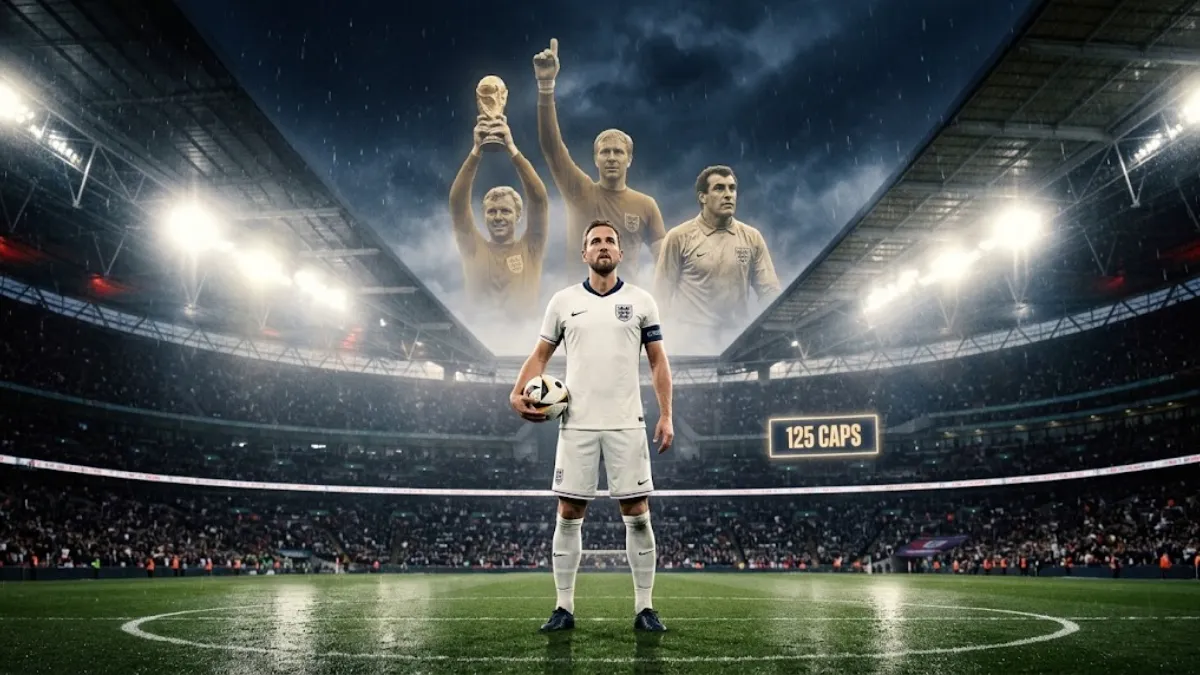
England captain Harry Kane is ready to write a new chapter in the annals of national football history. When he steps onto the hallowed turf of Wembley Stadium for the UEFA Nations League clash against Czech Republic, he will equal Peter Shilton's all-time record of 125 appearances for the national team.
Kane has long held the title of the top scorer in England’s history, netting 89 goals in 124 internationals. His international career kicked off in March 2015 during a match against Lithuania (4-0), where he marked his debut with a goal just 79 seconds after replacing Wayne Rooney. Since then, the forward has been a linchpin in the Three Lions setup. At the age of 33, he is still irreplaceable, leading the charts for goals in major international tournaments with 21 strikes in 36 games across six competitions, significantly ahead of Gary Lineker's tally of 10 goals in 18 appearances.
Kane's goal-scoring gap is monumental, with Wayne Rooney, second on the all-time England scorers' list, trailing by 36 goals — Rooney scored 53 in 120 matches. At club level, the striker has also demonstrated remarkable prowess, with 280 goals for Tottenham, 152 for Bayern Munich, and contributions for Millwall, Leyton Orient, and Leicester City adding to his impressive record.
However, one blemish on Kane's stellar biography remains: the lack of international silverware and the failure to replicate the triumph of the 1966 World Cup-winning team. Yet, the debate about who truly deserves the title of the greatest player in England's history is flaring up once more.
Moore? Charlton? Rooney? Kane's place among the legends
Names like Bobby Moore and Sir Bobby Charlton will always stand out as primary counterarguments to Kane's claim to greatness. Moore is the only captain to have lifted the World Cup trophy for England, doing so after the victory against West Germany (4-2) at Wembley in July 1966. By the age of 25, he had also won the FA Cup and the Cup Winners' Cup with West Ham, racking up 108 matches for the national team.
Meanwhile, Sir Bobby Charlton, who survived the Munich air disaster of 1958, became a symbol of world football, winning the World Cup and subsequently leading Manchester United to their first European Cup title, scoring a double against Benfica in the final (4-1). Currently, he sits third in England's goal-scoring hierarchy, with 49 goals in 106 games. Another icon, Sir Geoff Hurst, gained fame for his legendary hat-trick in the 1966 World Cup final.
Former England midfielder Danny Murphy has highlighted Kane's remarkable achievements:
Bobby Moore and Sir Bobby Charlton will always be central to these discussions due to what they achieved and the memories they left behind. As a child, my hero was Gazza (Paul Gascoigne), and Wayne Rooney was undoubtedly the most versatile and talented player in our history. But nobody can argue with the class, numbers, and longevity of Harry Kane. Those stats are those of a true legend.
When it comes to the greatest English player of all time, it’s ultimately a matter of personal taste and era, but his records unquestionably place him in that elite category.
Phenomenal stats and the absence of successors
Former England goalkeeper Paul Robinson believes the true scale of Kane's greatness will only be recognised in the years to come:
We often underestimate what we have right now, preferring to look back on the past through rose-tinted glasses. What Bobby Moore and Sir Bobby Charlton achieved has not been replicated since in an England shirt. Their legacy deserves the utmost respect, but modern football is a different game entirely.
The biggest compliment to Kane is the sheer panic we feel at the thought of what England would do if he were injured. There isn't a striker in the country who comes anywhere near his level. We will fully appreciate his contributions in 10-20 years. Yes, people point to the lack of team trophies, but he can’t play all the positions himself.
A double against Croatia (7-0) brought Kane's tally for the national team this calendar year to 11 goals in 12 matches. The captain has scored in six consecutive away games, with only Sir Tom Finney having a longer streak (seven matches from 1946 to 1948). Last season, the Ballon d'Or contender scored an astonishing 73 goals in 65 games for club and country, boasting five hat-tricks for England and making 110 starts with a 66% win rate for the team.
The cost of missed finals
The main barrier to Kane's unequivocal recognition remains his performances in key knockout matches. He has twice fallen just short of glory in European Championship finals and has been eliminated from World Cup semi-finals on two occasions. The upcoming Euro 2028, to be held in the UK and Ireland, will likely be his final opportunity to close this significant chapter of his career.
Critics often recall Kane's subdued performances in pivotal matches: the 2018 World Cup semi-final against Croatia, the Euro 2020 final against Italy at Wembley, a missed penalty in the quarter-final against France at the 2022 World Cup, along with the upcoming Euro 2024 final against Spain and semi-final clash against Argentina.
Danny Murphy argues it's unfair to place the entirety of the blame on one player:
The only thing missing from his picture is a win in a major tournament, and with each passing year, those chances fade. The captain and the striker always bear the brunt of responsibility. People say the magic disappears in crucial moments, but I wholeheartedly disagree: he's done far too much to even get the team to those decisive stages. A missed penalty can happen to anyone. The team dynamic and the tactical approach are just as vital as individual talent.
Once he equals Peter Shilton's record for the most international appearances, Harry Kane will solidify his status as England's footballing monument of the 21st century.