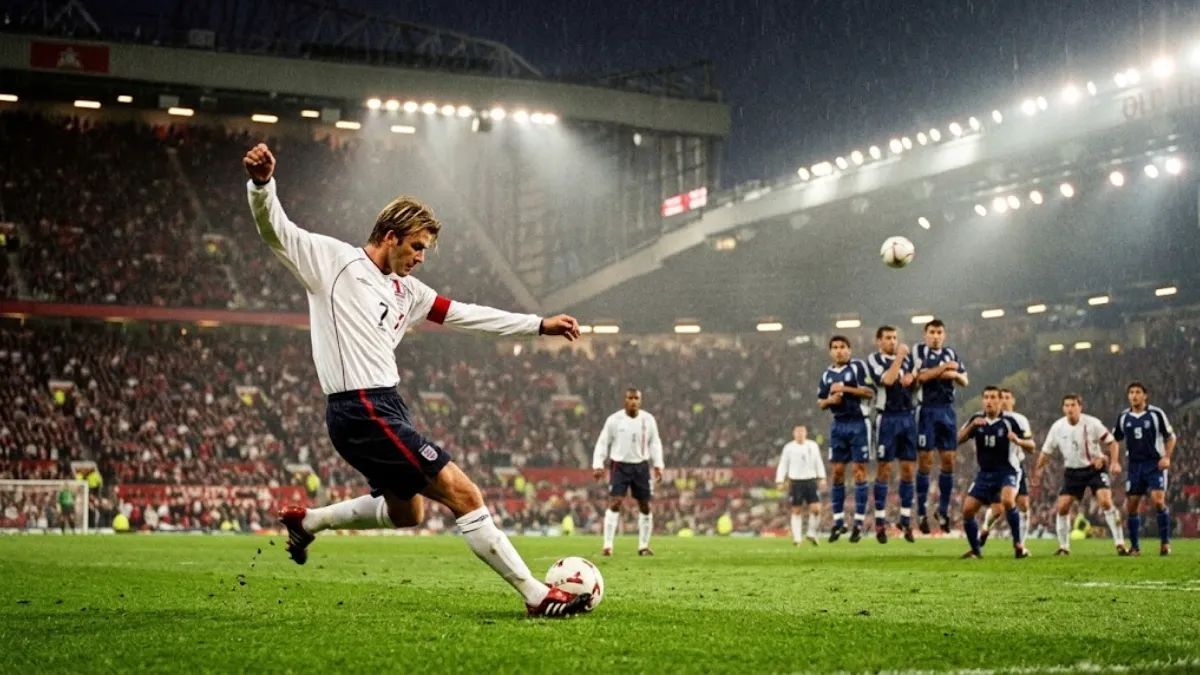
On that evening, it felt almost as though football had forsaken teamwork. Numerous missed set pieces during the match became irrelevant as a sense of inevitable conclusion loomed. It was the final chord in a dramatic symphony — obvious, yet flawlessly executed.
David Beckham curled the ball over the Greek wall, finding the top corner with pinpoint precision. The goalkeeper didn’t move; the midfielder was off like a shot, racing to the corner flag at his beloved Old Trafford to celebrate a goal that secured England’s fate.
This goal wasn’t just crucial for the country; it also became the defining moment of Beckham’s career. It forever etched into history how the midfielder would be remembered. The pivotal day for England's footballing icon came on 6 October 2001, during a World Cup qualifier.
A seemingly routine event transformed into something of far greater significance. Beckham's stunning free kick against Greece became the climax that recognised his greatness. Anyone watching live acknowledged that Beckham was head and shoulders above any other player on that pitch. His long, laser-like passes, sharpness, and involvement in every phase of play overshadowed everyone in white or blue. He glided across the pitch like a swan among geese, akin to Daniel Craig stepping into the shoes of 007 and leaving earlier portrayals in the dust. On that day, comparisons with the other 21 players seemed wildly unjust.
Beckham’s strike in the 93rd minute dispelled any doubts, even among the staunchest critics. Some remember the match for the masterpiece of a goal; most recall it for the culmination of outstanding play and the match-winner. But above all, this day would forever be etched in memories.
Drama at Old Trafford: redemption for a World Cup dream
Buoyed by their recent 5-1 thrashing of Germany in Munich, England approached the final group stage match with a simple task: secure at least a point against Greece to clinch top spot and a direct route to the World Cup 2002 in Japan and South Korea, sending the Germans into the playoffs.
However, Sven-Goran Eriksson’s team faced familiar jitters against the modest Greeks. After conceding a goal just before halftime, the hosts found themselves chasing the game. Beckham alone drove the team forward, evading two defenders, changing direction, and winning free kicks. Teddy Sheringham, who came on as a substitute at 35, deftly converted one of Beckham's set pieces, lobbing the bewildered Antonios Nikopolidis.
The joy was short-lived; within two minutes, Demis Nikolaidis restored Greece’s lead. Once again, England found themselves in a precarious position. Beckham repeatedly approached the ball, hands on his head in frustration after yet another miss, until destiny granted him one final opportunity.
Referee Dick Jol called a contentious foul in a challenge between Costas Konstantinidis and Sheringham. The free kick was debatable but added to the cinematic flair of the moment. There was an overwhelming sense of inevitability in the stands and on the pitch: Beckham knew he would score, the fans knew it, and the Greek players felt the same. With his trademark run-up and perfectly shaped ball over the wall, the score settled at 2-2, saving England's blushes.
Breaking tactical conventions
Beckham later recalled the match:
The ball was not reaching me on the wing, so I started drifting to other areas of the pitch. I remember Gary Neville shouting at me: "You’re going to get us caught! We need to keep our structure, or they’ll catch us on the break again and score." Normally, he’d have been right in 99 out of 100 matches. But that evening against Greece, I decided to ignore him. I went for it, winning fouls near the box. When goalkeeper Nigel Martyn threw me the ball to the left flank, Gary must have thought: “What the hell is he doing over there?”
On that day, the captain single-handedly carried England to the World Cup. The indirect tournament victory over Germany marked a rare triumph for the English national side against footballing giants at a crucial juncture.
In 2001, Beckham was the most recognisable sports figure globally, a model and a fixture in tabloids. He seemed destined to be remembered off the pitch more than on it. However, his decisive shot against Greece eclipsed the glamour, establishing his defining sports triumph.
Moreover, the match shattered typical tactical norms. For decades, England played with a 4-4-2 formation, often stifling the creative flair of exceptional talents like Glenn Hoddle and Paul Gascoigne. Beckham, nominally a right midfielder, dropped back to help the central defenders, drifted into midfield, and overloaded the left flank. He demonstrated that football can be fluid and that an exceptional individual can command the course of team play.
