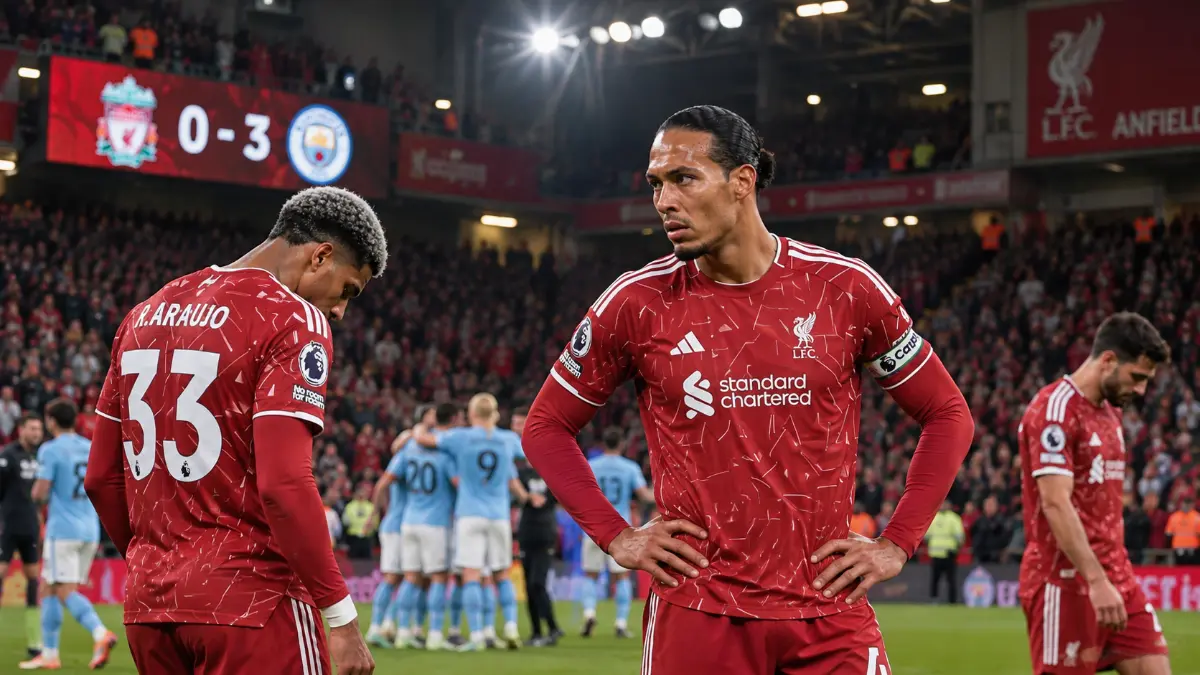
The recent loss to Manchester City has once again raised questions about Liverpool's imposing reputation at Anfield. For a significant portion of the match, Andoni Iraola's charges looked promising, only to capitulate after Ryan Gravenberch was dismissed on the 62nd minute, allowing City to score three times without reply.
Now, the challenge for Liverpool is formidable: they must improve their home results, enhance their attacking efficiency, and restore the stadium’s reputation as a fortress where opponents find success hard to come by.
Five winless home league matches
Iraola's unbeaten streak in the Premier League has come to an abrupt end. Prior to the clash with Manchester City, he had gone 24 matches without defeat, including his tenure at Bournemouth.
However, Liverpool have hit a rough patch at home, failing to win in their last five league matches: four draws and one defeat. This season, they have yet to secure any victory from three home league encounters, although they have triumphed at Anfield in both the Champions League and the EFL Cup.
Since the start of the calendar year, Liverpool have won just four out of 13 Premier League home games. In fact, they have recorded more away victories than they have at their own ground during this stretch.
Nevertheless, with the season still in its early stages, it's perhaps premature to draw final conclusions based on just three home fixtures.
“They're too easy to play against right now”
“The best teams in the world are incredibly difficult to play against. Liverpool are not that right now. It's far too easy to play against them at the moment. There are too many soft players in the side, and that needs to change,” Warnock remarked on BBC Radio 5 Live.
He emphasised the necessity for leaders, singling out Virgil van Dijk as one of the few players actively rallying his teammates.
Is the Anfield factor fading?
Former Manchester United midfielder Paul Scholes pointed out back in September that the atmosphere at Anfield no longer applies the same psychological pressure on opponents as it did during Jurgen Klopp's heyday.
“In the past, when you came to Anfield - especially during Klopp's time - the fans played a massive part. That seems to have faded now. I don't think the supporters have fully accepted what's happening at the club,” Scholes noted on The Good, the Bad and the Football podcast.
He also highlighted that opponents are now more comfortable on the ball during matches at Anfield than they used to be.
Scholes' former teammate Nicky Butt added that previously, some teams would step onto the pitch already mentally defeated. He believes the impact of Liverpool's home atmosphere has diminished significantly.
However, statistics still reveal just how historically challenging it is to play at Anfield, with the win percentage for visiting teams in the Premier League at just 12.5%. The question now is whether Liverpool's current squad can maintain this advantage.
Struggles in attack and injuries to key players
According to BBC reports, Liverpool have netted only seven goals in the current league campaign, with just two of those coming in home matches. In comparison, Manchester City have already found the back of the net 16 times.
The situation is exacerbated by injuries to Alexander Isak, Cody Gakpo, and Dominik Szoboszlai. Two of those three players have accounted for six of Liverpool's seven goals in the Premier League, meaning their absence severely limits the attacking potential of the Merseysiders.
Lewis Cummins has been trying to fill the gaps left by these injuries, but he currently lacks the experience and sharpness in front of goal. Increased attention is now on Florian Wirtz and Bradley Barcola, with expectations that these expensive newcomers will produce decisive moments against top opposition.
On a notable play in the 55th minute, Wirtz had the chance to continue an attack with free men Milos Kerkes and Barcola but opted for a shot that went wide of the goal. Such instances highlight one of Liverpool's key issues: the team lacks precision and decisiveness in the final third.
Iraola proud of his team but acknowledges the red card's impact
After the match, Iraola split the game into two distinct phases: before and after Gravenberch's dismissal.
“We played two different games. One before the red card and then another began. For 60 minutes, we performed very well. After the dismissal, City were the stronger side,” the manager explained.
Despite the defeat, he praised his players for their commitment and intensity.
“I’m really proud of my players. They put in a tremendous effort and left everything on the pitch. We lost and gained nothing from our performance, but I was very pleased with how we played,” Iraola stated.
However, a solid spell against a formidable opponent isn't enough. Liverpool must improve their finishing, regain their confidence at home, and extract more from players expected to significantly impact games.