In the aftermath of Chelsea's win against Leeds United, manager Xabi Alonso publicly accepted responsibility for what he termed as a disappointing first-half showing from his team.
This approach from the Spaniard reflects a desire to protect his fringe players, who rarely feature in the starting lineup, and shield their confidence. While several of these footballers had an off-day individually, the root cause of the issues lay in tactical shortcomings as the initial formation for ball possession was far from ideal.
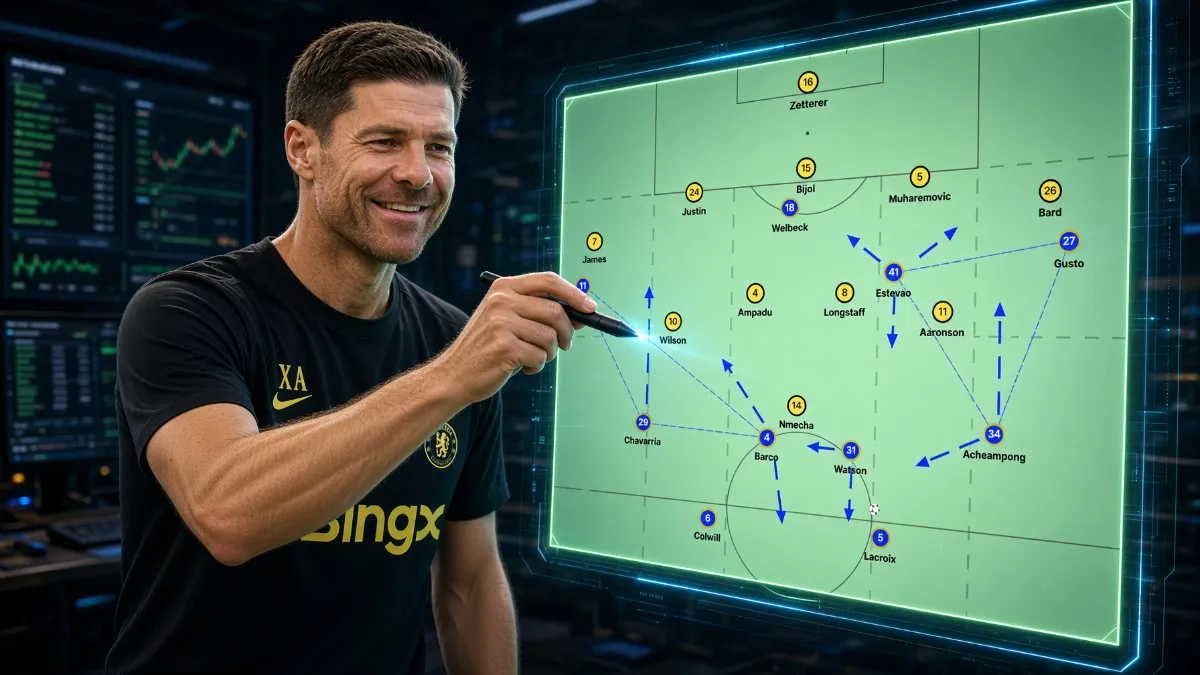
To optimise positional attacking without overhauling the team’s game style, Alonso could have implemented three targeted and practical adjustments.
1. Wing triangles and a 2-2 structural balance
To ensure reliable support during turnovers (rest defence 2-2), full-backs Valentino Barco and Josh Achampong should have alternated their support in the midfield to assist holding midfielder Watson.
The defender nearest to the ball would then continually feed passes to the wide attacker (Jamie Bynon-Gittens on the left or Malo Gusto on the right) and the player in the half-space (Chavarria or Estevao). Such interactions would have created stable three-man links on each wing, easing pressure and opening up space for quick one- or two-touch combinations.
2. A freer role for Estevao
Young Brazilian talent Estevao required a completely different function. It would have made sense to switch his role with Malo Gusto.
The Frenchman would have looked far more effective in his usual supportive role on the flank, while Estevao could thrive as a free-roaming playmaker in the middle. This would allow the Brazilian to frequently engage with the ball, sharpen the midfield play from deeper positions, and conduct attacks without being isolated on the wing.
3. Patience from Gittens and synchronisation with Chavarria
The understanding between Jamie Bynon-Gittens and Chavarria down the left was noticeably lacking, which is easily explained by a lack of shared playing time. Gittens often drifted too early into the centre, while Chavarria failed to make timely, supporting runs.
Here, patience was key: the winger should have received the ball at maximum width along the touchline and held his position, awaiting Chavarria's movement and Barco's support from deep. Only after creating a numerical advantage in that specific area of the pitch should they have pressed for a more aggressive approach.
Tactical zone analysis and adjustments for Chelsea:
| Game element | Xabi Alonso's base decision | Proposed practical optimisation | Expected outcome for the team |
| Wing connections | Isolated positions on the flanks, lack of targets in the deep zone | Alternating shifts of Barco and Achampong to Watson in a 2-2 setup | Formation of 3-v-2 triangles and smoother ball progression |
| Estevao's position | Stuck on the touchline with a lack of passes | Free-role 'number ten' in the centre, moving Gusto to the flank | Increased touches between lines and creativity in half-spaces |
| Gittens’ actions | Premature movements inside without opening up for partners | Receiving the ball wide and holding for Chavarria's run | Reliable control of pace without wasteful turnovers |
| Player surround | Disparate individual duels 1v1 | Coordinated trio interactions on the close flank | Psychological comfort and unlocking potential of the fringe players |
The first two points were fundamentally significant. They would have provided the squad players with a reliable and comprehensible tactical platform. Admittedly, while the correct build-up organisation alone wouldn’t have resolved the problems when out of possession that left the team trailing, well-organised links and intelligent positioning would have allowed the substitutes to showcase their best qualities on the pitch.