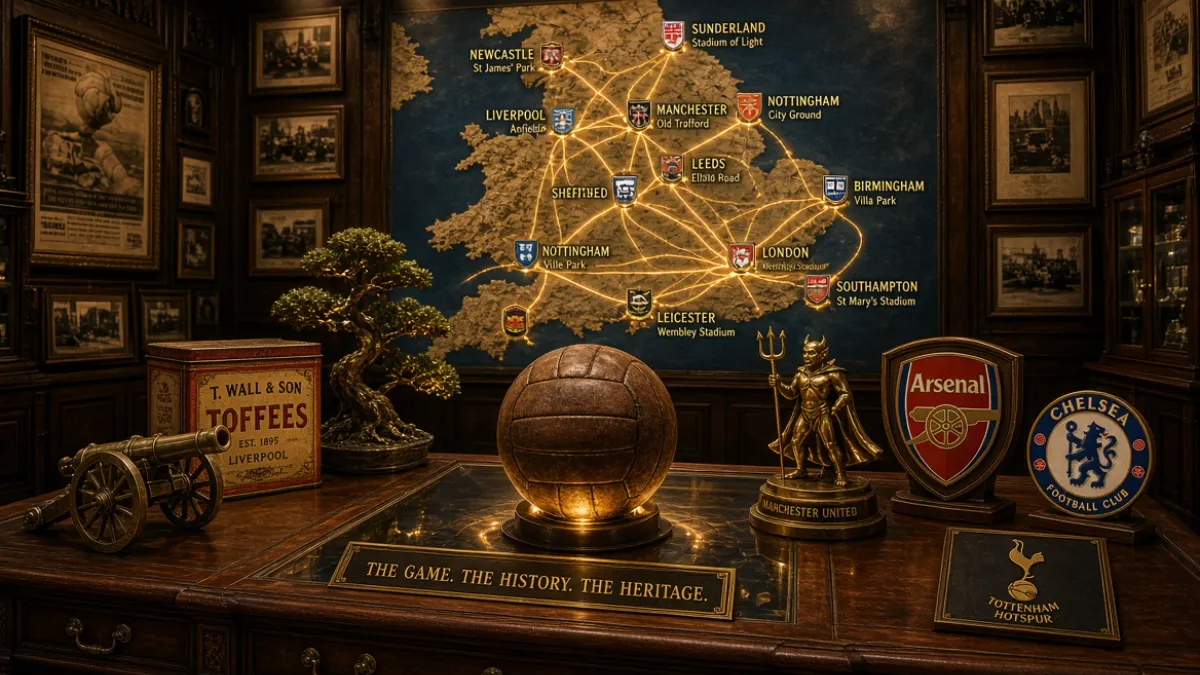
Every football club has its official name, but it's often the popular nicknames that give teams their true identity. The origins of these monikers are varied: some arose from the colours of their kits and local industries, while others stem from amusing historical quirks, traditions, or famous landmarks.
Let's delve into the stories behind the nicknames of all twenty clubs in this season's Premier League.
Arsenal - The Gunners
The nickname for Arsenal, "The Gunners," is intrinsically linked to the club's history. Established in 1886 by workers from the Royal Arsenal armaments factory in Woolwich, the team was initially called "Dial Square" after one of the factory workshops before becoming "Royal Arsenal." The club's industrial ties to arms manufacturing remain a key aspect of its identity, symbolised by the cannon in its badge. Despite moving to north London and shortening its name to simply "Arsenal," the nickname has stood the test of time.
Aston Villa - The Villans
Aston Villa shares one of the simplest nicknames in English football: "The Villans." There’s no complex story here woven with industry or animals; it’s a straightforward derivation from the club's name. Formed in the 1870s by worshippers from the local Methodist chapel, the club took its name from a grand Georgian mansion nearby. The nickname "Villans" became associated with its players and fans, even prompting playful jests from rival supporters due to its phonetic similarity to the word "villains."
Bournemouth - The Cherries
The nickname of Bournemouth, "The Cherries," is steeped in mystery, with two main theories and no definitive answer. One suggests that their red and white kits resembled cherries, while the other connects the nickname to the nearby Cooper Dean estate, where it’s said cherry trees once flourished. This uncertainty adds an element of charm, and "The Cherries" has become one of the most recognisable nicknames in the country.
Brentford - The Bees
Brentford's nickname, "The Bees," comes from a humorous misunderstanding. The club was formed in 1889 by members of local rowing and cricket clubs. A few years later, a group of students cheered for the team by chanting "Buck up Bs," which sports journalists misheard as "Buck up Bees." The error stuck, and bees have since become an integral part of the club's identity, adorning its modern crest.
Brighton - The Seagulls
Brighton's nickname came as a response to a rival team’s moniker. Originally known as "The Dolphins," this name fell out of use. In the 1970s, Brighton fans began adopting the nickname "The Seagulls" in retaliation to Crystal Palace’s "Eagles." This intense rivalry gave rise to a new identity that perfectly aligned with Brighton's coastal location.
Chelsea - The Blues or The Pensioners
Chelsea’s nickname, "The Blues," comes from the navy blue of their kits. Founded in 1905, the club initially sported "Eton blue" shades inspired by local landowner Lord Cadogan’s racing colours. The team switched to what is now recognised as royal blue in the 1907/08 season.
However, Chelsea also has another unique nickname, "The Pensioners," referencing the veterans of the British Army from the Royal Hospital Chelsea, which is located nearby. This nickname served as an early symbol of the club for nearly half a century but was phased out in 1952 by manager Ted Drake as he sought to modernise the team's image.
Coventry City - The Sky Blues
The nickname for Coventry City, "The Sky Blues," clearly illustrates how a change in kit colours can redefine a club’s identity. Since the early 1960s, the team's light blue colours became entrenched in the club’s image, a trend initiated under the legendary manager Jimmy Hill, who led the team to promotions from the Third Division to the First.
Crystal Palace - The Eagles
Crystal Palace has undergone several nicknames throughout its history. Initially dubbed "The Glaziers" due to the famous glass exhibition building, the club rebranded in the 1970s under manager Malcolm Allison's vision, inspired by Portugal's Benfica (known as "The Eagles"). Allison introduced red and blue colours to the badge. Though the rebranding didn’t yield immediate results, the nickname has remained, with a live eagle now soaring during home matches at Selhurst Park.
Everton - The Toffees
The unusual nickname for Everton, "The Toffees," directly relates to sweets. This tradition dates back to the late 19th century when the club played at early grounds in Liverpool before moving to Goodison Park in 1892. Two local sweet shops—the "Ye Anciente Everton Toffee House" and "Mother Noblett's," famous for its Everton Mints—added colourful flair to match days. A tradition emerged where the "Toffee Lady" would treat fans to various sweets before kick-off, cementing the nickname in the early 20th century.
Fulham - The Cottagers
Fulham's nickname, "The Cottagers," derives from their home ground rather than kit colours or careers. The name references Craven Cottage, situated along the Thames since 1896. The stadium was named in memory of a 18th-century hunting lodge that burnt down in 1888. Opened in 1905, the Cottage Pavilion remains one of the most recognisable landmarks in English football, while the team is also referred to as "The Whites" due to the traditional white shirts.
Hull City - The Tigers
Hull City's famous nickname, "The Tigers," is explicitly linked to the club’s colours. Founded in 1904, the club adopted black and amber stripes that visually echoed a tiger's coat. The first mention of the nickname in the press occurred on March 6, 1905, when a journalist dubbed a victory over Leeds City a "ferocious performance by the Tigers." Over time, the striped emblem became a key element of the club's identity and is now featured on its badge alongside the popular mascot Rory.
Ipswich Town - The Tractors
Ipswich Town's nickname, "The Tractors," has a rather unique origin, having been initially used mockingly by rival fans. Based in Suffolk, known for its agricultural heritage, the nickname gained traction during the club’s Premier League stint from 2000 to 2002 when supporters from bigger clubs would poke fun at their rural roots. One famous episode occurred in September 2000 when Leeds United fans taunted the "tractor drivers." Rather than taking offense, Ipswich fans embraced the moniker, making it part of their identity.
Leeds United - The Whites or The Peacocks
Leeds United bears the nickname "The Whites" due to their signature kit colour. Founded in 1919, the club historically didn’t always play in white. The pivotal moment occurred in 1961 when manager Don Revie decided to don all white, influenced by Real Madrid's dominance in Europe. Additionally, the club boasts an earlier nickname, "The Peacocks," originating from the historical name "Old Peacock Ground," where their Elland Road stadium sits, named after a nearby pub.
Liverpool - The Reds
Liverpool’s nickname, "The Reds," is rooted in the traditional red kit colour. Interestingly, the club initially wore blue and white colours inherited from a split with Everton in the early 1890s. It was not until 1964 that legendary manager Bill Shankly famously switched the team to a solid red kit, a move he believed would give his players a psychological edge. This signature style has endured, making "The Reds" an immortal moniker for the Merseysiders.
Manchester City - The Citizens
Manchester City has several nicknames, but "The Citizens" stands out. It cleverly plays on the word "city" in the club's name, highlighting the team’s connection with Manchester's residents. Known as Manchester City since 1894 after the reorganisation from Ardwick, the club aimed to represent the entire city rather than just a specific district. The sky blue colours adopted that same year also led to the nicknames "The Sky Blues" or simply "The Blues," while in modern times, "Cityzens" has been officially adopted for the global fan community.
Manchester United - The Red Devils
Perhaps one of the most intriguing backstories belongs to Manchester United's nickname, "The Red Devils." Originally known as "The Heathens" when the club formed in 1878 in Newton Heath, the nickname underwent a cultural shift in the 1960s under Sir Matt Busby. Inspired by a rugby team known as "Les Diables Rouges" during their tour, Busby was taken by the aggression and power of the name, which he adopted for United as the club rebuilt after the tragic Munich air disaster in 1958. The ferocious moniker replaced the earlier identity, with a devilish figure adorning the emblem and the famous Fred the Red mascot debuting in 1994.
Newcastle United - The Magpies
Newcastle United's nickname, "The Magpies," is derived from the club's kit design. The black and white stripes on their shirts closely resemble a magpie's plumage, representing a classic example of how the visual identity translates into a popular name. Locally, fans also affectionately refer to the club as "Toon," derived from the unique pronunciation of the word "town" in the northeast of England, but "The Magpies" remains the quintessential nickname.
Nottingham Forest - The Reds or The Tricky Trees
Nottingham Forest is often simply referred to as "The Reds" in homage to the historical kit colour selected since the club's inception back in 1865. However, the team also boasts a more colourful nickname, "The Tricky Trees," linked with the club's emblem, which traditionally features a stylised tree representing the name (Forest) and its historical ties to Sherwood Forest.
Sunderland - The Black Cats
The story behind Sunderland's nickname, "The Black Cats," is among the most mysterious in English football. The notion of the black cat has followed the club for over a century, though the exact origins remain unclear. Popular legends attribute it to the Black Cat Battery artillery unit safeguarding the River Wear's mouth, while other tales suggest that black cats have often been lucky charms for players and fans alike. The nickname gained official validation in 2000 when a vote unveiled "The Black Cats" as the dominant choice over alternatives like "Mackems," "The Miners," and "The Light Brigade."
Tottenham - The Spurs
Tottenham's nickname, "The Spurs," flows naturally from the club's distinctive name. The term "Hotspur" comes from Sir Henry Percy, a legendary English knight from the 14th century, renowned for his military campaigns and immortalised in the works of William Shakespeare. The Percy family owned land in the Tottenham area. In the 19th century, a local cricket club adopted the name, and when the football team was founded in 1882, they followed suit, adding "Tottenham" to distinguish themselves from other teams. Thus, the full club name was born and has since been abbreviated to the globally recognised "Spurs."
