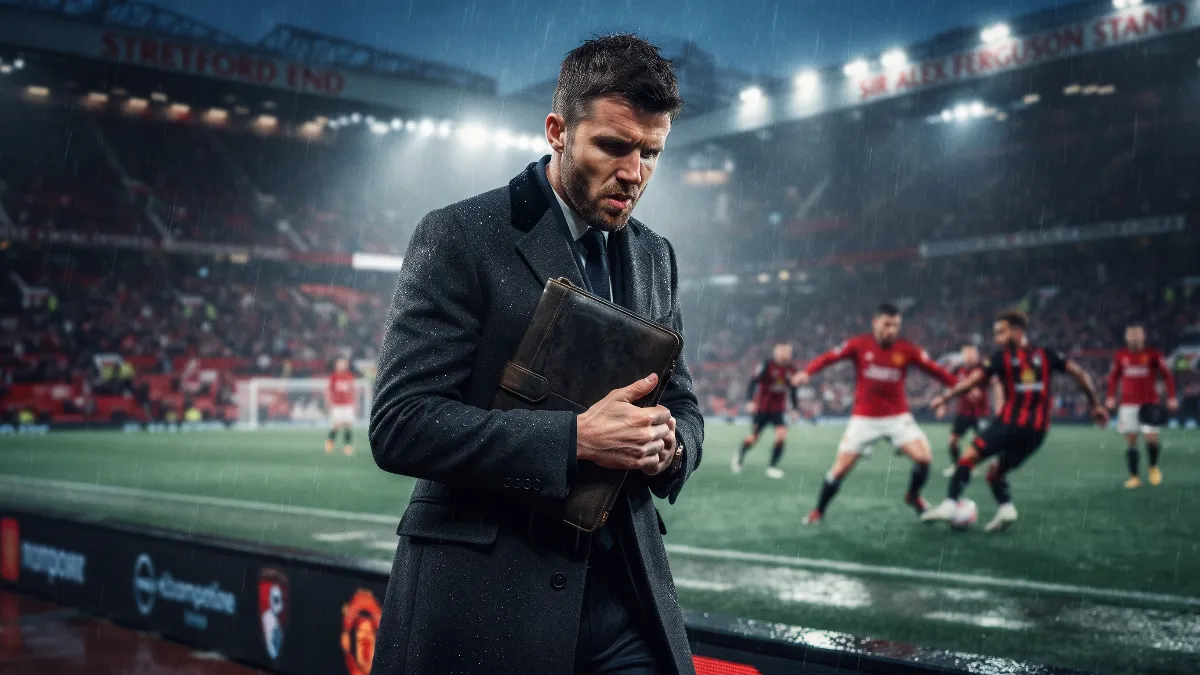
In the crucial upcoming clash with Bournemouth, Michael Carrick's best chance of stabilising his position is to reduce the team's reliance on last-minute decisions.
The most alarming assessment of Manchester United's 4-1 defeat to Como came from Youri Tielemans, who described a team torn apart in every phase: failing to coordinate their pressing, make sound decisions in possession, or function cohesively.
Bournemouth, under Marco Rose, has the qualities to punish any miscommunication from their opponents; they recently thrashed AC Milan 3-0. The stakes are sky-high for Carrick, with the team winless in their last seven matches and the hierarchy expressing increasing concern.
Carrick's tactical task isn't about overhauling Manchester United in a matter of days; it's about establishing reliable connections on the pitch. Here are seven specific changes that could help the team regain their confidence:
1. Establish a solid foundation for ball possession
Carrick should start with his deep-lying players. During his time at Middlesbrough, his teams frequently engaged in short interactions between the centre-backs and the two holding midfielders, while the full-backs were more reserved.
- Against Bournemouth, the two holding midfielders should stagger their positioning. One can drop deep to offer a short pass, while the other pushes higher up the pitch.
- Implementing a temporary shape with three players at the back and two in front will help counter the initial pressure from their opponents.
- The ball-carrier must be allowed to assess their options or advance if unchallenged, rather than merely circulating the ball for the sake of statistics.
2. Reintroduce Bruno Fernandes as the lynchpin
Manchester United cannot hope to improve their possession game if their key attacking players are isolated from the ball.
- Fernandes needs a clear role above the holding zone, while another attacker must maintain a threat behind Bournemouth's defensive line.
- If Fernandes drops deep for the ball, another player must occupy the space between the lines.
- Joshua Zirkzee could function as the link player, while Bryan Mbeumo offers a threat either on the flank or as a centre-forward.
3. Stretch Bournemouth's defence before accelerating
The team should avoid turning every improvement into an attempt to play every pass at maximum speed. Bournemouth's pressing can be personal, creating both threats and spaces.
- A midfielder moving towards the outside of a central defender can draw an opponent's winger, freeing up space.
- This creates a clear opportunity to switch play to the opposite flank once Bournemouth has shifted to one side.
4. Build the defence even before losing possession
The episode involving Como's third goal highlighted that simply losing possession is an error, but a lack of cover turns it into a calamity.
- Both full-backs shouldn’t automatically move forward simultaneously when the central midfielders push up.
- The positioning during an attack must consider the possibility of a counter-attack, rather than just leaving five players at the back.
5. Align the pressing rules
While Carrick doesn't need to promise a full-pitch press, the team must have a unified trigger for entering a press that is clear to every player.
- A compact midfield block that triggers on a pass to the flank or when an opponent receives the ball with their back to goal will reduce the risk of gaps between the lines.
- There should be a clear stopping point: if the opponent bypasses the first line of pressing, the team must switch to zonal defence, rather than continuing a chaotic chase.
6. Prepare for the opponent's direct play
Bournemouth knows how to punish opponents with long balls rather than working through all lines, particularly using second-ball wins around Evanilson.
- The central defender must battle for aerial duels, while teammates focus on controlling potential second-ball areas.
- On-field communication must be precise: if a defender steps out of line, someone has to cover the space left behind.
7. Manage the game without panic
The behavioural aspect is crucial; a missed goal or squandered chance shouldn’t lead to frantic and forced passes.
- The presence of injured players (Patrick Dorgu, Luke Shaw, Kobbie Mainoo, Manuel Ugarte) limits Carrick's selection, calling for straightforward and intuitive team functions.
- Crucially, the team must demonstrate progress by calmly operating after their initial attacking option is blocked.
