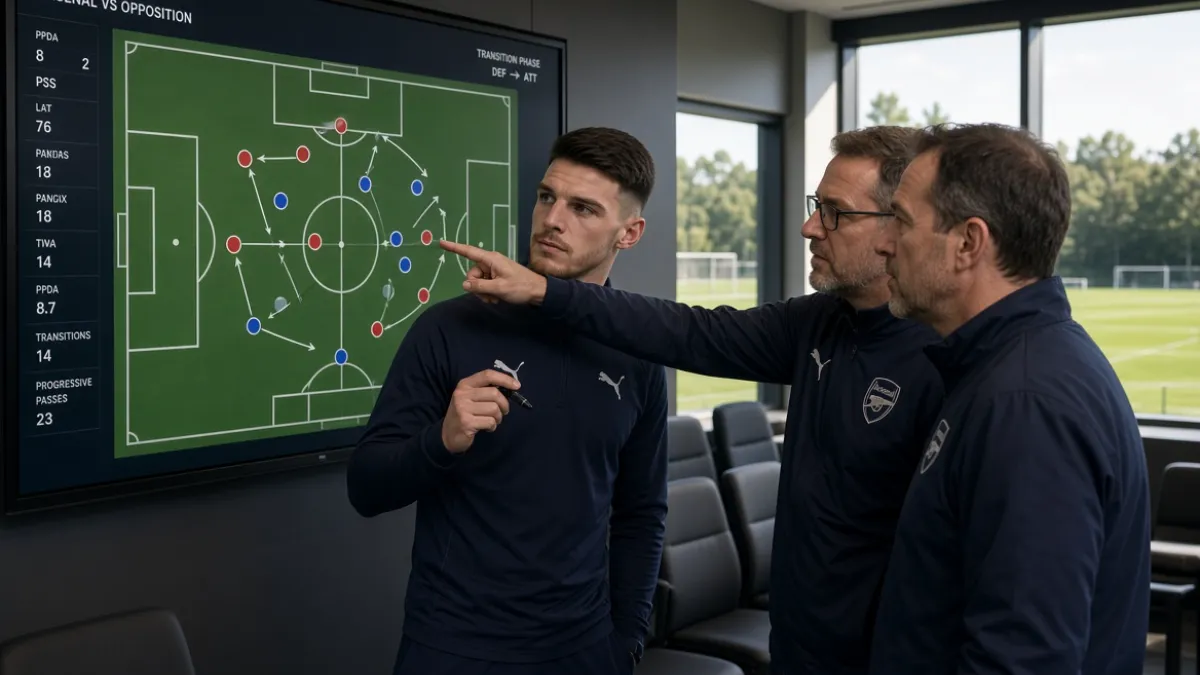
In a recent match against Nottingham Forest, Declan Rice put in an enormous shift, impacting nearly every area of the pitch. His 113 touches of the ball seamlessly connected the team's attacking and defensive actions. However, this versatility highlighted a significant issue: Arsenal must clearly delineate the responsibilities Rice is expected to carry out systematically and the emergency situations he shouldn't have to rectify alone.
Three roles in one match: from creation to goal-saving
During the match at the City Ground, Rice had to take on several distinct roles:
- Finisher: In the second half, the midfielder made a run into the box for a cross from Jurrien Timber but blasted over from a promising position.
- Provider: Just minutes later, his timely switch to the left flank allowed Noni Madueke to drift inside and open the scoring via a deflection.
- Defensive saviour: In the dying moments of the game, Rice managed to track back and block a dangerous strike from Chris Wood, preserving the three points.
This range of actions makes the Englishman an invaluable asset for Mikel Arteta. However, the risk lies in the team becoming overly reliant on him as a universal answer to any tactical weaknesses. The central midfielder simply cannot be in both the opposition's box and simultaneously cover for the central defenders if the team's structure is not adapted in time.
What should be Rice's starting focus?
Rice's primary task is to make possession meaningful. In the first 15 minutes of the match, Arsenal dominated with 80% of the ball, yet struggled to break down the home side's rigid defence.
In such scenarios, the value of Rice's passes is measured not just by his accuracy percentage, but also by his ability to find the right attacking vector. Shifting the ball out to an unmarked winger is a vital way to unsettle the opposition's defence, relieving Rice of the burden of trying to navigate through a crowded central area.
Furthermore, Rice has been effective from set pieces: his deliveries regularly create threats following attempts from Kai Havertz and Gabriel Magalhaes, allowing him to contribute without exhausting runs from deep.
Why emergency interventions are a warning sign?
Blocks against Wood and Ezri Konsa’s late tackle demonstrated that the end of the match was far from calm for Arsenal. While individual brilliance secured the win, the series of urgent interventions close to their own goal indicates that the transitional structure was faltering.
The team should not plan its defence around solely relying on Rice's sprinting back after losing the ball. The system must be designed to snuff out the opponent's counter-attacks early.
Declan Rice's versatility is a powerful weapon for Arsenal. However, the club will not become truly formidable until the midfielder can relish his diverse functionality rather than solely playing the role of fire-fighter in every critical situation.
