
During pre-season, it became clear that Xabi Alonso's system focuses on positional flexibility in possession phases. This suited Chelsea's talented attacking trio of Cole Palmer, Joao Pedro, and new signing Morgan Rogers perfectly. The trio shone against Fulham, with Palmer particularly standing out as he roamed across the pitch, consistently applying pressure on the opposition. This article explores how the man of the match delivered such a performance and why Fulham found him so challenging to manage.
Part 1 – Tactical role: Freedom to roam
On paper, Palmer operated in his usual right flank role within a 3–2–5 possession structure—this is where he thrived under previous Chelsea coaches. However, a subtle yet crucial difference was the close proximity of the attacking trio, allowing Palmer the freedom to transition between different zones. Especially under Enzo Maresca, Palmer's mobility appeared constrained and methodical rather than the free-flowing movement Chelsea fans enjoyed during Mauricio Pochettino's tenure.
He (Xabi Alonso) simply told me I’d have more freedom to move around the pitch. You saw that with my goal against Fulham. Last season, I wouldn’t have made that run because that area wasn’t seen as ‘safe.’ But he’s saying: drift into that area, drop deep, meet the ball, create, and just do what you do best.
— Cole Palmer (in an interview with Sky Sports)

Image 1.1: Chelsea's 3–2–5 structure in possession against Fulham's 4–4–2 block.
Part 2 – Positional possession phases: Through, around, and behind
According to Sofascore, Chelsea had only 38% possession against Fulham, leading to relatively few prolonged phases of possession control. In these situations, Palmer posed various threats by seeking options to receive the ball through, around, and behind Fulham's 4–4–2 defensive block.
Through the block:
Palmer consistently sought the ball between the lines and in cramped spaces for interaction with Pedro and Rogers. Most such passes didn’t make it from the central area due to Chelsea's defensive structure, as the midfielders often opted for safer sideways passes.

Image 2.1: Palmer opens up for a pass in the centre through Fulham's zonal block.
However, when he received the ball in these zones with the intention to drive forward, Palmer showcased quick body movements to turn and accept the ball in an open stance with his first touch. This enabled him to instantly see the entire field for creating moments or shooting opportunities. Defending against Palmer in these scenarios was extremely challenging due to his precise timing. Additionally, regularly taking on defenders in this manner deterred opponents from closing him down effectively.
One best example in the match was his involvement in Rogers’ goal. When Malo Gusto received the ball on the right flank, Palmer rapidly moved off Fulham's defensive line to receive it. Assessing the situation before the touch, he noted the pressure from Sander Berge and the movement vector of the Norwegian. Palmer let the ball pass by his body and touched it with his far foot while turning, escaping his marker in the process. He then found Maxence Lacroix, who assisted Rogers.


Images 2.2–2.4: Palmer receives the ball in an open body position and evades Berge's movement.
In other instances where Palmer was unable to turn to an open stance due to tight pressing or lack of space, he confidently accepted the ball back-to-goal, shielding it effectively before either passing it to a nearby teammate or creating a moment with a delicate touch. Defenders found themselves in a predicament: tight marking didn’t rule out threats, while allowing Palmer space created even greater risks.

Image 2.5: Despite tight marking, Palmer finds Gusto with a smart lay-off, who has space to attack.
Palmer illustrated his freedom of movement by shifting into central channels and the left flank, creating numerical advantages to breach the opposition’s structure. Fulham's defence faced dilemmas: should the marker follow Palmer all the way (disrupting the zonal structure) or stay put (granting Chelsea an extra man in attack)?

Image 2.6: Palmer shifts to the left flank, receives the ball freely, and delivers a pass to Rogers' run.
Around the block:
Palmer is known for frequently wanting the ball and regularly demanding it from his teammates. He doesn’t restrict himself to areas within the opponent's block and is happy to drift into free spaces beyond it—whether on the flank or deeper in the pitch.


Images 2.7 and 2.8: Palmer receives the ball on the right flank and drops deeper beyond Fulham's block.
Palmer's key contribution when moving to the flank lay in coordinating positional rotations on the right side rather than posing a direct goal threat. He instructed right centre-back Josh Achiampong and right wing-back Malo Gusto to push forward and take on more attacking positions. This direction can become pivotal for Alonso: consistent rotations will add variability to the wing combinations. In their match against Fulham, the hosts often looked lost in distributing their pressing zones.


Images 2.9 and 2.10: Positional changes on Chelsea's right flank initiated by Palmer’s movement deeper.
Behind the block:
Palmer is often perceived as a player primarily reliant on the ball at his feet. However, this portrayal underestimates his off-the-ball work. Throughout the match, Palmer regularly offered his teammates an option for a vertical pass by making runs behind the defenders. Although partners did not always see these movements, his readiness to continually stress the defence highlighted his high work rate.
Palmer's runs behind the line stretched Fulham's defensive line. Particularly dangerous were diagonal movements from the right flank to the left, ready to attack space, which disoriented the home defence.


Images 2.11 and 2.12: Palmer's movements behind defenders to attack space and stretch the defensive line.
Part 3 – Transitional phases: Dominating space
Palmer felt most comfortable in quick transitions from defence to attack, providing the most impact—reminding many of his form during Mauricio Pochettino's 2023/24 season. Decision-making accuracy, a constant focus on progressive ball movement, and the quality of passes led to the creation of a series of dangerous moments.
Palmer read loose balls perfectly and reacted instantly to loose situations. This was evident right from the first minute when he set up the goal for Joao Pedro and continued throughout the match.


Images 2.13 and 2.14: Palmer reacts quickly to loose balls, maintaining possession and starting attacks.
By looking to penetrate and take risks with the ball, Palmer operated pragmatically: if there wasn’t a clear route to continue the attack, he didn't force it, instead opting to keep possession intelligently.
Palmer's off-ball mobility in transitions also offered an advantage. The Chelsea number ten consistently selected corridors for his bursts of speed, achieving this at high intensity. This was precisely how he scored his own goal, making a timely run across the pitch to receive a pass from Joao Pedro.

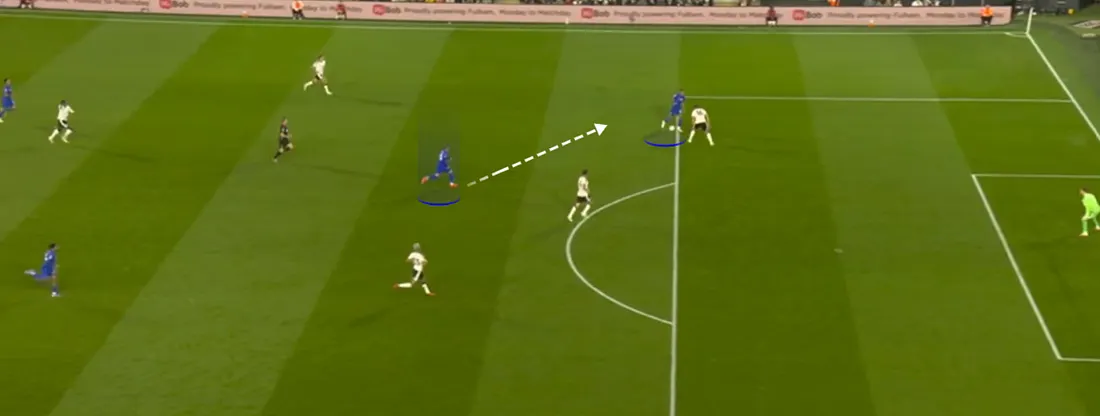
Images 2.15 and 2.16: The intensity and regularity of off-ball movements allowed Palmer to occupy key positions during transitional phases.
Receiving the ball in space, Palmer threatened equally as a creator and finisher. One standout moment in the second half was his solo run through several Fulham defenders, who struggled to stop him as the ball seemed glued to his feet.
Part 4 – Conclusion: Physical condition and tactical freedom
A key factor allowing Palmer to unlock his technical arsenal was his full recovery of physical condition. The dynamics of his movements revealed that he had shed the lingering effects of minor injuries that limited his influence last season.
When you're injured, you step onto the pitch with thoughts like, ‘Can I make this movement or not?’ You start overthinking, avoiding certain routines because they used to hurt...
— Cole Palmer (in an interview with Men In Blazers)
The tactical freedom provided by Xabi Alonso to the entire attacking group gives Palmer the perfect platform to express himself. With the arrival of Morgan Rogers, Palmer now has two high-quality partners for short combinations in the wide areas.
A sample size from just one match may seem limited, yet Palmer has demonstrated enough evidence over recent seasons to confidently forecast a return to peak production in the 2026/27 season, provided he maintains his health. His performance against Fulham serves as an excellent prologue to the season under Xabi Alonso.

