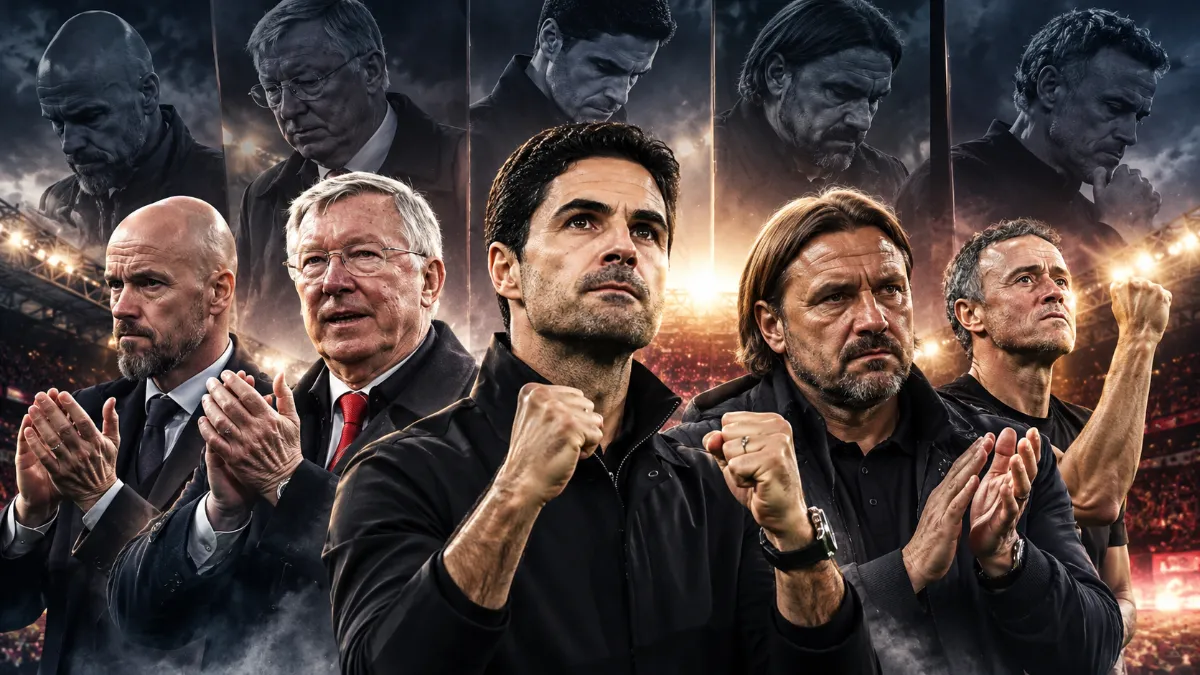
Michael Carrick is somehow clinging to his post at Manchester United. The club hierarchy is giving him another chance to turn things around in the match against Chelsea. While the former midfielder’s predicament looks grim, many coaches have managed to pull themselves back from the brink of dismissal.
We take a look back at eight notable managers who found themselves on the precipice of being sacked but miraculously retained their jobs.
Mikel Arteta
This is often referenced whenever a coach finds themselves in troubled waters. How close did Arsenal come to dismissing Mikel Arteta? We may never truly know. There were no specific reports about his job being on the line, but the club's patience must have been tested after finishing eighth in the 2020/21 season, marking their first absence from European competitions since the Wenger era.
A win in the FA Cup during his first campaign added to his credit, but that buffer began to dwindle when Arsenal lost their first three matches of the 2021/22 season without scoring a single goal. A heavy 5-0 defeat to Manchester City saw the Gunners languishing at the bottom of the Premier League. In response, they gathered a solid 20 points from the next eight games and never looked back. Trust the process, as they say.
Andoni Iraola
Remember when Andoni Iraola couldn't buy a win at Bournemouth? Nine matches, no wins, just four points. With that dismal record, the Basque coach approached a home game against Burnley in October 2023. He arrived with excellent credentials from Rayo Vallecano, but it’s anyone’s guess how long the club would have waited for his methods to work.
Frank de Boer was dismissed from Crystal Palace after just four matches. Other managers barely have the time to unpack their bags. Look at the pressure Pierre Sage is currently under. However, the Bournemouth hierarchy showed remarkable restraint. The team secured a 2-1 victory over Burnley and soon embarked on a run of six wins in seven matches.
That season, Iraola set a new club record for Premier League points. He did it twice more, which culminated in a spot in European competitions. Now, they relish victories against Real Sociedad and AC Milan under his successor, Marco Rose. Imagine if the owners hadn’t exhibited patience at the very start.
Luis Enrique
Now a double treble-winner and regarded as one of the best managers in the world, it’s quite amusing to think that Luis Enrique seemed set to be remembered as the man who struggled at Roma, did okay at Celta, and flopped at Barcelona.
In January 2015, such a fate seemed likely. Reports suggested Lionel Messi was unhappy, results were erratic, and the Catalan press was sharpening its knives. But a mid-season victory against Atletico Madrid changed everything, famously captured in a photo of Messi, Neymar, and Luis Suarez joyfully celebrating a goal at Camp Nou.
Daniel Farke
As harsh as it may seem, there was a certain logic behind claims that Leeds were contemplating replacing Daniel Farke after clinching promotion with 100 points in the summer of 2025. His time at Norwich built him a reputation as the managerial equivalent of Cameron Jerome or Dwight Gayle: too good for the Championship, not quite good enough for the Premier League.
A grim run of six defeats in seven matches seemed to confirm those worries. By late November, there were widespread reports suggesting Farke was on the verge of being sacked. Yet the German demonstrated unexpected pragmatism by switching to a back three. Almost instantly, Leeds became one of the toughest teams to break down in the division. A year later, The Athletic reported that an agreement had been reached for him to extend his contract at Elland Road until 2029. An incredible turnaround.
Alex Ferguson
This is classic. The tale of how Alex Ferguson saved himself from the sack at Manchester United is known to every football fan.
David Moyes
Moyes was likely to get the boot if West Ham lost to Everton on Saturday.
This headline appeared in The Guardian in January 2023. Journalist Andy Martin reported that Moyes was at odds with some of his key players, and the club felt his defensive tactics did not suit the squad, despite summer spending of £160 million. The Hammers were dangerously flirting with the relegation zone. However, a 2-0 victory over Everton gave Moyes a reprieve. Frank Lampard was sacked two days later, and the Hammers gradually climbed out of trouble. Five months later, Moyes celebrated triumph in the Conference League like a madman. What a moment that was.
Erik ten Hag
Where do we even begin with this master of escape? Erik ten Hag appeared doomed before the 2024 FA Cup final. Reports were suggesting his departure was inevitable regardless of the outcome. Yet Manchester United produced a tactical masterclass, defeating Manchester City 2-1. This forced the hierarchy to rethink its position and offer the Dutchman a new contract, despite a disheartening eighth place in the league.
It’s easy to empathise with fans wanting ten Hag to stay following that unexpected triumph at Wembley. However, the hierarchy needed to be smarter. A bit more ruthlessness that summer could have saved the Mancunians a great deal of strife further down the line. And here we are.
Mauricio Pochettino
Tottenham found themselves languishing in the bottom half of the table when they visited Aston Villa in November 2014. By that stage, Mauricio Pochettino was already fielding questions about his future. His side trailed until the 84th minute when a free-kick from Harry Kane took a deflection off the wall to secure a dramatic comeback. The Argentine manager later reflected on that goal.
“I might find many other fantastic goals, but for me, those goals are about emotions and the time you're living. For me, that goal was incredible because for us all, it meant the possibility to stay here today. It’s true, the team was 14th or 13th, and we were under slight pressure, because the team was there and playing well, but not winning matches. In football, it’s always the case: when results aren’t great, the first person to go is the manager. That's why that goal allowed us to stay and try to change the club.”
