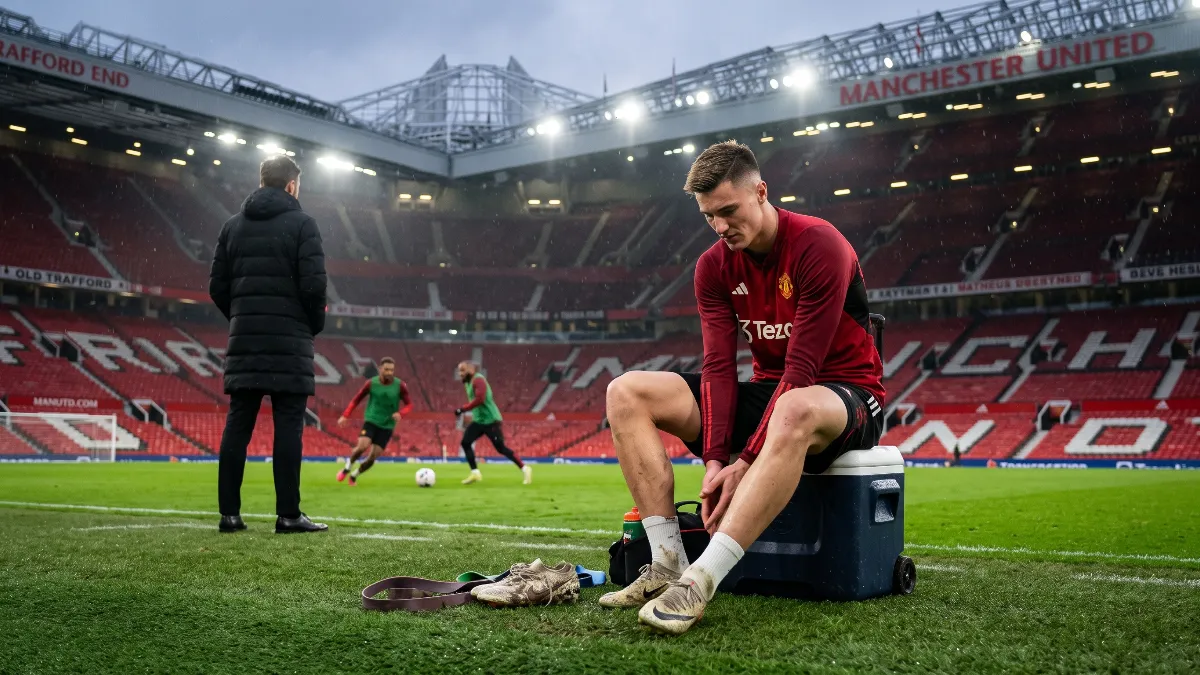
Benjamín Šeško's injury has presented Manchester United manager Michael Carrick with a fundamental tactical dilemma. The 23-year-old Slovene striker has not featured since September 16, when he felt severe discomfort in his shin during a cup match against Brighton. A month on, the situation remains unclear as Carrick has officially ruled Šeško out until the end of the year, and the medical staff are seriously weighing up the need for surgery.
Šeško had already netted twice in six games at the start of the season, but this absence creates a problem far beyond just losing one name off the team sheet; it's a crack in the entire attacking system. Carrick does have alternatives at his disposal: Matheus Cunha has the vision to create, Bryan Mbeumo can exploit space at pace, and Joshua Zirkzee brings connection between the lines. However, none of these players replicate the typical role of a classic number nine, for which Šeško was brought in.
What the Mancunians' attack has lost
Benjamín Šeško plays as a central pivot around whom United's other attacking players operate:
- Linking play with centre-backs: The Slovene keeps the opponent's defence pinned back, preventing defenders from pushing forward to receive passes.
- Threat behind the backline and target for crosses: His relentless runs into space force opponents to retreat, giving wingers a clear target for their crosses in the box.
When an alternative player is deployed at the forefront, it alters three interlinked roles on the pitch in quick succession, and none of the available options can adequately cover Šeško's role.
Cunha, Mbeumo, or Zirkzee: Carrick's compromises
- Matheus Cunha: He possesses a delicate pass and the instinct to drop deep to link up with Bruno Fernandes. This helps the side break through pressing. However, when the Brazilian drops to collect the ball, United loses a target in the opposition box. In such a scenario, either Mbeumo or a left-sided midfielder must shift infield, which forces a full-back to fill the flank. This shift disrupts the geometry of the attacking trio.
- Bryan Mbeumo: The Cameroonian has hit great form, scoring three goals in six Premier League matches. He is particularly dangerous on fast breaks and when attacking space. However, moving Mbeumo centrally robs the right wing of its main source of threat, and in tight positional battles inside the box, he lacks the physicality for back-to-goal confrontations.
- Joshua Zirkzee: Nominally, the Dutchman is a pure centre-forward, but his playing style resembles that of a link player (a ‘false nine’). If Zirkzee drops back to receive the ball, his teammates must synchronously make runs behind him. Otherwise, United's attack becomes sterile passing in front of the opponent's box without shots or pressure.
Tactical gap and January implications
The problem is further aggravated by a stylistic contradiction between the lines. While Youri Tielemans and Kobbie Mainoo prefer a controlled tempo, Bruno Fernandes, Cunha, and Mbeumo are keen to push the ball forward at lightning speed. Without a reliable forward like Šeško ahead, the defenders' long balls fail to connect, and second balls frequently fall to the opposition.
Until Šeško's return, Carrick will need to do more than simply change names in the lineup; he must overhaul the movements of the entire frontline to fit the specifics of his missing player. Additionally, this crisis sends a clear message to the scouting department ahead of the winter transfer window: squad depth is not measured by the number of forwards on the roster, but by the ability of a team to withstand the loss of a player without completely dismantling its attacking model.
