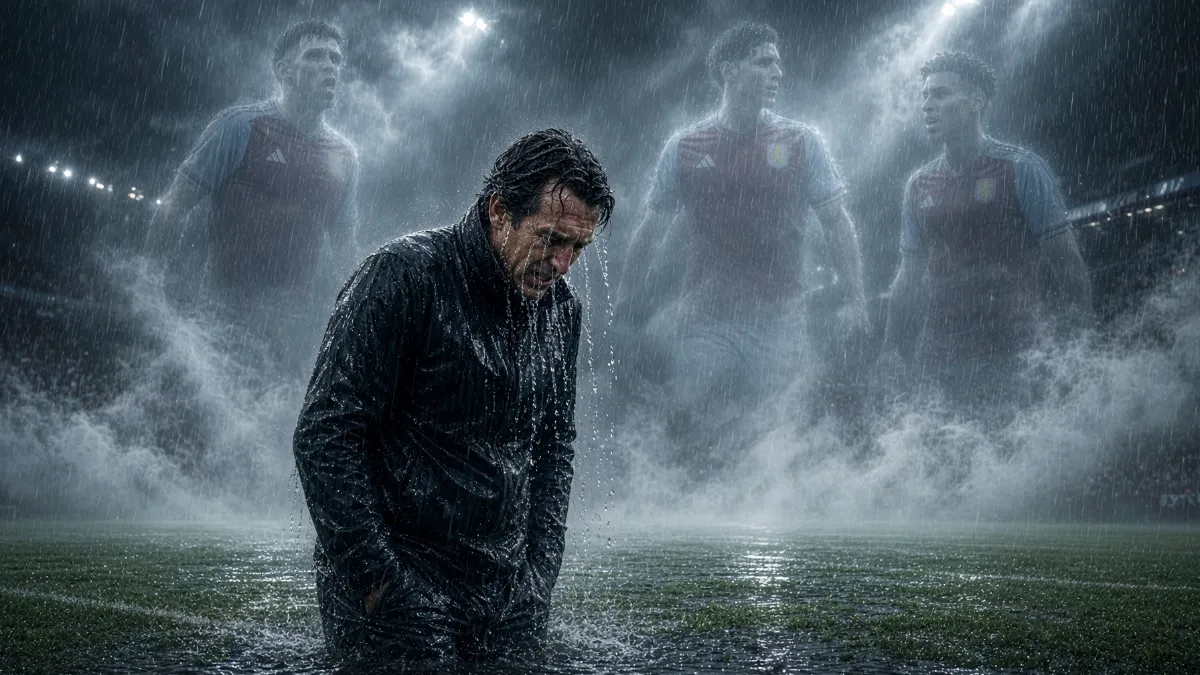
At the start of the season, Aston Villa's transfer campaign was hailed by experts across Europe as potentially the best on the market. The reality has struck hard: after four rounds of the Premier League, the Birmingham squad have managed a pitiful single point, a shocking goal difference of 1–7, and an embarrassing 19th place in the relegation zone.
Is the solid and vibrant project of Unai Emery collapsing before our eyes? While it may be too early to write off the team, the underlying reasons for this nightmare start certainly merit close examination.
A total sell-off: losing six key players is impossible to endure without pain
The Birmingham side is undergoing a tectonic restructuring. While the departure of players like Doniella Malen and Enzo Barrenechea, who were lost in loan spells, went unnoticed, the exit of foundational players has shaken the very ground beneath the coaching staff.
Morgan Rogers, who had a phenomenal season scoring 14 goals and making 12 assists across competitions, triumphantly won the Europa League and even made it to the World Cup 2026 with the England squad, made a logical move to Chelsea, who paid €138 million for the versatile player.
Esri Konsa, a steadfast leading centre-back, transferred to Arsenal just before September when they desperately needed to replace the injured William Saliba.
Ollie Watkins moved to conquer Saudi Arabia, where he has already forced Karim Benzema out of the starting XI at Al-Hilal, netting 3 goals and 2 assists in four matches. For Villa, this is an irreplaceable loss as the striker consistently guaranteed over 15 goals per season in the Premier League.
Youri Tielemans, the team’s chief playmaker and engine of midfield, has strengthened Manchester United’s midfield, while Lucas Digne has joined Louis Enrique’s rotation at PSG.
The departure of Emiliano Martinez to Chelsea has struck a colossal blow. The Argentine was among the top three goalkeepers in the league for goals prevented (5.39) and ranked ninth for saves per 90 minutes, remaining a key emotional leader in the dressing room.
Handling the consequences of such a clear-out in just a few weeks is simply unrealistic. New signings need time to gel, especially considering a whole group of players has come into the club.
So far, only a handful have seen consistent game time. Sion Suzuki has shown promise in goal, Aaron Wan-Bissaka has brought competition to Matty Cash, Joao Gomes is gradually taking charge in defensive midfield, and Nicolas Jackson managed to grab a debut goal in the Champions League against Brugge.
The rest are still finding their feet: they either feature only in rare substitutions, don’t make the squad, or are sidelined like Leon Goretzka. Adding to the woes, injuries have sidelined key midfielder Amadou Onana and young Bryan Majo, who had scored against PSG in the UEFA Super Cup match. Given these squad constraints, the disastrous start feels almost predestined.
Attacking impotency and paralysis at their end
In their opening four league fixtures, the Birmingham side has managed just one goal, despite having an expected goals (xG) tally that suggests they should have scored at least four times.
The same grim picture applies to their points tally: they have one point instead of the four they deserved based on expected goals. However, even if they did have those points, it would not change the overall picture – the club would simply be languishing in mid-table.
The team has forgotten how to break down opposition defences. Emery's men currently sit bottom of the league for total shots (only 33 attempts) and have the worst shot accuracy percentage (24.2%). With touches inside the opposing penalty area, Villa are second from bottom (54), while their duels’ intensity ranks them third from bottom (3.6).
The team’s solitary goal came from a set-piece – after a corner kick, rather than from open play.
The defensive ranks are equally chaotic. At least two of the goals conceded stemmed from glaring individual mistakes and sluggish decision-making. Pau Torres gifted a goal to the opponent with a careless pass to the goalkeeper against Brighton.
In the game against Nottingham Forest, the team initiated a counter-attack, but Boubacar Kamara opted for a flashy back-heel; John McGinn lost his duel, allowing Liam Delap to shoot from outside the box unopposed.
Against Arsenal, the defensive formation of 5–3–2 completely crumbled. A full-back should have tightly marked Eberechi Eze, but both a midfielder and Riccardo Calafiori marched into the open corridor. Ian Maatsen allowed Bukayo Saka to breeze past on the flank, leading to the Arsenal winger tapping in from an excellent position.
Another critical question is the team’s physical condition. In the match versus Brighton, Villa held the ball for a meagre 31.4% of the time and scraped together a dismal 0.54 xG against 3.5 for the opponent, losing most duels (46.3%). Against Nottingham Forest, the team attempted to dictate play but still allowed their opponents to outplay them.
The apotheosis of their impotence came against Hull City: dominating the ball for 73% of the game and creating over 2 xG worth of chances, Villa failed to score a single goal.
A déjà vu of a year ago: Emery has pulled the club from the brink before
The Spanish specialist is facing the most extensive clear-out in his Birmingham career. Leaders have departed before: in the summer of 2024, Moussa Diaby, Douglas Luiz, and Diego Carlos left, and in winter, John Duran followed. But this current restructuring eclipses all previous ones.
It’s worth noting that exactly a year ago, the Birmingham side experienced a similar nightmare:
- Crisis ahead: after four rounds of the 2025/26 season, the club had the second-worst expected goals figure (3.07), just ahead of Wolves (2.63), while 40 long-range efforts produced a mere 0.08 xG. The team rightfully found itself in the relegation zone.
- Change in attacking leadership: Marcus Rashford, who had formed a great partnership with Ollie Watkins during his loan, returned to Manchester United. Marco Asensio also departed.
- Transfer pressures: the forced sale of Jacob Ramsey to Newcastle disappointed squad leaders. New signing Evann Hessan from Nice struggled to fill the void (only two goals in 1000 minutes and quickly loaned to Crystal Palace). Of the deadline-day signings (Harvey Elliott, Victor Lindelof, Jadon Sancho), only the Swedish defender became a consistent starter.
- Physical decline and criticism of the manager: Emery publicly labelled the team as “lazy”. Watkins remained silent until the sixth round, and in a match against Sunderland, the Birmingham side, playing a man up from the 33rd minute, managed to concede while only mustering one shot on target in the half.
Back then, Villa languished in 18th place after five games but managed to produce a miracle: they triumphed, finishing in the top four of the Premier League and winning the League Cup. The contrast between domestic league struggles and European triumphs is repeating itself exactly: last year’s crisis was overshadowed by a win against Bologna, while now it’s a convincing away victory against Brugge in the Champions League.
Unai Emery has repeatedly proven his ability to right the ship over the long term. The international break for national team matches needs to serve as a turning point for addressing these errors. A brutal fixture list lies ahead, with the level of resistance in the Champions League incomparable to the Europa League. Whether the Spanish tactician can perform his magic once more and restart the stalled mechanism will soon become clear in the coming months.