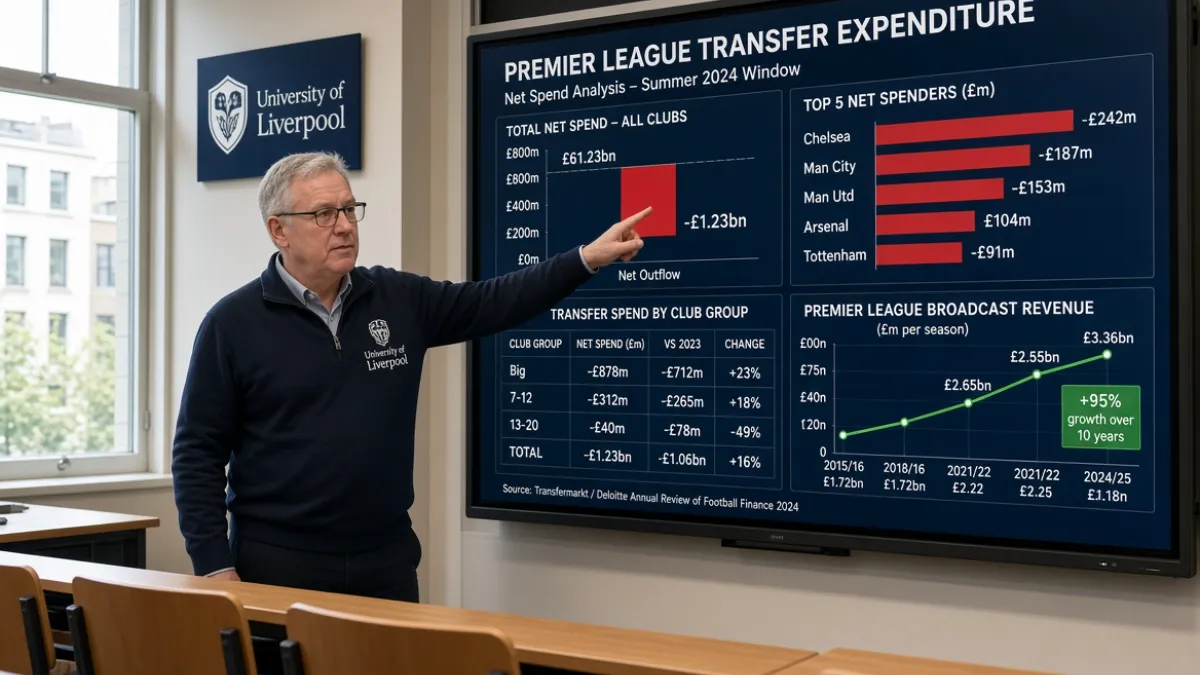
There was once an unwritten rule in world football: premiums applied only to players holding English passports. Today, however, this markup extends to any player already competing in the Premier League.
This season's transfer window saw record spending, with the average price for a player acquired from another Premier League club reaching a staggering £39.4 million — nearly double the average of £20.2 million for newcomers from abroad.
Kieran Maguire, a football finance professor at the University of Liverpool, describes this phenomenon as the "Premier League tax." Clubs in England are engaging in their transfer business more readily and confidently amongst themselves, selling stars to direct competitors. Though significant sums still flow to foreign clubs, the proportion of high-profile domestic transfers is rapidly outpacing international signings. Nowadays, only a select few elite European teams can compete with the financial clout of the Premier League.
How the Premier League has altered the global market
The changes have affected not just absolute figures, but also the geography of deals. The number of high-profile transfers, costing £40 million and above, has more than doubled in two years: there were 13 such deals in the 2024/25 season, while the summer of 2026 recorded 27.
Just two years ago, seven of these deals involved European clubs, while only six were conducted within England. This summer saw a complete shift: nine transactions over £40 million occurred between Premier League and European clubs, but domestic transfers above that figure tripled — from six to 18. Overall spending on domestic transfers has also surged more than twofold.
Maguire attributes this shift to changes in scouting models, with mid-tier clubs employing advanced algorithms to identify young talents in foreign markets, bringing them to England and adapting them to the league. A prime example is Carlos Baleba, whom Brighton signed from Lille three years ago for £23 million, only to sell him to Manchester United last week for £70 million. This model has turned clubs like Brighton into a sort of testing ground for players before they are sold to one of the traditional top clubs.
This booming transfer market in England is generating deals that are impossible in any other league:
- Savinho's move from Manchester City to Tottenham for £75 million;
- Iliman Ndiaye's transfer to Manchester City from Everton for £65 million;
- Mateus Fernandes' sale from West Ham to Tottenham for £85 million.
In contrast, the elite clubs of Europe managed a mere seven transfers of £40 million or higher between themselves during the entire summer, all of which were confined to Barcelona, Bayern Munich, and PSG. Trevor Watkins, former chairman of Bournemouth, candidly asserts that the Premier League has created an isolated financial bubble, with inflows of cash far exceeding that of the continent, making English clubs the only ones capable of paying such exorbitant transfer fees and wages.
Summer expenditure statistics across leagues (2021–2026)
According to footballtransfers.com, the financial chasm between the Premier League and other world leagues has reached an all-time high:
| League | 2026 | 2025 | 2024 | 2023 | 2022 | 2021 |
|---|---|---|---|---|---|---|
| Premier League | £3.49 billion | £3.14 billion | £1.98 billion | £2.36 billion | £1.94 billion | £1.13 billion |
| Serie A | £994 million | £1.03 billion | £873 million | £830 million | £801 million | £582 million |
| La Liga | £645 million | £591 million | £492 million | £417 million | £483 million | £271 million |
| Bundesliga | £667 million | £739 million | £541 million | £665 million | £425 million | £395 million |
| League 1 | £517 million | £552 million | £640 million | £788 million | £501 million | £359 million |
| Championship | £387 million | £310 million | £231 million | £198 million | £85 million | £57 million |
| Saudi Pro League | £325 million | £411 million | £410 million | £820 million | £33 million | £57 million |
| Source: footballtransfers.com | BBC | ||||||
Number of transfers costing £40 million and above
The data clearly illustrates the explosive growth of internal transactions between clubs in the English top flight:
| Category / League | 2026 | 2025-26 | 2024-25 |
|---|---|---|---|
| Premier League | 27 | 24 | 13 |
| Serie A | 4 | 4 | 3 |
| La Liga | 2 | 1 | 3 |
| Bundesliga | 4 | 0 | 2 |
| League 1 | 3 | 1 | 2 |
| Within PL (from PL club to PL club) | 18 | 15 | 6 |
| PL vs. the rest of the world | 9 | 9 | 7 |
| Source: footballtransfers.com | BBC | |||
The transfer market as a game of balance sheets
The transfer market has transformed into a battle of financial statements, where the profit margin from a deal is often valued more than a player's on-field metrics (tackles, goals, or assists) as it enables clubs to reinvest without breaching financial regulations.
A clear example is Elliott Anderson's transfer. Nottingham Forest bought him from Newcastle for £35 million and sold him to Manchester City for £116 million. Taking into account amortization, the club had around £21 million on their balance when he departed. Under the new Squad Cost Ratio (SCR) rules, the club recorded a profit of £95 million. The SCR calculation spreads this across three years, generating £31.67 million in annual profit for the club. No longer can clubs patch up financial holes with one-off sales; they are now forced to demand top dollar for players.
However, SCR rules give a colossal advantage to the wealthiest clubs. Representatives of the so-called Big Six (Arsenal, Chelsea, Liverpool, Manchester City, Manchester United, and Tottenham) spent £1.658 billion on new signings, thanks to massive commercial revenues and large stadiums (notably the multi-purpose Tottenham Hotspur Stadium). The remaining 14 clubs in the league spent a total of £1.833 billion, but their existence hinges on successful player trading; Aston Villa and Newcastle both completed five incoming deals over £40 million only after selling off hundreds of millions in player assets.
Porto forced to compete with Coventry and Brentford
The reduction in English money flowing into Europe paradoxically fuels inflation of salaries and demands on the continent. La Liga's corporate CEO, Javier Gomez, has criticized the financial model of the Premier League, stating that the unsustainable approach of English clubs destroys healthy competition and inflates wage bubbles in France, Germany, and Spain.
According to Deloitte's Money League report, 14 of the 30 richest clubs in the world belong to the Premier League. While the top four are Real Madrid, Barcelona, PSG, and Bayern Munich, the rest of the top 10 are dominated by six Premier League representatives, led by Liverpool.
FC Porto's president, Andre Villas-Boas, has lamented the harsh reality of European football: the Portuguese giants can no longer compete in the market with the Premier League's powerhouses and must contend for promising players with mid-table and newly promoted sides:
For Porto, this means we are battling for talent not against Manchester City or Liverpool, but, with all due respect, against Coventry and Brentford. The fact that they have such financial might makes our work incredibly challenging. The Premier League exists in a league of its own, and English clubs are becoming increasingly dominant in European competitions.
This dominance is further confirmed by recent results: Aston Villa clinched the Europa League, Crystal Palace the Conference League, while Arsenal reached the Champions League final. The financial bubble surrounding English football continues to grow, sharply increasing wealth disparity across Europe.
