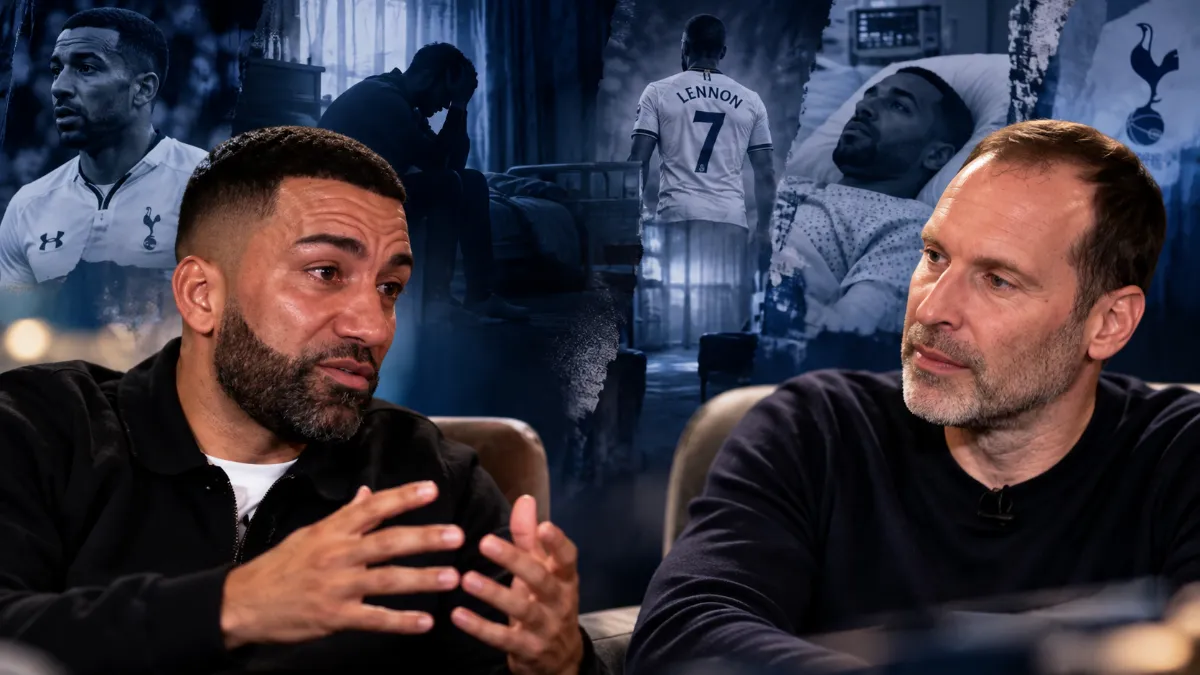
Former Tottenham and England player Aaron Lennon has opened up to Petr Cech about his prolonged struggle with mental health challenges that culminated in severe depression and his eventual hospitalisation. Lennon admitted that he was unaware of the extent of his condition for a long time.
Signs of his struggles first emerged towards the end of his career at Tottenham. Lennon began to experience unexplained fatigue, had trouble sleeping, and gradually lost enjoyment in things he once loved. However, it wasn’t until he began therapy that he started to comprehend the significance of these symptoms.
Lennon shared:
I didn’t really recognise it until it was too late.
His move to Everton and new phase in his career provided a temporary distraction from these issues, but after a few years, they returned with a vengeance, leading to deep depression. Throughout this period, he maintained a façade around his teammates, concealing his true state for a considerable time.
A significant challenge for Lennon was his difficulty in asking for help. He explained that both his personality traits and the culture in professional football made it particularly hard to acknowledge vulnerability.
The former player remarked:
It’s especially tough for men to say: 'I’m actually feeling bad today; I need to talk to someone.'
Lennon was also concerned that revealing his mental health struggles could jeopardise his position within the team and his place in the starting lineup. Accustomed to managing difficulties on his own and helping others, he found it hard to admit that he needed help himself.
Eventually, his condition deteriorated to the point where hospitalisation became necessary.
Lennon revealed:
I was in such a dark place, I had suicidal thoughts. I hit rock bottom.
Despite this crisis, he confessed that he likely wouldn't have sought help on his own. Now, he views his hospitalisation as a life-saving turning point.
In his conversation with Petr Cech, Lennon also discussed the evolution of attitudes towards mental health in footballers. They noted that during their careers, there were hardly any specialists available for players to approach with such issues, whereas now, there is a much greater focus on mental health awareness.