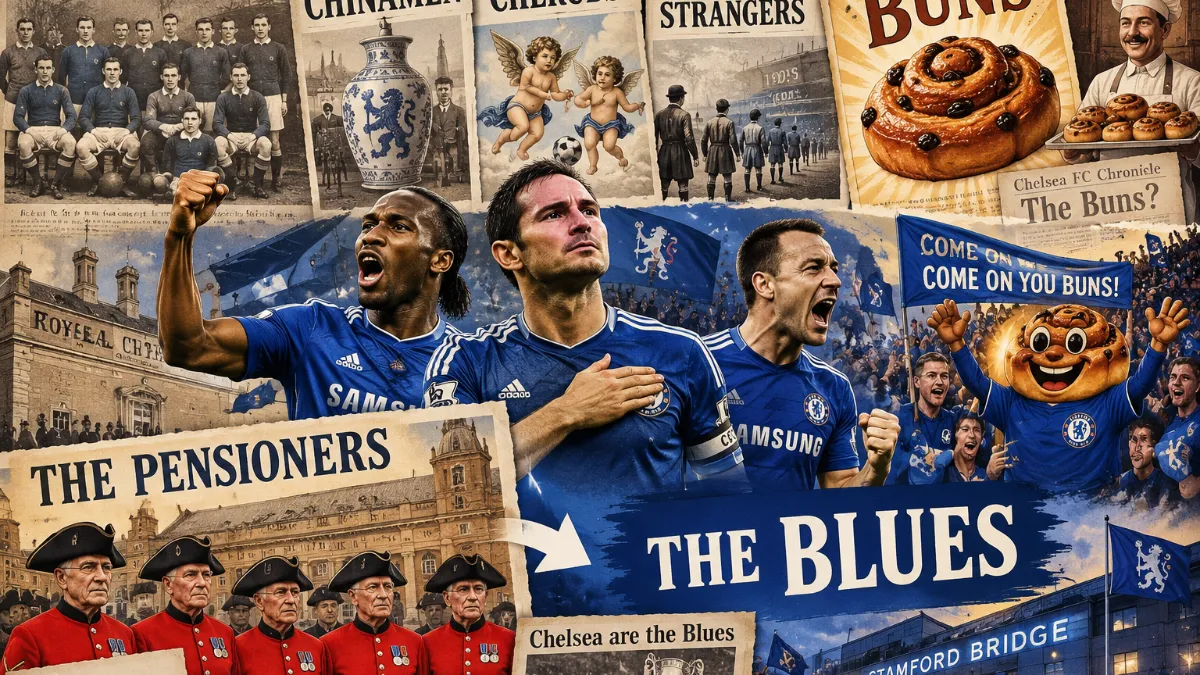
In 1905, Chelsea had yet to decide on a nickname for their players. Among the options were 'Chinamen', 'Cherubs', 'Little Strangers', and, notably, 'Buns'.
Chelsea was founded in March 1905 and soon faced a dilemma that today would likely be addressed by an entire marketing department.
A brand image was needed.
A symbol was required.
A nickname had to be established.
Today, the answer is obvious — The Blues.
But at that time, the club was still shaping its identity, prompting the press and club programmes to propose various options.
And imagination quickly ran wild.
First, there were the 'Chinamen'

One of the suggested nicknames was 'Chinamen'.
It had no relation to China.
The Chelsea area was known for its Chelsea porcelain, which led to the idea of linking the football team with this craft.
At the beginning of the 20th century, this reasoning seemed quite reasonable.
Chelsea porcelain meant the players would be 'Chinamen'.
Fortunately for future sports editors, this option did not catch on.
Next came the 'Cherubs'

Another contender was 'Cherubs'.
One can only imagine a modern Stamford Bridge:
'Come on, Cherubs!'
Fan banners featuring little angels.
Rivals joking about wings.
The history of English football could have taken a very strange turn.
But even this was not the most imaginative option.
Then there were the 'Little Strangers'
Among the suggestions was 'Little Strangers'.
This essentially meant 'Little Strangers' or 'Little Outsiders'.
The explanation was simple: Chelsea had just emerged as a new club in English football.
But the name sounded more like a children’s book than a football team nickname.
Thus, this option quickly faded away.
And then came the 'Buns'
Now we get to the most interesting part.
One of the symbols of the area was the famous Chelsea bun — a sweet roll filled with raisins and spices, historically associated with Chelsea.
And someone proposed:
Why not call the players The Buns?
Yes, 'Buns'.
This was not just a random joke from a fan.
The club programme, Chelsea FC Chronicle, at one point even supported this nickname.
In other words, there was a time when the young football club essentially told its fans:
Looks like we are The Buns now.
What modern football might look like
If this nickname had stuck, today’s football world would look a bit different.
Arsenal — the Gunners.
Manchester United — the Red Devils.
Liverpool — the Reds.
Chelsea — the Buns.
The Buns signed a forward for £100 million.
Real Madrid knocked the Buns out of the Champions League.
The Gunners thrashed the Buns in a London derby.
And instead of Stamford the Lion, the club could well have rolled out a giant bun filled with raisins onto the pitch.
In the end, the 'Pensioners' won out
Ultimately, the main nickname became The Pensioners.
The reason lay literally next door to the stadium.
In the area is the Royal Hospital Chelsea — home to the famous war veterans in red uniforms, the Chelsea Pensioners.
The connection to the area proved so strong that 'Pensioners' gradually overshadowed the other options.
However, this name was not universally liked at first.
The club worried that the term 'Pensioners' would make a completely new team appear old before it even had a chance to establish itself on the pitch.
And rivals quickly found an opportunity for jokes.
Whenever Chelsea had a poor match, the obvious explanation arose:
What did you expect?
They’re Pensioners.
Ted Drake sent the Pensioners into retirement
By the early 1950s, the club decided to change its image.
When Ted Drake took over the team in 1952, he disliked the outdated nickname and the associations with old age.
Chelsea gradually began to move away from the Pensioner image.
The main nickname became The Blues.
The Blues.
Simple.
Clear.
No more buns.
Three years later, Chelsea became champions of England for the first time.
Somewhere, an alternative universe exists
In it, Chelsea’s management in 1905 decided:
No, 'Pensioners' sounds boring.
Let’s go with Buns.
And now, one of Europe’s largest clubs is officially known as 'The Buns'.
The Buns have six English championships.
The Buns have won the Champions League twice.
Didier Drogba — a legend of the Buns.
Frank Lampard — the all-time top scorer for the Buns.
And before matches at Stamford Bridge, tens of thousands scream:
COME ON YOU BUNS!
Sometimes, the history of football truly hinges on which word an editor of a club programme decided to print on a page...