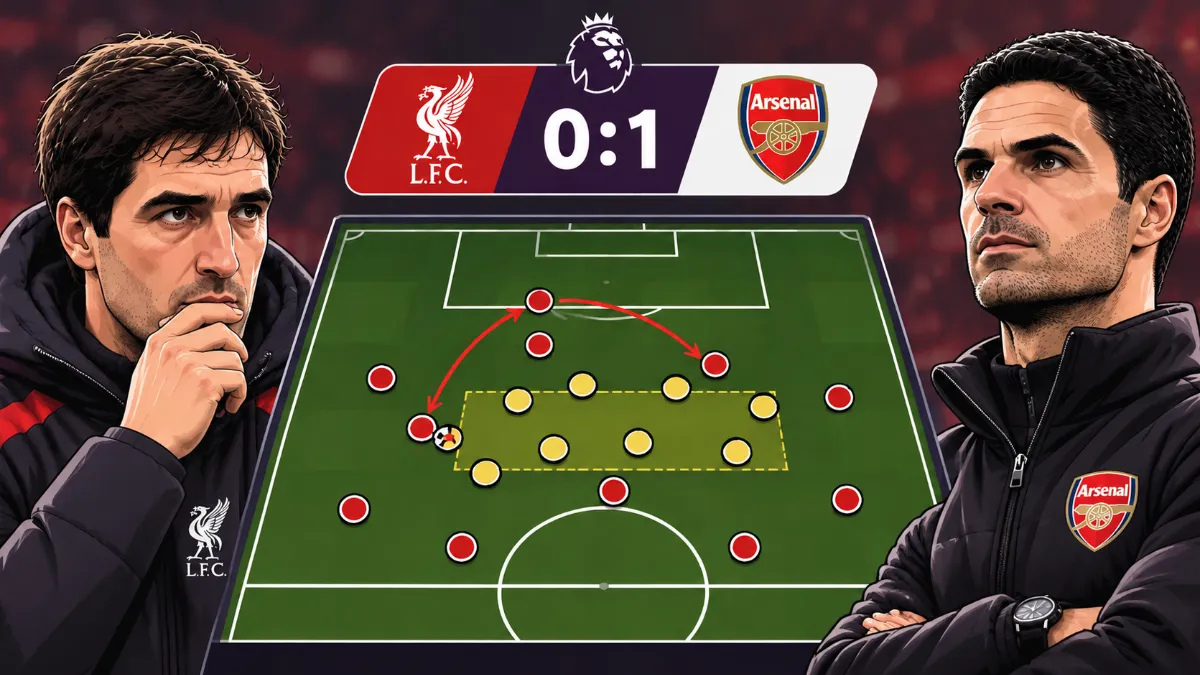
Arsenal secured a disciplined victory at Anfield with a 1-0 scoreline, thanks to Kai Havertz's precise strike and a defensive masterclass. Mikel Arteta's team effectively nullified Liverpool's high-intensity build-up, allowing the hosts only four shots on target despite conceding the lion's share of possession.
The match was determined by spatial control and the suppression of transitions. Liverpool, under Andoni Iraola, approached the game intending to utilise the flanks and press Arsenal with a fluid 4-2-3-1 formation, which frequently resembled a 3-2-5 in possession. By pushing Milos Kerkez high and asking Florian Wirtz to move between lines, Iraola aimed to disrupt Arsenal's defensive block, creating spaces for Alexander Isak to exploit. The aim was clear: high-intensity pressing to provoke errors and quick verticality to punish them.
In contrast, Arteta prioritised compactness in midfield and structural discipline. Aware of the instability at Anfield, Arsenal operated in a well-coordinated 4-2-3-1 structure that transitioned into a mid-block 4-4-2 when the ball was with Liverpool's centre-backs. The strategy was not to dominate possession — evidenced by their 44% share — but to control the areas where Liverpool pose the most danger. Deploying Declan Rice and Bruno Guimarães as a double pivot, Arteta established a barrier that effectively isolated Liverpool's creative engines, allowing Havertz to serve as the main outlet in transitioning from defence to attack.
Liverpool's tactical setup
Iraola opted for a 4-2-3-1 formation that heavily relied on the technical ability of Alexis Mac Allister and young Trey Nyoni in the pivot. The tactical plan was designed to provoke Arsenal’s press and then bypass it with diagonal passes to the flanks, particularly targeting the width provided by Bradley Barcola and Cody Gakpo. Liverpool's build-up play assumed Virgil van Dijk would act as the main distributor, trying to find Wirtz in pockets of space. However, the pressing triggers that usually activated when the ball arrived at Arsenal's full-backs were often overlooked due to David Raya's long passes.
Defensively, Liverpool maintained a high line, with Ronald Araujo and Van Dijk responsible for controlling the space behind them. The plan was to compress play in the middle third, but the lack of pressing on Rice in the 16th minute proved fatal. Despite having 56% possession and 18 total shots, Liverpool's failure to create quality chances was a direct consequence of predictable wide play. By attempting 33 crosses, Liverpool fell into a trap of playing around Arsenal's block rather than through it. The hosts' expected goals figure of 1.31 indicates they created dangerous moments, yet the mere four shots on target underscore a significant failure in the final third against a well-organised low block.
Arsenal's tactical setup
Arteta’s team mirrored the 4-2-3-1 setup but with completely different functional roles. A key aspect was the defensive cover provided by Rice and Guimarães. Their main task was to watch Wirtz and prevent Mac Allister from dictating play. Arsenal’s defensive structure was exemplary, as they made 26 interceptions, showcasing their ability to read Liverpool's passing lines. Gabriel and Riccardo Calafiori maintained vertical compactness, denying Isak space to turn or make runs into channels. This forced Liverpool to shift to the flanks, where Arsenal felt comfortable defending their box.
In possession, Arsenal operated directly and purposefully. The winning goal in the 16th minute exemplified their tactics: Rice found space to assist Havertz, who capitalised on a momentary lapse in Liverpool's central marking. Havertz functioned as a “false nine,” dropping deep to overload the midfield or press the last defender, stretching the defence. By utilising Noni Madueke and Christos Tzolis as hard-working wingers who diligently contributed defensively, Arteta ensured that Liverpool's full-backs, particularly Kerkez, were never allowed to create “two-on-one” situations. This performance showcased outstanding tactical maturity, prioritising the score rather than aesthetic superiority.
Tactical chess match
The decisive battle unfolded in Zone 14 — the space just outside the penalty area. Liverpool’s system is built around delivering the ball to Wirtz in this zone, but Arteta's decision to utilise the double pivot of Rice and Guimarães effectively closed off that corridor. The statistics are striking: despite 18 shots, Liverpool only hit the target four times. This indicates that while Liverpool could penetrate the final third, they were forced to shoot from distance with low probability of goals or head the ball under intense pressure.
Arteta won the tactical battle by identifying that Liverpool's main weakness under Iraola is their vulnerability to patient, vertical counterattacks. By conceding possession, Arsenal lured Liverpool's mid-block forward, creating the very space that Havertz needed for the opening goal. Once ahead, Arsenal dropped into a deeper block, forcing Liverpool to try to beat them in the air — a challenge Gabriel and Calafiori handled by making 17 clearances. Iraola's insistence on crosses (33 in total) ultimately worked in Arsenal’s favour and highlighted Liverpool's failure to adapt to the physical profile of Arsenal's defence.
In-match adjustments
Iraola recognised the stagnation in attack quite early. In the 59th minute, he replaced Nyoni with Dominik Szoboszlai, aiming to add athleticism and runs to the midfield. Further changes in the 67th and 81st minutes brought Rio Ngumoha, Kostas Tsimikas, and Lewis Kumas onto the pitch. These substitutions forced Liverpool into a more aggressive, almost 4-2-4 formation in the dying minutes. While this increased pressure, the quality of chances did not improve, as Arsenal's structure remained resolute.
Arteta's responses were entirely reactive and aimed at preserving the advantage. The introduction of Myles Lewis-Skelly for Guimarães in the 62nd minute bolstered the left flank, though the young player's yellow card in the 72nd added tension. Later, Arteta switched to a five-defender system, bringing on Piero Incapie for Havertz in the 84th minute, effectively killing the game. The substitution of Martin Ødegaard for Mikel Merino in the 88th minute further strengthened the midfield block. These changes ensured that despite a late flurry of corners for Liverpool, David Raya rarely had to make difficult saves, managing the game as Arteta required.
Ultimately, the outcome of the match was determined by Arsenal's superb defensive display and Liverpool’s lack of a Plan B when central routes were blocked. Arteta's tactical gamble of conceding possession and relying on structural integrity paid off, as Liverpool’s 18 shots posed almost no real threat. Havertz's goal in the 16th minute allowed Arsenal to settle into a shape that Liverpool simply could not break. By forcing the hosts to shift play wide and winning aerial duels in the box, Arsenal's tactical discipline turned Anfield’s “cauldron” into a stalemate, earning three crucial points.
