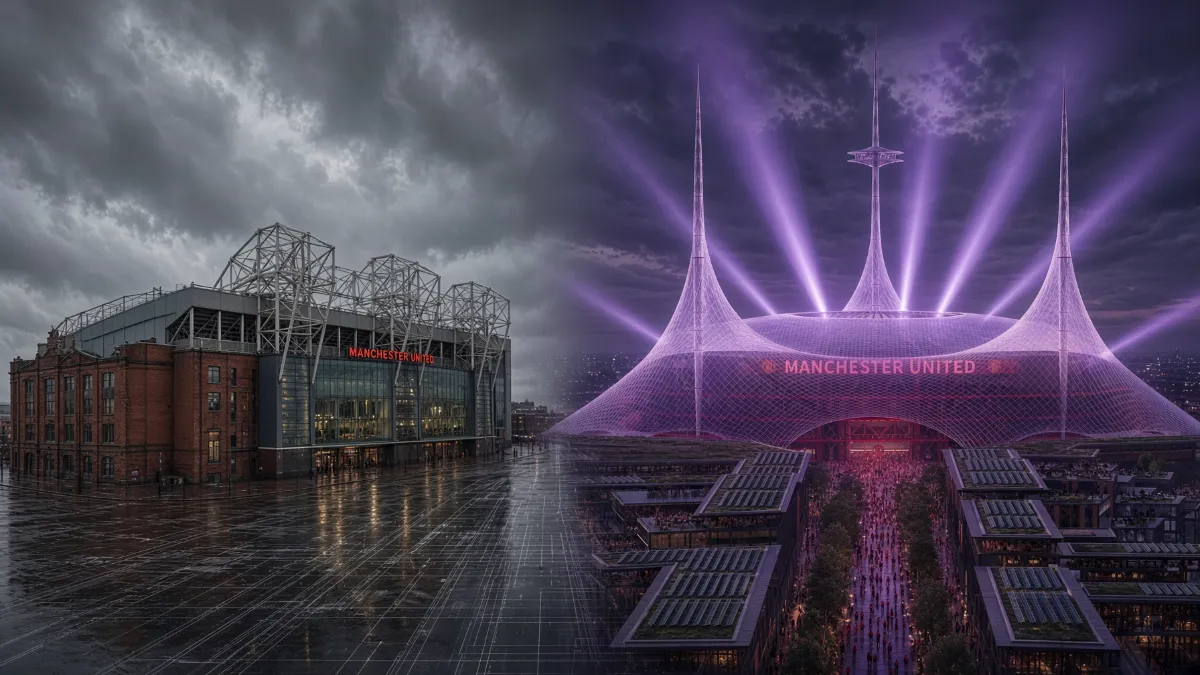
The anticipation surrounding Manchester United's proposed 100,000-seat stadium, hailed as the 'North Wembley', reached a high point in 2025. Fans dreamed of a move by the decade's end. However, by autumn 2026, the situation took a disheartening turn, with the official opening now pushed back to 2035. This timeline looks particularly bleak against the backdrop of rivals who have already made their moves: Tottenham with their new home in 2019, Everton relocating in 2025, and West Ham settling into their former Olympic venue since 2016.
The Red Devils are not just erecting a football arena; they are embroiled in a colossal battle for land, logistics, budgets, and a massive redevelopment of an entire industrial area in Manchester.
The estimated cost of building this sporting giant stands at £2 billion. This project is intricately linked to the global development of surrounding areas, including new residential quarters, transportation networks, and commercial zones. While United can self-fund the stadium, constructing an entirely new urban cluster is beyond their capabilities. Until architectural plans, governmental permissions, and financial structures are agreed upon down to the last penny, machinery is unlikely to break ground in full force.
2035 deadline: A sober assessment rather than illusions
Initially, the board wrestled between two paths: refurbishing the historic Old Trafford, increasing its capacity to around 87,000, or building a modern complex nearby with a 100,000-seat capacity.
Sir Jim Ratcliffe and the regeneration committee made a decisive choice in favour of a new build. In spring 2025, the club’s bosses spoke boldly about a ribbon-cutting ceremony in 2030 or 2031, relying on government support. However, by summer 2026, the tone shifted dramatically.
A crucial breakthrough came through an agreement with the logistics company Indurent, enabling the club to purchase a strategic 25-acre plot northwest of Old Trafford. Previously, negotiations had hit a wall due to a logistics and rail hub issue with Freightliner.
Yet, acquiring the land does not equal breaking ground. Club Operations Director for Infrastructure Development, Colette Roche, noted that the project is undergoing a complex stage of approvals, and the club will refrain from making reckless promises. Roche labelled 2035 as the most realistic deadline, suggesting that an early completion would only occur under ideal legal circumstances. According to reports from talkSPORT and City AM, the next decade will involve not just foundational work, but a chain of arduous preparatory stages: public consultations, transportation calculations, legal documentation of infrastructure, and the construction cycle itself.
The location trap: Building amid dense urban sprawl
The main barrier for those in Manchester is geography. The plot is not on a greenfield site at the outskirts of the county. Old Trafford is tightly wedged between a web of flyovers, warehouses, industrial sites, the Manchester Ship Canal, and residential areas. The stadium must operate not only on the twenty match days each year but also generate significant daily income.
The chosen site is a mere 350 metres from the old stadium — a significant advantage, allowing the team to continue playing at their historic home throughout the construction period, avoiding the humiliating exile endured by Tottenham at Wembley.
However, the site's logistics are extremely complicated. The Freightliner cargo terminal has long held the project hostage. Both authorities and the club faced the threat of compulsory land acquisition processes, dragging on indefinitely with numerous legal disputes. The purchase of the land from Indurent alleviated the need to take Freightliner’s sites for the stadium foundation, but challenges remain regarding access for machinery, the relocation of utilities, and building approach roads.
A new city within Manchester: 17,000 homes and 92,000 jobs
While securing a player can happen in a day, piecing together a complex urban land parcel can take much longer. Every square metre requires environmental checks, geological surveys, rights acquisitions, and municipal inspection approvals.
The Old Trafford Development Commission, launched in 2024, unites key regional figures: Greater Manchester Mayor Andy Burnham, former team captain Gary Neville, Lord Sebastian Coe, Trafford Council members, and fan association activists.
The arena is positioned as the primary sporting cluster in the north of the country, promising to provide a significant boost to the entire economy of Britain:
- Up to 17,000 new housing units;
- Around 92,000 fresh jobs;
- Projected economic impact of up to £7.3 billion annually.
These forecasts are impressive, but they simultaneously paralyse the approval process. A 100,000-seat behemoth requires fundamental renovations of urban arteries:
- Substantial increases in capacity for tram and rail stations;
- Wider pedestrian corridors to prevent congestion;
- New routes for emergency vehicles and public transport;
- Upgraded utilities to meet the demands of hotels, office blocks, and residential areas;
- A new comprehensive counter-terrorism security system.
While the club has the right to design and pay for the stadium itself, reshaping the public transport map, roads, and municipal housing across the entire conurbation is beyond their jurisdiction. This is where officials and transportation monopolies enter the picture, dragging any initiatives out for years.
Funding struggles: Why taxpayers are against it
The financial aspect has become explosive. The club has made it clear that investors will cover expenses for the stadium itself. Government assistance was sought only for the surrounding road, rail, and social infrastructure.
On paper, this division seems logical: private business builds the sports core, while the municipality develops the urban environment. However, political discourse has ignited a scandal.
Manchester United is among the wealthiest corporations globally, owned by a cohort of billionaires. Critics pose a valid question: Why should taxpayer money support a commercial project for the elite amid a severe crisis in urban funding? Chancellor Rachel Reeves has publicly backed Trafford’s regeneration, but verbal approval from ministers does not equate to a written cheque.
According to talkSPORT, the club has ultimately abandoned hopes for direct financial contributions from the treasury to fund the stadium and has completely pivoted towards private capital. Securing £2 billion is a monumental challenge. The club must decide on a funding structure: issuing shares, securing credit pools from global banks, selling commercial naming rights, or attracting external minority investors. No lender will commit hundreds of millions until the project clears all oversight bodies.
A masterpiece by Norman Foster: Architecture versus pragmatism
The conceptual design from renowned firm Foster + Partners has captured the football world's imagination. A signature feature is a colossal suspended dome, supported by three monumental masts. This structure is envisioned as a striking architectural manifesto and an engineering tool for rainwater collection.
However, the eye-catching geometry complicates construction significantly. Such a roof requires unique calculations regarding wind loads, natural light for the turf, acoustic resonance, evacuation routes, and fire safety. The more complex the design, the longer builders and engineers will search for safe solutions.
What fans see in glossy renderings is a bold architectural sketch rather than finished working documents for contractors. Transforming the sketch into blueprints will take more than one season.
Why refurbishing the iconic Old Trafford is a dead end
A logical question arises: Why embark on a multi-year construction process, when the old stadium could be modernised?
The arena has been serving the club since 1910 and currently holds 74,000 spectators. The last significant expansion of the stands occurred about twenty years ago. Today, the stadium is deteriorating, with leaking roofs, cramped under-stand areas, and modest VIP boxes crying out for attention, falling behind the likes of Santiago Bernabeu, Camp Nou, or Tottenham Hotspur's arena.
Yet, expanding the historic stadium without catastrophic sacrifices is impossible. The main stand abuts a railway line and a canal. Any tier addition would require extraordinarily expensive engineering structures above live trains.
Moreover, a phased renovation sector by sector would reduce the stadium's capacity to a minimum during construction, depriving the club of hundreds of millions in matchday revenue. Ultimately, the costs of a compromise refurbishment to 87,000 seats would come perilously close to the expense of building a new 100,000-seater. The hierarchy opted to pay more upfront for a flawless asset.
Learning from rivals: The illusion of speed
Many cite Tottenham, Everton, and West Ham as examples, but these comparisons are misleading:
- Tottenham: The club opened their state-of-the-art stadium in April 2019, with costs approximating £1 billion. However, plans were announced back in 2008. Ten years were spent on legal battles over land around White Hart Lane, and delaying the project left the team homeless for almost two years at Wembley. Londoners experienced the same struggles that United is now poised to face.
- Everton: Transitioning from Goodison Park to the 53,000-seat Bramley-Moore Dock stadium took around three years of active construction. However, an unoccupied, abandoned dock presents a distinct zone; managing security and logistics for 50,000 fans at a port is immensely simpler than facilitating a 100,000-crowd flow in a residential area.
- West Ham: The Hammers' move to the Olympic park in 2016 involved not construction but renting a pre-existing venue from the state. Taxpayers invested over £323 million in transforming athletics into football, while the club moved into the ready-made facility for a modest £15 million and a small annual rental fee. No such Olympic infrastructure exists in Manchester.
Scale matters: The challenge of 100,000
Accommodating 100,000 fans is an extraordinarily complex technical challenge that changes all the rules:
- Tottenham Hotspur Stadium holds 62,000 fans.
- Emirates Stadium — 60,000.
- Anfield — 61,000.
- Etihad Stadium — 53,000.
- St James' Park — 52,000.
- The new Everton home will host around 53,000.
The only competitor in England is the 90,000-seater Wembley, but it doesn’t host weekly matches. Filling and emptying a 100,000-seat bowl on a drizzly Tuesday night without collapsing Manchester's entire urban environment is an unprecedented scale of challenge.
The club must finalise blueprints with Foster + Partners, defend the project during hearings, establish infrastructure agreements with the municipality, and secure a firm construction contract with a general contractor amid rising material costs.
The wait will be long and nerve-wracking. But if the bosses succeed in seeing this vision to fruition, Manchester will not simply gain a new football home to replace a leaky historical monument, but a grand architectural symbol of British football in the 21st century.