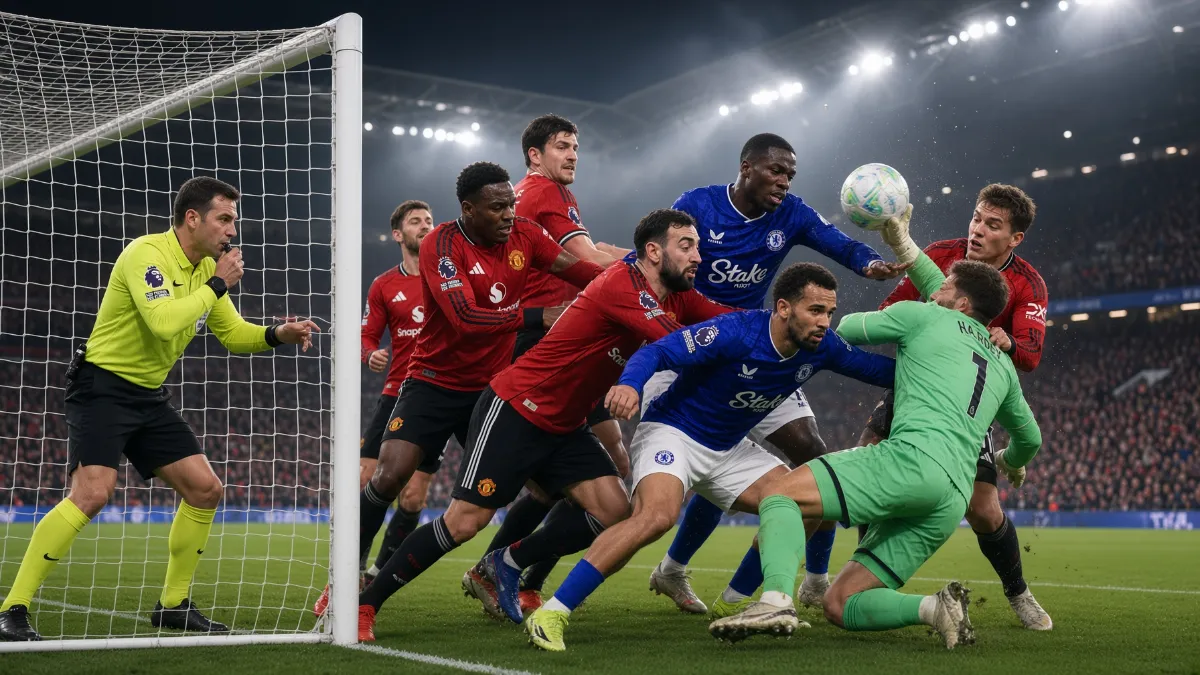
As the new Premier League season approaches, referees have geared up to enforce a crackdown on delays, grappling, and explicit fighting in the penalty area during set pieces. This was reported by football journalist Dale Johnson.
Last season, persistent shoving and wrestling in the area became a significant concern. Of the 20 VAR interventions that should have been penalised, a staggering quarter were due to missed penalties where attacking players were blatantly dragged down without the ball.
During the summer, the referee corps consulted coaches, club captains, and officials, leading to a directive across the Premier League, Championship, and Women’s Super League to punish any unsporting actions decisively.
What referees will be watching for
While the football rules remain unchanged, the emphasis on player behaviour has shifted. Referees will now be quick to penalise players if they:
- completely ignore the ball and focus solely on their opponent;
- make no attempt to challenge for an aerial ball;
- hold an opponent with both hands;
- perform extended grabbing of body or shirt;
- block a goalkeeper's movement when attempting to claim the ball.
Defenders turning their backs during corner deliveries solely to obstruct attackers will face immediate consequences, leading to fouls or penalties being awarded.
Howard Webb, the head of the refereeing body, emphasized the need for decisive action:
We want referees to officiate with confidence and punish what they see on the field. Fewer warnings and chats, more tangible consequences. If we see fewer infringements, it should stem from a change in player behaviour, not us shying away from enforcing the rules.
Referee training and player reactions
The Pro Ref team has visited all training facilities across the league, demonstrating incidents that will undoubtedly lead to penalties this season. Noteworthy cases include Tomas Soucek being grabbed by Brentford's Kian Lewis-Potter and Luke O'Nien's wrestling hold on Pascal Struijk.
Additionally, match officials will now be armed with pre-match analytical reports, detailing each team's set piece routines. This approach allows referees to position themselves optimally on the pitch and identify key fighting points.
Who stands to gain or lose from these new rules?
Last season, a record 269 goals in the Premier League came from set pieces, accounting for 25.7% of all goals – the highest among Europe’s top leagues.
Arsenal led the way, scoring 25 goals while conceding just 7, alongside Manchester United and Tottenham, who netted 21 and 19 goals respectively. The new stringent interpretations are likely to complicate matters for teams that have made aggressive blocking a key part of their strategy.
Conversely, this development may benefit teams that have historically struggled to defend against set pieces. Liverpool conceded the most goals from set pieces with 19 last season, while Chelsea and Newcastle were not far behind, allowing 17 goals each.
