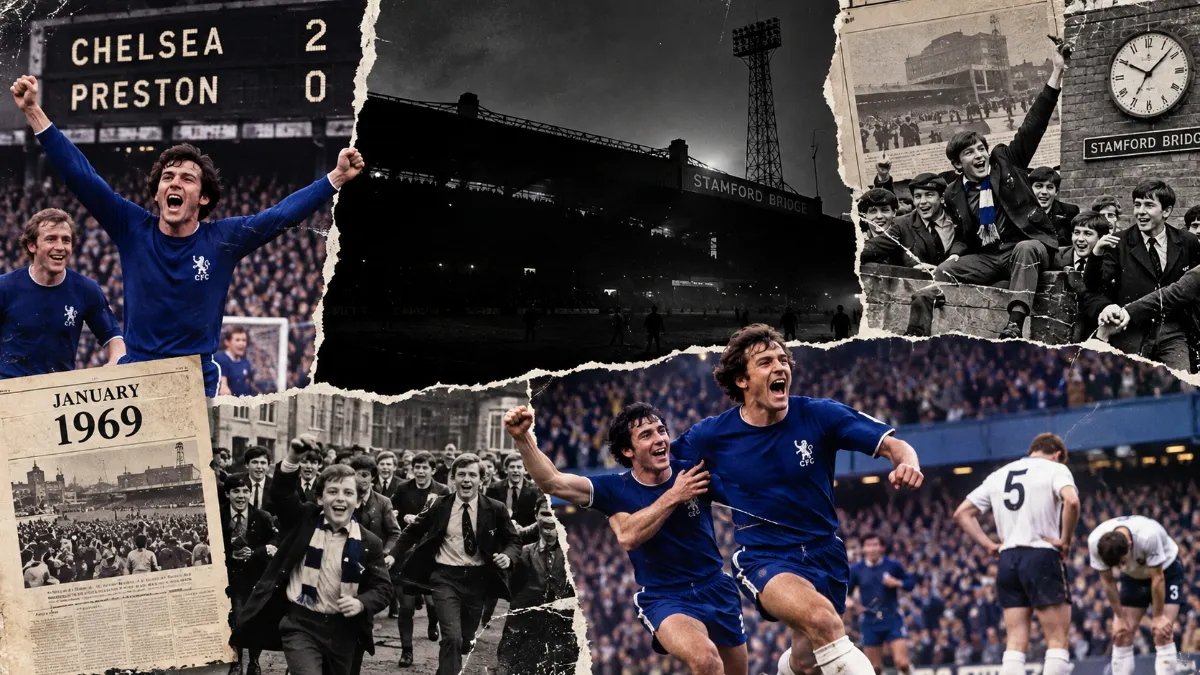
In January 1969, Chelsea faced Preston in the fourth round of the FA Cup, requiring three attempts to settle the tie. After finishing the first match 0-0, the teams replayed on February 3 at Stamford Bridge, and everything seemed to be going Chelsea's way.
With just 15 minutes left, Chelsea were ahead 2-0 with goals from Ian Hutchinson and Alan Birchenall. A sizeable crowd of 44,239 watched as the Blues appeared on course for the next round.
Then, just as they were preparing to celebrate victory, the stadium's floodlights started to flicker.
Before anyone could react, the lights went out completely, plunging the field into darkness.
The referee tried to keep the game going for a short while, but soon had no choice but to take the teams off the pitch.
Announcements echoed around the ground:
Hold on, we’re sorting this out.
The crowd waited patiently, but the problem was far from solved.
The cause? A fire right outside the stadium
The issue stemmed from a fire in the major power distribution unit located near the stadium entrance.
Overheated wiring had damaged the cables.
Ironically, new fire extinguishers had just been delivered to Stamford Bridge that very day and thankfully came in handy.
The fire was extinguished, but the lights remained off.
Match officials made the shocking decision to cancel the game altogether.
No thought was given to resuming with the remaining 15 minutes or preserving the scoreline of 2-0.
Instead, it became clear: it would all have to be played again.
Ian Hutchinson’s goal vanished too
The cancellation hit Hutchinson particularly hard, as he had just scored his first goal for Chelsea's first team.
Now, it was as if he had never scored at all, with official records wiped clean.
Two goals were thrown into the bin.
Seventy-five minutes of football? Gone.
And the 44,000 fans were left to thank them for attending, only to find most would need to buy tickets again.
When would the replay take place? Of course, on Monday at 3pm
Chelsea faced another hurdle: uncertainty remained over whether the floodlights would be repaired in time.
Organisers decided then to eliminate evening matches altogether — if lights were likely to fail again at night, why not arrange the replay for midday?
The new fixture was set for Monday, 3 February at 3:00 PM.
A weekday when everyone was at work and schools remained open.
All problems seemed resolved, or so they thought.
Expectations plummeted attendance, yet 36,522 fans showed up!
London uncharacteristically fell ill on a Monday
Thousands of adults miraculously managed to avoid work.
Many schoolchildren reached similar conclusions regarding their lessons.
Some called in sick, while others simply skipped out without any excuses.
There were reports of detentions for kids caught ditching class.
In club lore, tales emerged of fans losing jobs after opting for football over work.
But after once paying for the match that was called off at 2-0, who would let a job get in the way?
And for their loyalty, they were rewarded quite ironically
Fast forward to the 15th minute, and Preston struck first with a goal from Jerry Ingram.
0-1.
Chelsea laboured throughout the remainder of the match.
Anyone who had risked their job for the game might have begun to question their life choices.
On Wednesday: Chelsea lead 2-0 — the lights go out.
On Monday: You lie to your boss, head to the stadium, and Chelsea find themselves down 0-1.
Fast forward to the 89th minute.
David Webb lifts the mood of all the skivers
Defender David Webb was pushed forward into attack.
In the 89th minute, Webb scored. 1-1.
Not too shabby. Extra time might be on the cards.
Rounding the minute, Charlie Cook netted the second. 2-1.
Final whistle blows.
Chelsea advance.
One of the costliest ways to overcome Preston
To progress to the fifth round, Chelsea needed to:
- Play a match against Preston;
- Engage in 75 minutes of a replay;
- Score two goals that were subsequently cancelled;
- Endure a fire;
- Gather 44,000 fans;
- Send them home;
- Schedule another match on a working Monday;
- Attract another 36,000 fans;
- Be behind until the 89th minute;
- And finally, win.
In total, this involved nearly three whole matches just to secure a place in the next round.
And yet, some still complain about FA Cup replays.
Even journalists faced backlash after the match
After the third game, a BBC reporter approached exiting fans to inquire how they managed to get out of work in the middle of the day.
He also raised the morality of skipping work for football — not the most wise question at a moment when fans had just endured that farce.
Two young fans took issue with the interview.
A scuffle ensued, the journalist ended up shoved against the barrier, and the recording of the interview was taken from him.
Police later sought the suspects, but to no avail.
While the lights had been restored at the stadium that day, the tension around Chelsea was still very much alive.