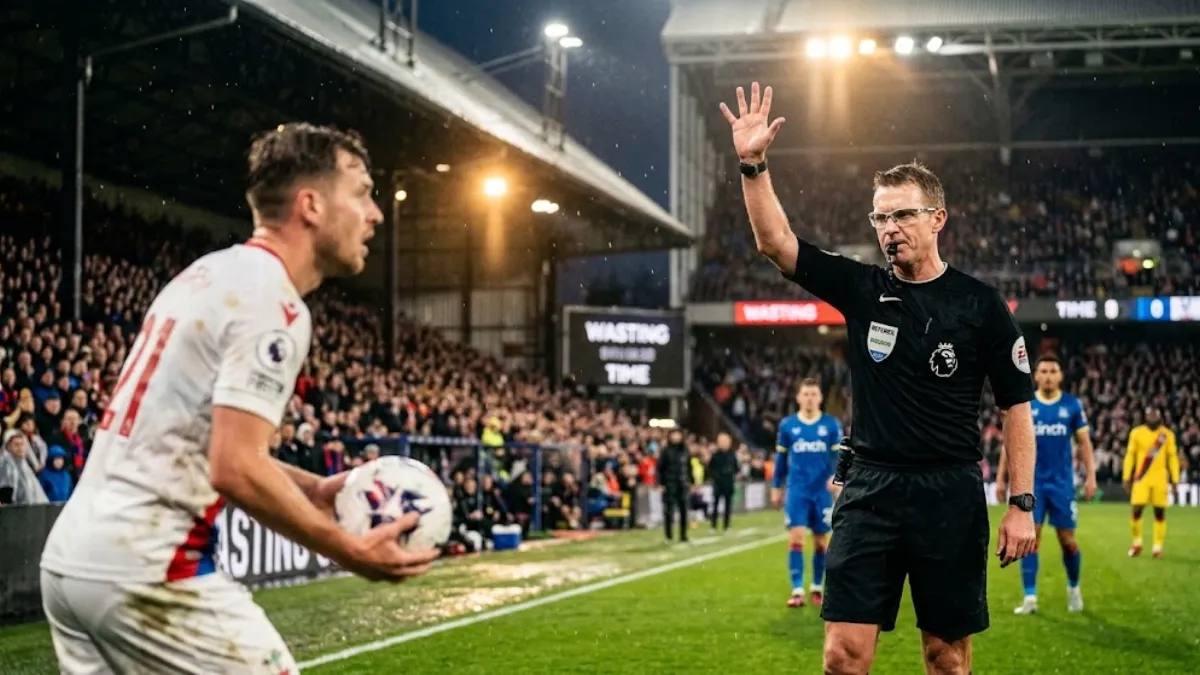
After five rounds of the 2026/27 Premier League season, Opta analysts have observed an encouraging trend: the new football directives introduced over the summer, aimed at speeding up the restart of play, are starting to bear fruit.
The issue of time-wasting has become a significant headache for football officials in recent years, frustrating both referees and fans alike. Players have been increasingly clever in trying to slow down their opponents or simply ‘run the clock down’ as matches draw to a close. In response, the International Football Association Board (IFAB) took the bold step of implementing reforms that were trialled at the last World Cup.
The crux of the new measures is stringent time control during the restarts. The so-called ‘five-second rule’ for throw-ins and goal kicks isn’t a literal deadline; referees are now empowered to begin a countdown if they suspect a player is deliberately delaying the game. The visual clue is a raised hand from the referee, reminiscent of the countdown seen in wrestling, as athletes scramble to return to the ring before getting knocked out.
Moreover, the regulations surrounding substitutions have been tightened. If a player takes longer than ten seconds to leave the pitch, the substitute must now wait a full minute before being allowed to enter the fray.
The experiment at the World Cup was deemed successful, and the Premier League hierarchy agreed to roll out the new rules at the start of the 2026/27 season. With 50 matches now played, the recent international break offered an ideal moment to assess the initial impact.
Referees clamping down in the Premier League
While fans have yet to see a goal kick result in a corner due to time-wasting, one goalkeeper has already been punished for holding on to the ball too long. Referee Adam Hertzog, making his debut in the top flight during the match between Leeds United and Crystal Palace, deemed that Eagles keeper Walter Benitez had held the ball for more than the allowed eight seconds, leading to a corner for the home side.
Another instance of drawn-out substitutions was noted in a match featuring Crystal Palace. During a home loss to Manchester City, Anan Halayli took what seemed to be an eternity to leave the pitch, causing Oscar Mingueza to wait a full minute at the sidelines. The irony was palpable, given that Palace were trailing 1-3 and likely had no interest in wasting time.
Additionally, there have been four instances where players were penalised for taking too long on throw-ins, resulting in the throwover being awarded to the opponents:
- Jorrell Hato (Chelsea) against Fulham;
- Neco Williams (Nottingham Forest) versus Aston Villa;
- Riccardo Calafiori (Arsenal) against Sunderland;
- Olivier Boscaly (Brighton) against Arsenal.
Stats confirm: more time with the ball in play
The crucial question posed by Opta is whether these isolated instances of punishment reflect a genuine impact on the matchday experience. The statistics suggest a resounding yes.
Analysts compared current figures with data from previous Premier League seasons (Opta has tracked precise game time since the 2015/16 season).
After five rounds of the 2026/27 season, the average percentage of time the ball is in play has reached 57.7%. This is the highest figure recorded in the last five years, since the 2020/21 season (58.0%). In terms of raw numbers, the net playing time per Premier League match averages 56 minutes and 35 seconds. This ranks as the third-best in history, trailing only behind the 2023/24 (58:11) and 2024/25 (56:59) seasons. With last year's figure at just 55 minutes and 23 seconds, fans are now enjoying over a minute more of live football in each match.
The domino effect: speeding up all restarts
The new rules have led to an interesting side effect: referees are now adding less time. This season, an average of eight minutes and four seconds is being compensated per game — the lowest since the 2021/22 season (7:29).
But the biggest victory is the tangible acceleration of play. The average time taken for throw-ins has dropped by more than two seconds compared to last season (15.3 seconds down from 17.8). This represents the lowest average since the 2016/17 season (15.2 seconds). At first glance, two seconds may seem trivial, but if this trend continues, and the number of throw-ins remains on par with last year (13,615), the league could save over nine and a half hours of pure waiting time — nearly a minute and a half (88.5 seconds) in every match.
Goal kicks are also being executed significantly faster, now averaging 27.7 seconds — a record low in statistical terms. Last season, the average time taken for goal kicks surpassed 30 seconds (30.4), but this season’s start has seen an almost three-second drop. Considering there were 5,901 goal kicks last season, this translates to over four hours and 40 minutes saved across the season, equating to nearly 42 seconds in each match.
The implementation of five substitutions in the 2022/23 season inevitably led to increased stoppages, but the new directives have managed to overturn this trend too. Last season, the pause for substitutions (including double or triple switches) took an average of 76.1 seconds, reduced now to 64.3 seconds — the lowest figure since before the five-substitution rule was introduced (2021/22: 63.4 seconds).
Less obvious benefits: corners, free-kicks, and penalties
Surprisingly, the acceleration of play has impacted even those set pieces not covered by the new IFAB directives.
The average time taken for corner kicks, which had been steadily increasing in recent seasons due to meticulous rehearsals of tactical plays, has decreased from 36.1 seconds to 33.9 seconds. Free kicks are now deployed on average in 33.3 seconds (the quickest since the 2020/21 season). Direct free kick executions have sped up too, now taking 74.5 seconds — 11 seconds quicker than last season.
Penalties have also been taken significantly faster: the average delay before a spot-kick is a mere 117.4 seconds, almost 47 seconds swifter than the previous year's 164.7 seconds.
Despite being early days in the season, the new anti-stoppage directives are demonstrating compelling effectiveness. Fans can now revel in the extra time, likely spent simply enjoying more of the beautiful game.
