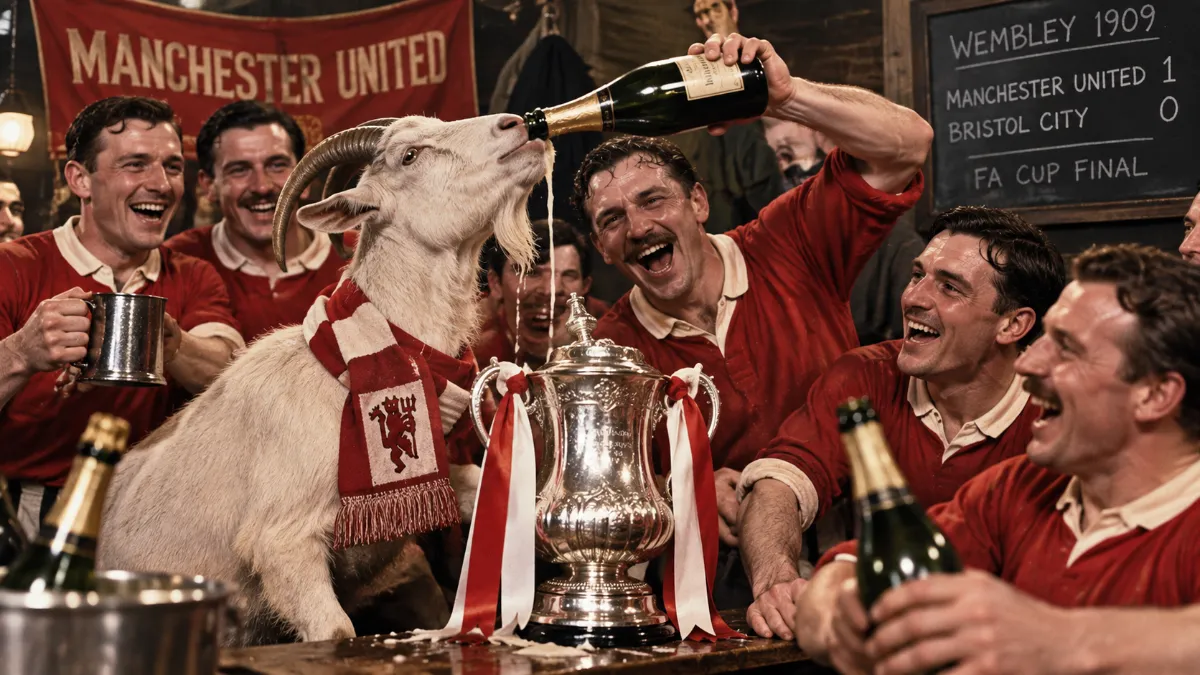
In 1909, Manchester United clinched their first FA Cup, marking a significant moment in the club's history. But what many may not know is that their live mascot, a goat named Billy, was there to celebrate alongside the team. As the tale goes, Billy overindulged in champagne, tragically succumbed to alcohol poisoning, and his head eventually found a place in the club museum.
Back in the early 20th century, football mascots were quite different from what we see today. Manchester United, then on the brink of becoming a prominent force in English football, had previously boasted a St. Bernard and even a goose, misrepresented as a canary.
Then came the goat.
Billy was no ordinary goat; he joined the players on trips to the pub and, as the club's amusing history recounts, partied a bit too hard after their FA Cup triumph.
The saga begins with Charlie Roberts, the captain of Manchester United at the time.
Somehow, Roberts came into possession of this live goat, gifted by the theatrical company The Bensons. The reason for such a quirky gift from a theatre troupe remains a delightful mystery.
Roberts aptly named the goat Billy, and soon, he became the club’s mascot.
During an era when mascots were actual animals rather than people in oversized costumes, Billy was led out before home matches, introduced to the fans, and gradually became a beloved fixture of club life.
But Billy's adventures didn't stop at the stadium.
He travelled with the team, frequently accompanying players to local watering holes, adapting to the boisterous spirit of early 20th-century football locker rooms.
The pivotal day arrived on 24 April 1909.
Manchester United reached their first FA Cup final, taking on Bristol City at Crystal Palace. Sandy Turnbull scored the only goal in a 1-0 victory.
With their first piece of silverware in hand, the celebrations were understandably exuberant.
In the midst of the revelry, Billy was apparently offered champagne, and the unfortunate consequence followed. The legend asserts he drank far too much and soon died from alcohol poisoning.
This tale fits so perfectly into the romantic folklore of the early football era that it almost sounds concocted a century later.
A goat. An FA Cup final. Champagne. Death from festivities surrounding a first trophy.
But the absurdity doesn’t end there.
Rather than disappearing from history, Billy's head was preserved and later became an exhibit in the Manchester United museum.
In a unique twist, one of the club’s first living mascots bizarrely secured a place in its history posthumously.
It’s worth noting, however, that while the existence of Billy and his role as the club mascot are well-documented in historical records, the accounts of his champagne-fuelled demise are less concrete.
No contemporary newspaper articles detailing the goat's tragic death from alcohol have surfaced, making this part of the story a treasured club legend rather than an medically documented fact.
Yet, the very notion feels utterly believable.
Especially when you recall the early mascots of the club: first, a goose misrepresented as a canary, followed by a St. Bernard raising funds, and then a goat mingling with players in pubs.
By contrast, the modern-day Fred the Red seems rather tame.